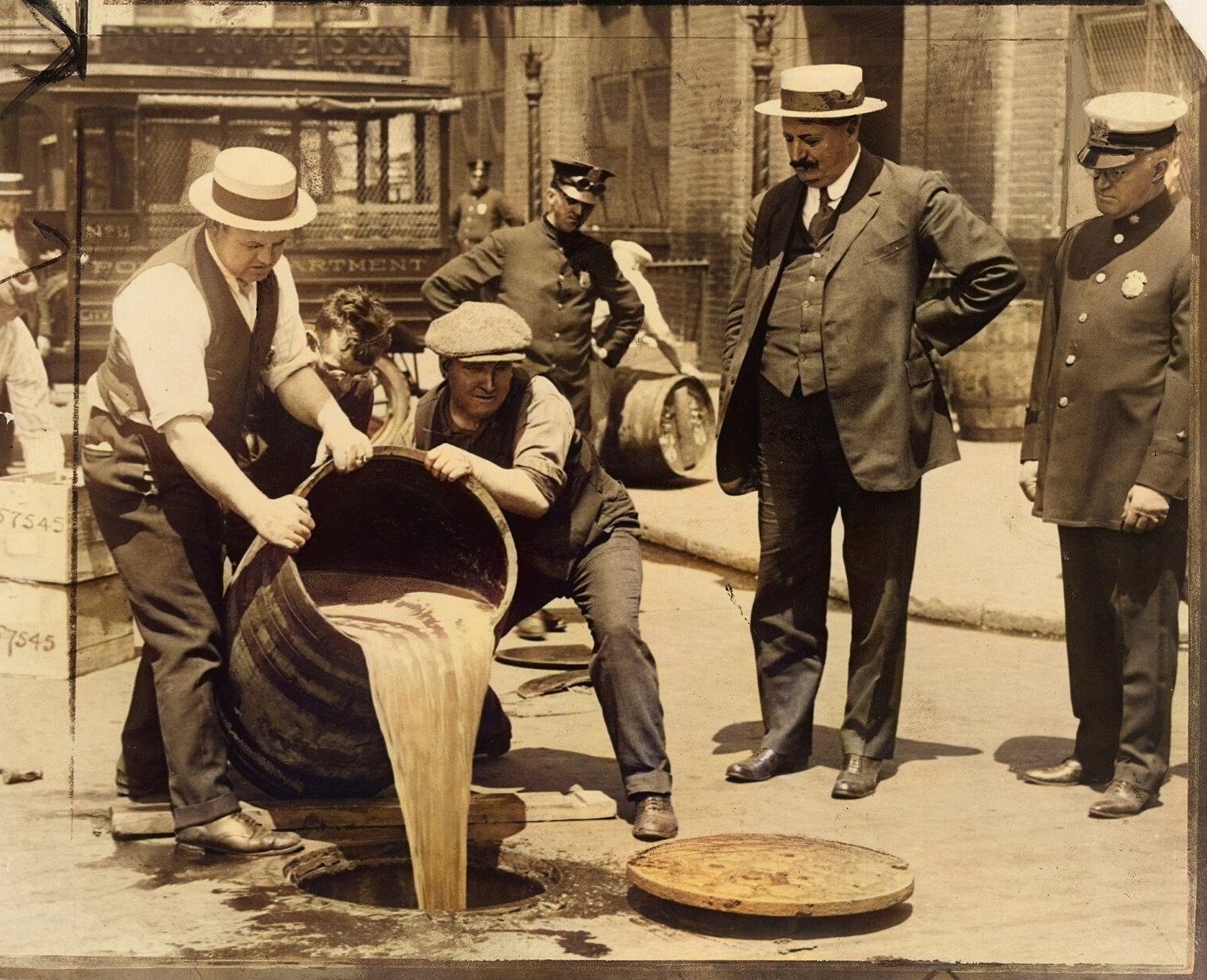
The government poisoned the booze
Every few years a claim about Prohibition goes around again in videos and posts. It usually sounds something like this.
During Prohibition the U.S. government poisoned the liquor Americans bought, on purpose, to kill drinkers. Officials knew people were dying and kept going. At least 10,000 Americans were killed.
Some of that is true. The government really did require poison in alcohol, and people really did die after drinking it. By the end of this page you will cut the claim apart and stamp each piece with a verdict.
The best witness is a New York doctor named Charles Norris, who spent Prohibition examining the dead. In 1926 he said the government carried moral responsibility for the deaths. In 1928 he wrote that most talk of government poisoning was "sheer poppycock." Keep both statements in mind.
Christmas at Bellevue
Over the Christmas weekend of 1926, Bellevue Hospital, New York City's big public hospital, took in 65 people sick from holiday drinking. By December 28 the Associated Press counted 23 dead across the city, 17 of them in Manhattan. Bellevue's alcoholic ward held 79 patients that morning, 14 of them women. By the next day hospitals in Manhattan and the Bronx had admitted 137 cases.
The man who had to explain the bodies was Dr. Charles Norris, the city's chief medical examiner. His office was the first modern one of its kind in the country. His toxicologist, Alexander Gettler, tested organs from the morgue for poisons, one case at a time. Norris told reporters that 468 people had died in Manhattan that year from poisonous liquor. Then he pointed at Washington.
"Knowing that it is not stopping drinking by putting poison in its alcohol, the United States government must be charged with moral responsibility for the deaths that poisoned liquor causes."
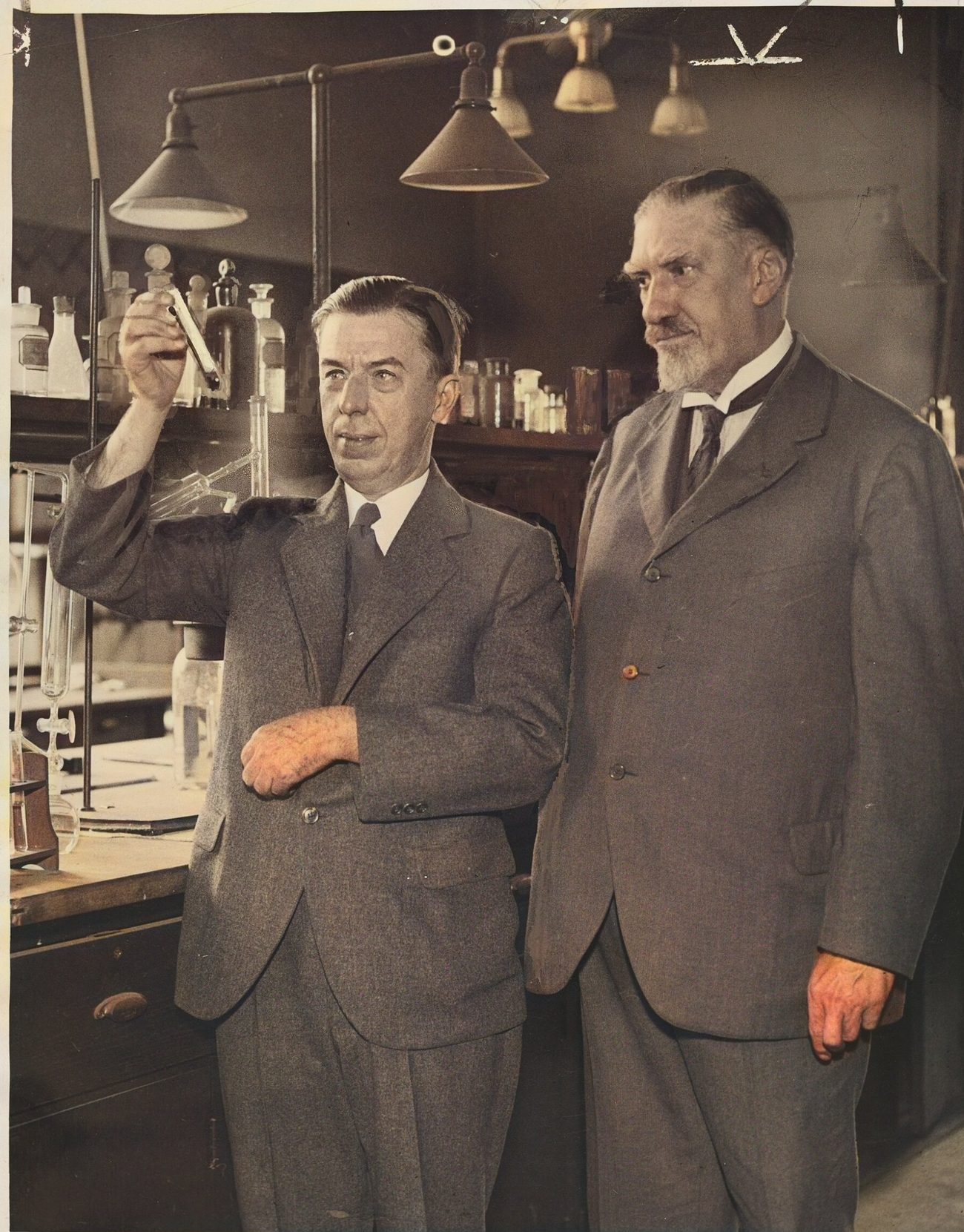
Norris's own office reported something different that same week. His assistant, Dr. Thomas Gonzales, said only one body showed traces of poisonous liquor. Autopsies on seven of the dead found the cause was excessive drinking. In Washington, Treasury officials said the 2 per cent of wood alcohol in most industrial alcohol was not enough to kill anyone.
The drinkers were victims of poison the government put in its alcohol, and the government bears moral responsibility.
Seven autopsies. Cause of death: too much drinking. One body out of the first group showed poison.
Poison by the formula
Industrial alcohol stayed legal all through Prohibition. Factories needed it for everything from paint to perfume. Under a law passed in 1906, alcohol meant for industry could skip the heavy liquor tax if it was denatured first, which meant something was added to make it unfit to drink. The usual additive was wood alcohol, also called methanol. It is a poison that can blind or kill.
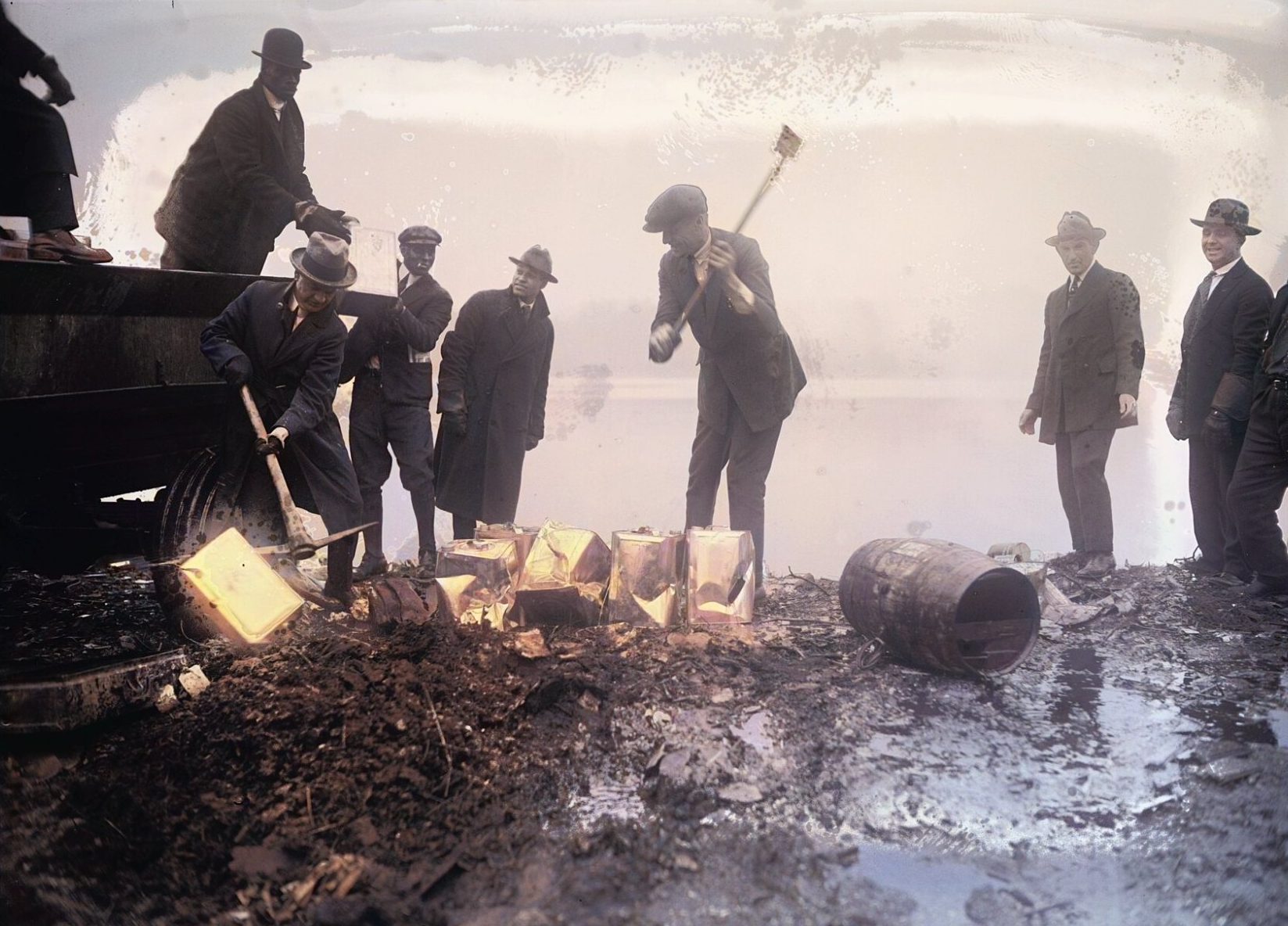
Once Prohibition began in January 1920, tax free industrial alcohol became the easiest liquor in America to steal. By the government's own figures, about 80 million gallons were made under permit every year and only about 70 million showed up again in legal products. Ten million gallons a year got away. Bootleggers redistilled it to strip out the additives, cut it with water and flavoring, and sold it as gin or whiskey. The cleaning was never complete.
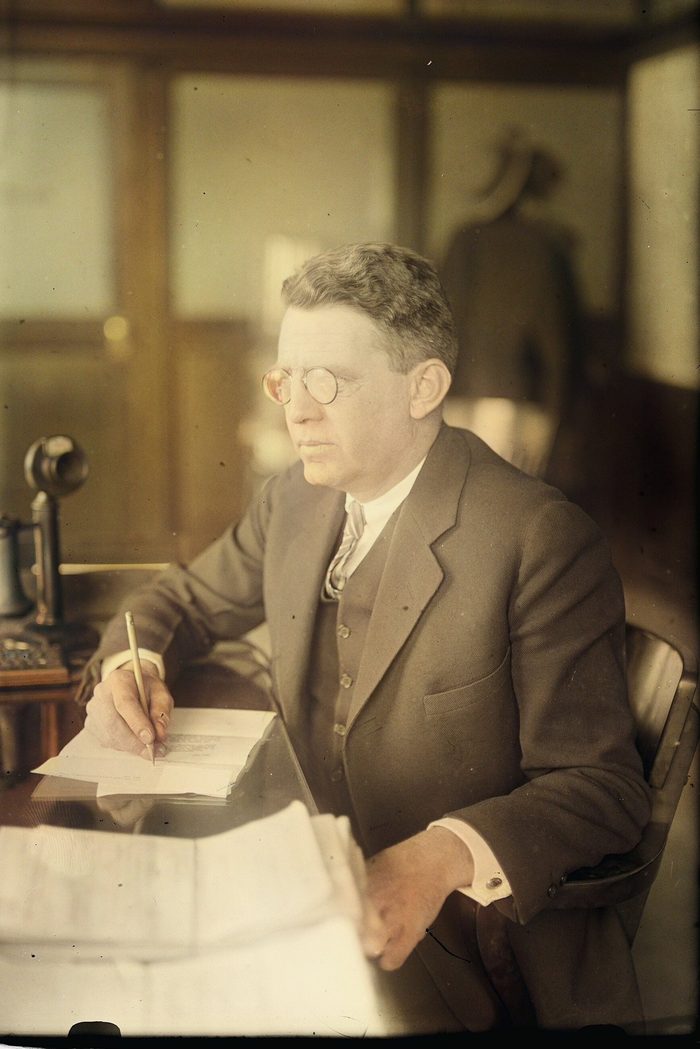
Chester Mills, the federal prohibition chief for New York, said the harder agents squeezed one kind of industrial alcohol, the more bootleggers turned to the harsher kind, called completely denatured alcohol. A new formula for that alcohol had already been ordered. On January 1, 1927, one week after the Christmas deaths, it took effect as planned. It doubled the wood alcohol.
| Ethyl alcohol, the kind people drink | 100 parts |
| Wood alcohol, methanol | 4 parts |
| Pyridine bases | 2.25 parts |
| Benzene | 0.5 part |
The old formula used 2 parts wood alcohol. On April 1, 1927, a foul chemical called aldehol, made from burned kerosene, replaced the pyridine. The wood alcohol stayed at 4 parts.
The new formula set off a fight in Congress. Wayne Wheeler, the chief lawyer and lobbyist of the Anti-Saloon League, the most powerful dry organization in the country, defended it in the plainest terms.
"The Government is under no obligation to furnish the people with alcohol that is drinkable when the Constitution prohibits it."
Wayne B. Wheeler · quoted in Time, January 10, 1927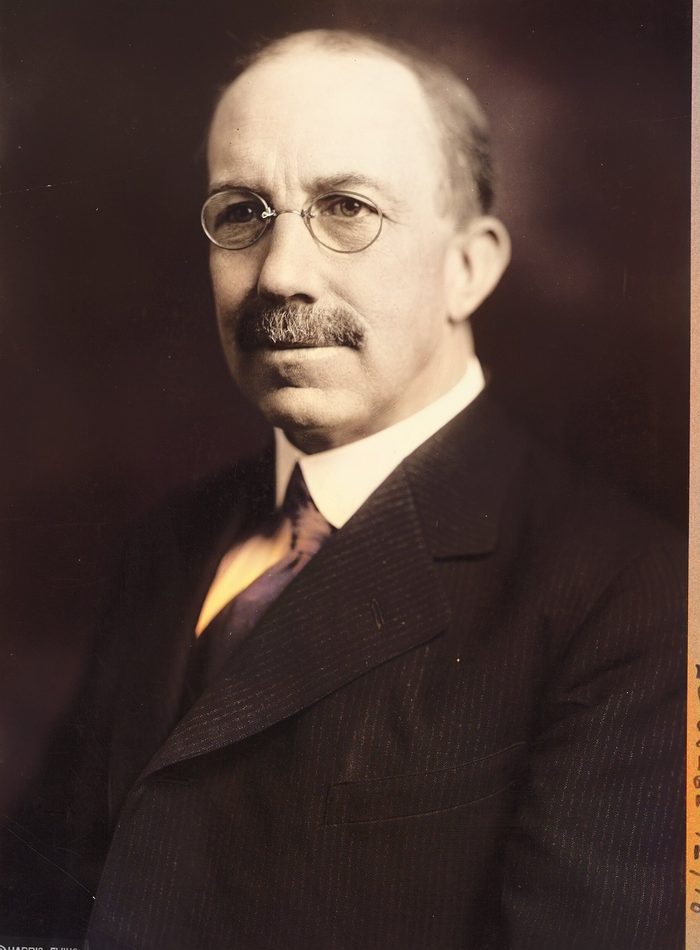
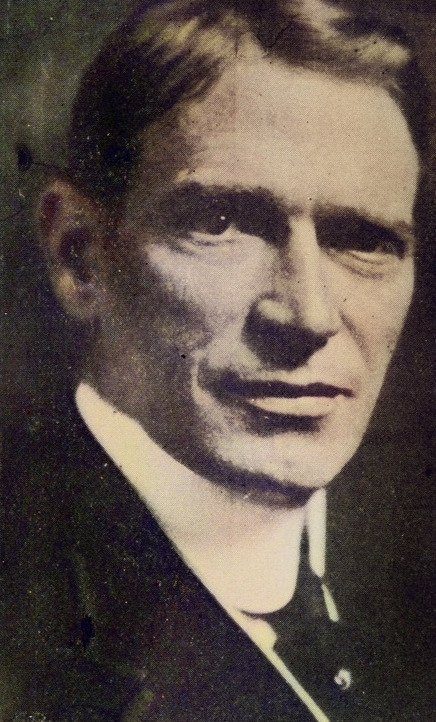
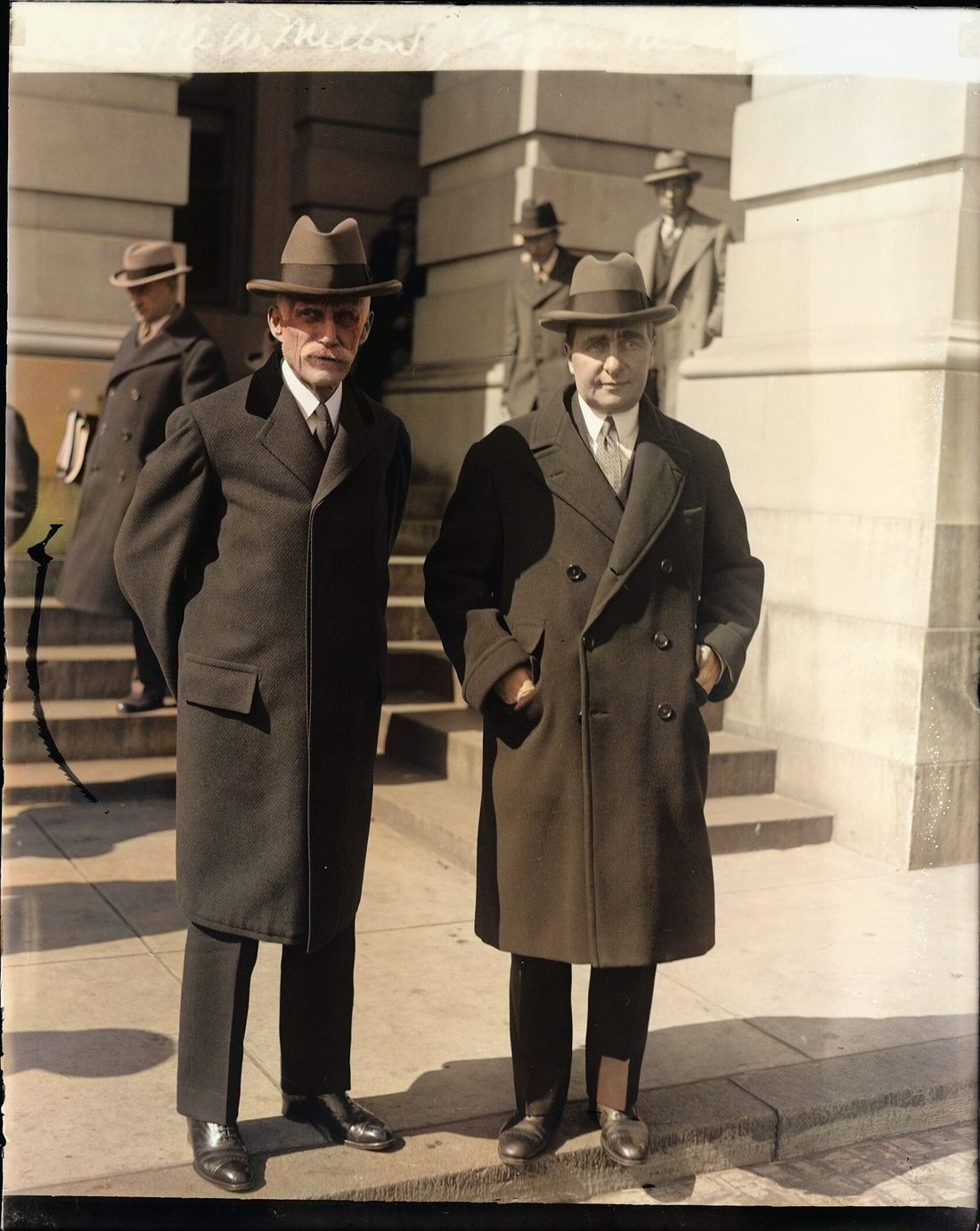
Senator Edward Edwards of New Jersey, a wet who wanted Prohibition repealed, answered him. "I call it legalized murder," he said, "with the United States government an accessory before the fact." Treasury Secretary Andrew Mellon said he opposed using poison to enforce the law, but Formula No. 5 would stay until government chemists found an additive that was harmless and could not be removed. The aldehol switch in April was their attempt. The chief prohibition chemist, James Doran, said aldehol's taste was "terrible" and "very nauseating," and federal officials predicted bootleggers would be left selling "crankcase cocktails."
Five cents a glass
The deadliest week of the poison years came in October 1928, during a presidential campaign and a World Series. On Sunday, October 7, eleven people died in New York City and more than 60 were admitted to Bellevue's alcoholic ward. By Wednesday the count was 34. Most of the dead were found near the waterfront on the Lower East Side. Charles Coleman, a 45 year old laborer from Henry Street, died at Bellevue three hours after an ambulance brought him in. Peter Zolka, 50, of Division Street, cried out in pain loudly enough to bring a patrolman. He died three hours later.
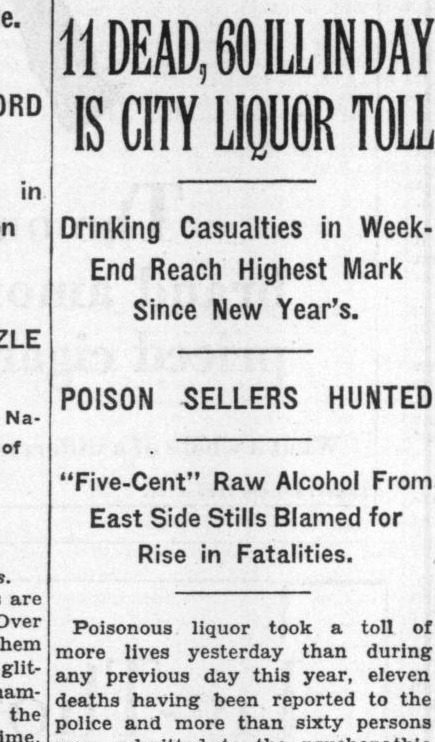
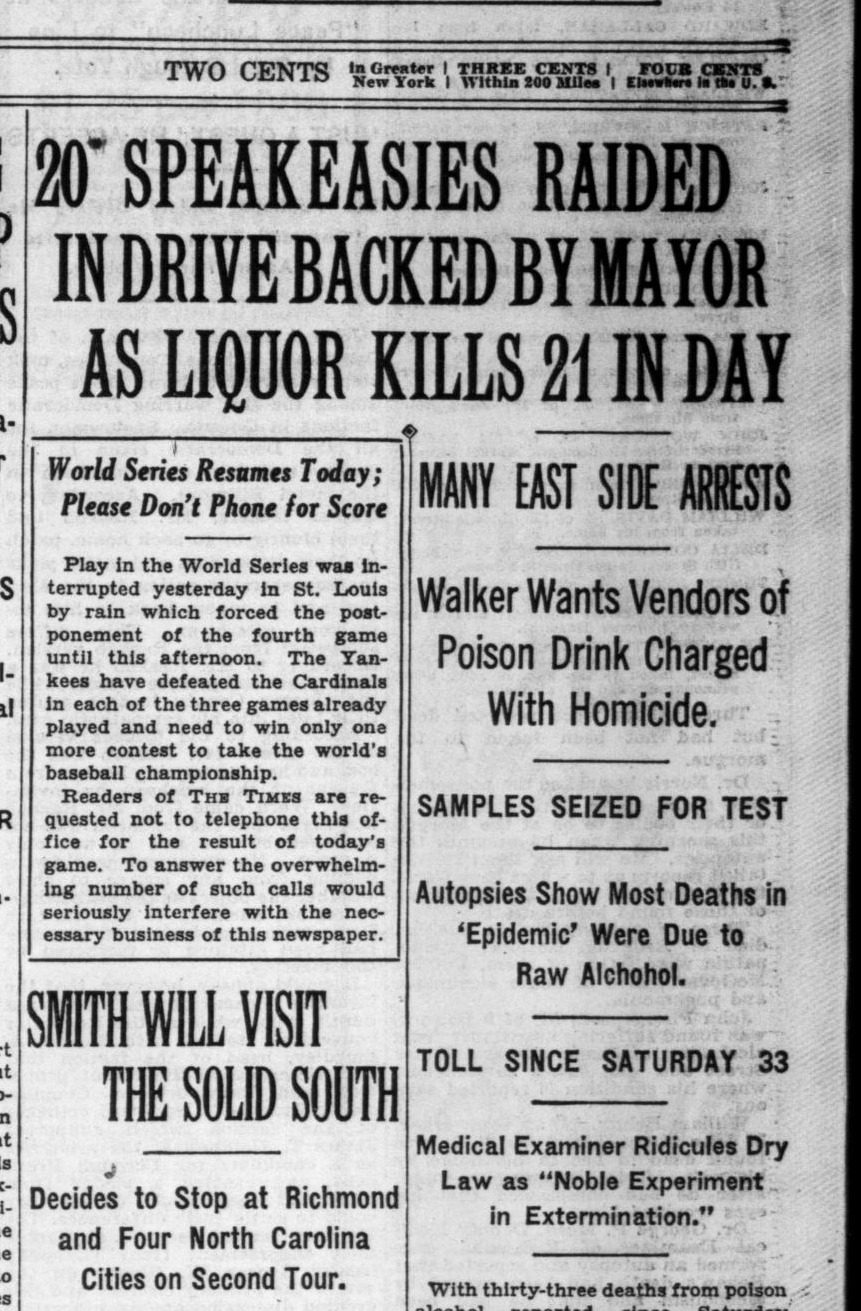
Waterfront dives were selling a drink called smoke, raw alcohol with a chemical that turned it cloudy, for 5 or 10 cents a glass. Police raided 20 speakeasies in one night. Norris and his assistants worked through the autopsies at the morgue, and he gave reporters a line aimed at both men running for president, Herbert Hoover and Al Smith.
"I invite both Presidential candidates to see the noble experiment in extermination."
Charles Norris · The New York Times, October 9, 1928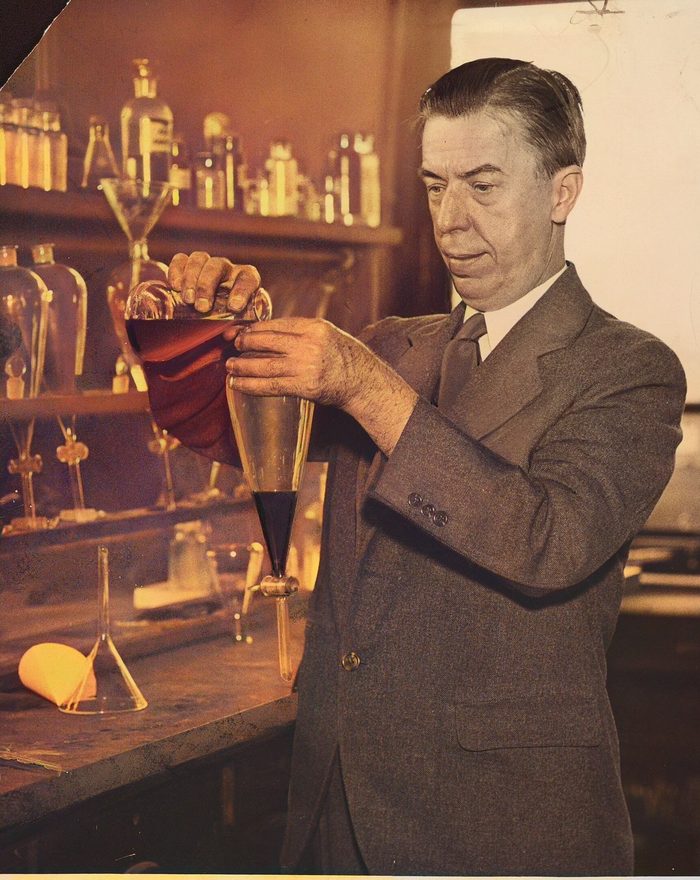
By October 10 Norris had traced 18 of the deaths to undiluted wood alcohol. This was not stolen industrial alcohol with poison left in it. It was the poison itself, sold as liquor. A federal grand jury confirmed that 24 people had died from drinking wood alcohol. Then it said the deaths were not a federal matter, because wood alcohol "is not a beverage, but a recognized poison" and no federal law covered its sale. Gettler told reporters the government's poisoned formulas caused some deaths in the city. For this week, the bottles held something worse.
Run Norris's arithmetic
Two months after the Bowery deaths, Norris worked the numbers in print. The lethal dose of wood alcohol, he wrote, "varies from an ounce in special conditions to five for the strong constitution." Take one pint of bootleg at the strength of ordinary whiskey, 80 proof, and assume the bootlegger cleaned none of the poison out. Pick the alcohol it was made from.
Pick a source for the pint.
A pint is 16 ounces. At 80 proof, 6.4 ounces of it is alcohol. The fatal range is the one Norris gave in 1928. Doctors today know wood alcohol can blind or kill in smaller amounts, and that the symptoms can take hours to show up.
Draw the line first
If poisoned alcohol killed Americans in huge numbers, the death records should show it. Federal statisticians tracked deaths from alcoholism in the same ten states and Washington, D.C., every year from 1900 to 1940. Michigan is one of the ten. The line is shown through 1919. Before you see the rest, draw what you think happened.
Press and drag across the shaded years to draw your prediction for 1920 to 1940. You can also skip straight to the record.
Show the data table
One caution before you trust the line too far. It counts deaths certified as alcoholism. A death from wood alcohol was filed under poisonings, so it does not appear here. The chart can show that drinking kept killing people all through Prohibition. It cannot show how many died of the poison.
Where ten thousand comes from
Numbers travel faster than their labels. Here are seven figures connected to this story. Line them up by size, then regroup them by what each one actually counts.
The ten thousand figure appears in Edward Behr's 1996 book Prohibition, and in science writer Deborah Blum's 2010 account, which said the poisoning program had killed at least that many "by some estimates." Neither explains how the count was made. A 2019 look back in the Saturday Evening Post noted that nearly every source cites the number, "though no one seems to know how the number was derived." The only ten thousand in Norris's own writing is a guess about something else: that nearly ten thousand New Yorkers would die of "strong drink" in 1928.
Read past the quote
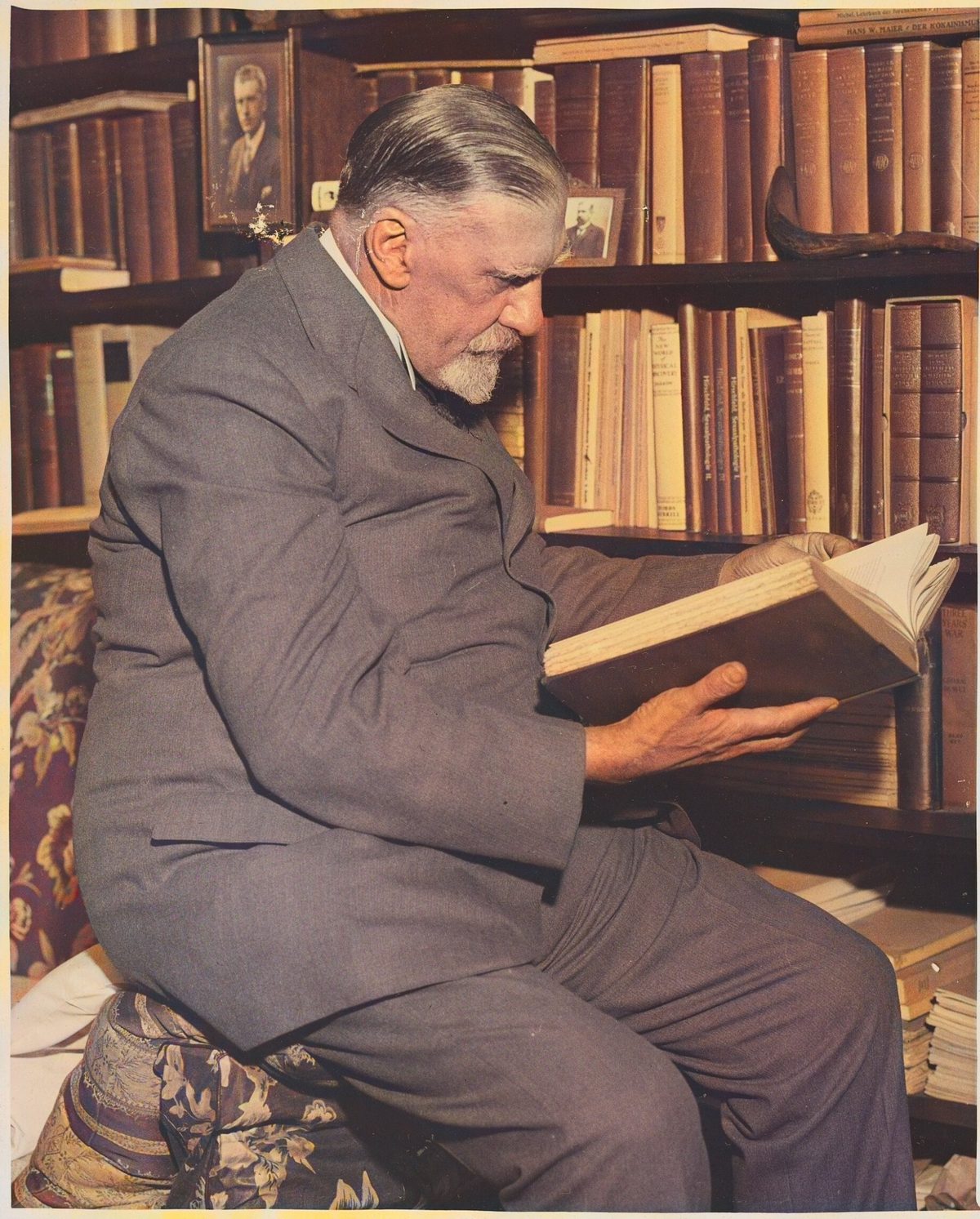
Norris's essay was called "Our Essay in Extermination." Its last line is the one people quote when they say the government poisoned its citizens. Start with that line, then widen the frame one step at a time.
So these five and twenty Americans died not of poison liquor but of poisoned liquor. Who poisoned it? The Government? By no means. There is a lot of loose talk about Government poisoning of drinking alcohol, and most of it is sheer poppycock. The Government permits, it is true, the use of wood alcohol as a denaturant.
These denaturants were originally added to the alcohol under Government control and connivance. But let us not blame the Government too harshly. Something must be added to grain alcohol to prevent its being all drunk away and thereby denied to legitimate industry and business. ... there has been no intention of enforcing Prohibition by a death penalty or slow torture.
Twenty-five citizens have been done to death by poison in one city. Nearly ten thousand in the same city will die this year from strong drink. Our national casualty list for the year from this one cause will outstrip the toll of the War. These are the first fruits of Prohibition ... This is the price of the Great Experiment ...
This is the net dividend of our noble experiment — in extermination.
Alone, this line reads like an accusation of mass murder.
Fifty three to nineteen
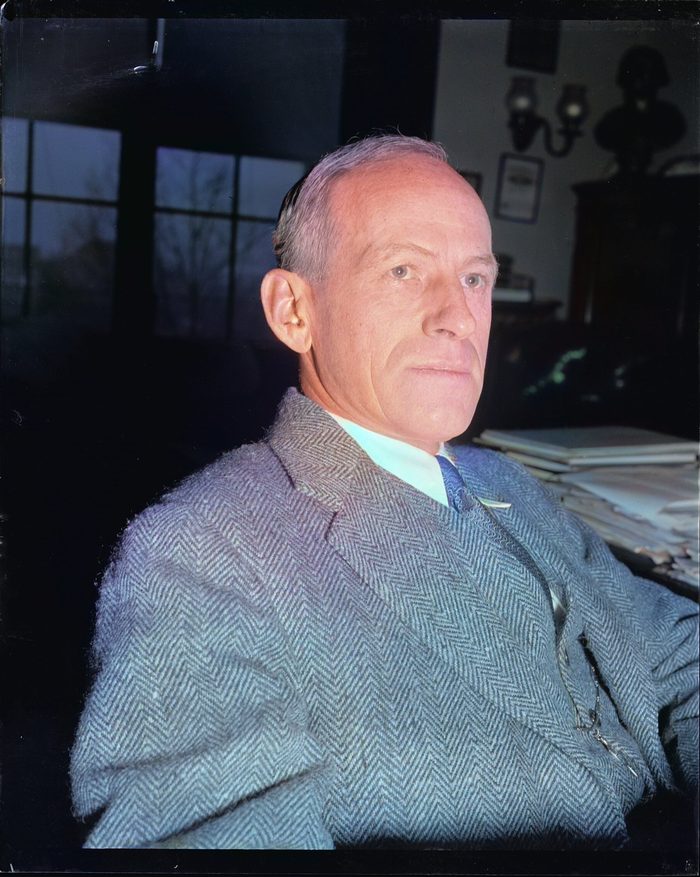
Could the government have stopped using poison? Senator Millard Tydings of Maryland tried to make it stop. In May 1930 he offered an amendment that would have banned wood alcohol as a denaturant. The government, "driven by fanatics," he told the Senate, "advocates the death penalty for doing nothing more than drinking a pint of liquor."
Senator Morris Sheppard of Texas, the Senate's leading dry and the author of the Eighteenth Amendment, answered that denatured alcohol held only 2 to 4 per cent wood alcohol, not enough to poison anyone in ordinary amounts. On May 14 the Senate rejected Tydings, 53 to 19. He tried again on June 6 and lost, 45 to 16.
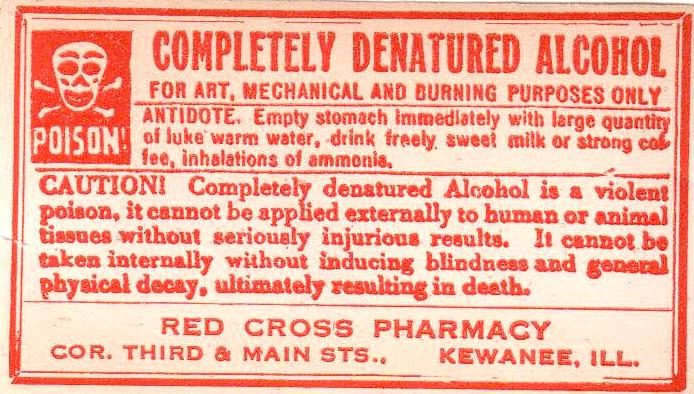
Wood alcohol stayed in the formulas until Prohibition ended on December 5, 1933. It is still in the denatured alcohol sold at hardware stores today, labeled as poison.
Cut the claim
Here is the claim from the top of the page, rewritten as the five separate things it asserts. Glued together, it sounds like one charge. Cut it apart, then test each piece against the record.
Make the argument
150 to 200 words. Pick one prompt and use evidence from at least two numbered sections.
When you are finished, copy everything and paste it into the Classroom assignment. Your work saves in this browser as you type.