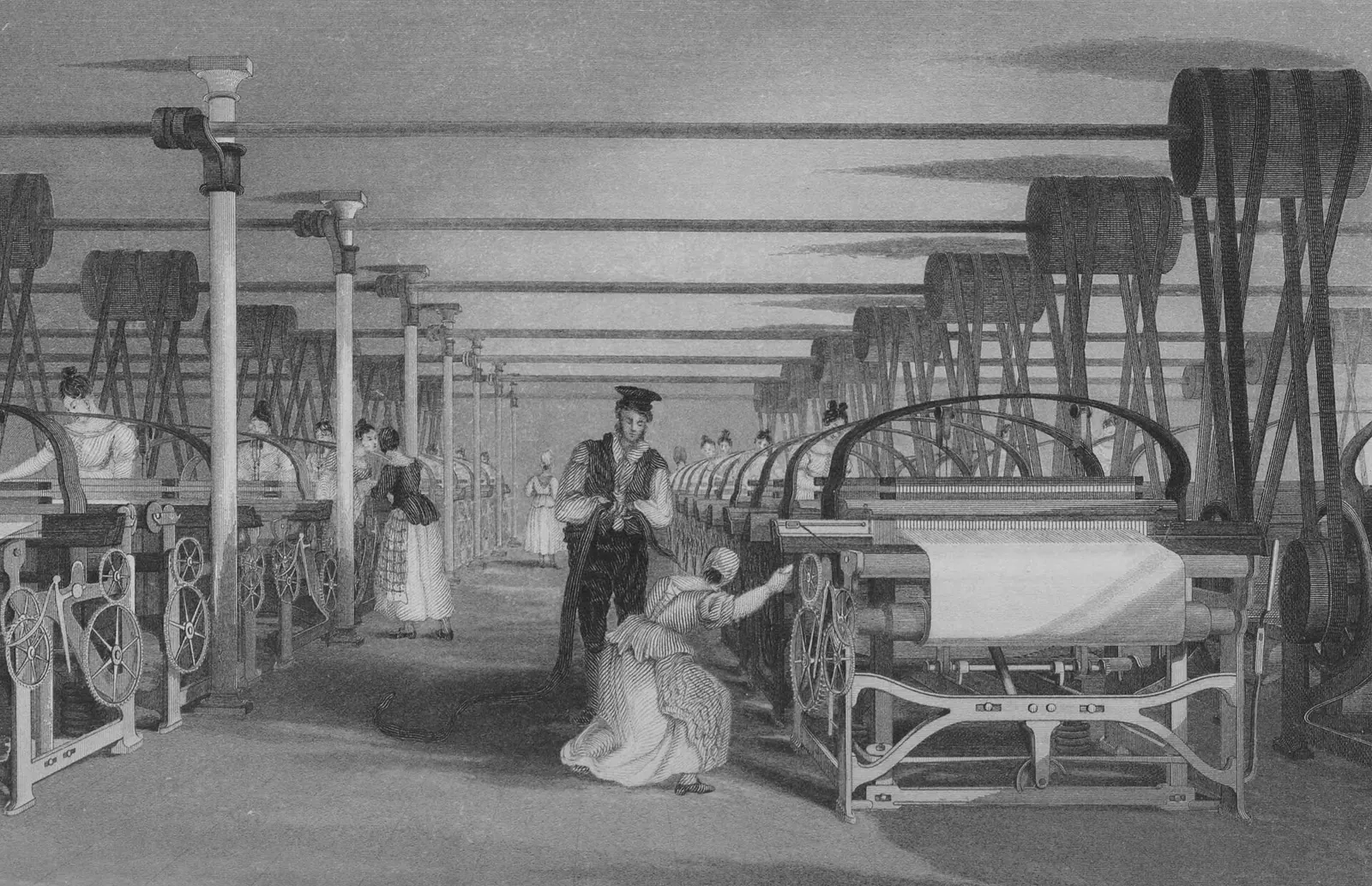
Piece 1Yorkshire and LancashireAbout 1806
The best paid workers in town
Around 1806, two kinds of cloth workers in northern England were doing very well.
Croppers in Yorkshire finished wool cloth by hand. They trimmed the fuzzy surface smooth with shears that weighed 40 to 50 pounds. Learning to do it right took years.
Handloom weavers in Lancashire wove cloth at home on looms they owned. They set their own hours. Many kept their loom in an upstairs room with big windows for light.
These were proud, skilled men. Their families lived well on what they made.
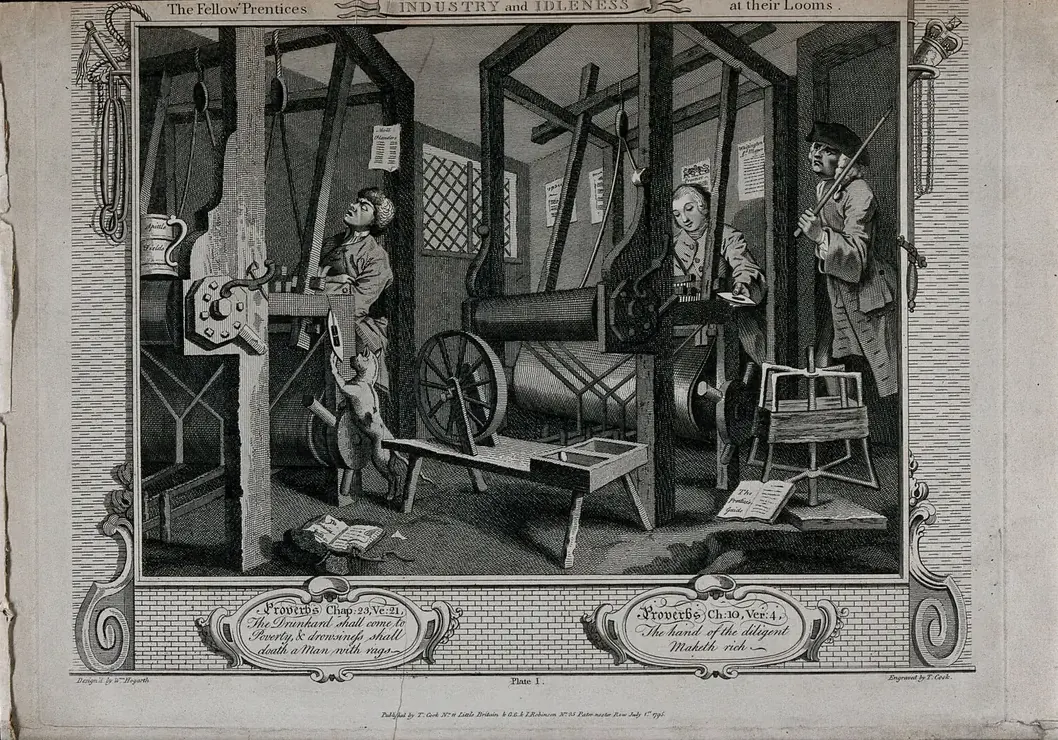
Piece 2Lancashire1800 to 1845
Then the machines arrived
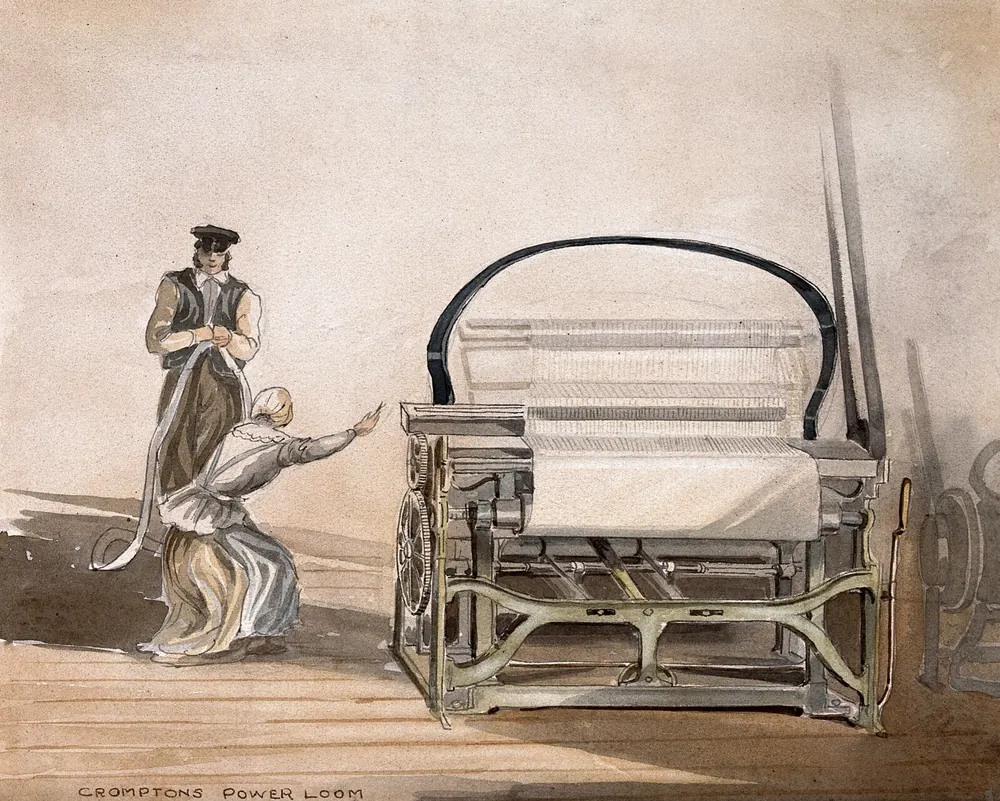
A power loom is a weaving machine driven by water or steam. It does not need a skilled weaver. It needs someone to watch it and fix broken threads.
In Yorkshire, shearing frames did the croppers' job. The cloth came out rougher, but it cost much less to make.
Word spread that an untrained boy on a power loom could weave three and a half pieces of cloth in the time a skilled weaver made one.
Watch both looms
Play the hand loom first, then the power loom. Listen to the sound and count how often the shuttle crosses.
By hand
By power
Now imagine three hundred of them
The weaving shed at Queen Street Mill in Burnley, the last steam powered weaving shed in the world. Visitors are handed ear protection. Mill workers learned to read lips because nobody could hear a voice over the looms.
One hour at the loom
Run the hour. Each line on the bolt marks one piece of cloth.
A mill owner can now get three and a half pieces for the wages of one boy. What happens to the price a hand weaver gets paid for each piece he weaves?
One cambric weaver's weekly pay, in shillings
Cambric is a fine cotton cloth. Figures from Mark Hovell, The Chartist Movement, 1918. Some prices for weaving fell as much as 80 percent.
Piece 3Hill End, near LeedsMarch 1812
A warning signed "Ned Ludd"
In 1811 and 1812, owners of the new machines started getting letters like this one. Mr. Smith owned shearing frames near Leeds. Tap the marked words to read the letter the way he would have.
"Information has just been given to me that you are the holder of those , and I was to write to you and give you to pull them down . . . if they are not taken down by the end of next Week, I will detach to destroy them . . . ."
Signed by the General of the Army of ,
Piece 4Nottinghamshire and Yorkshire1811 to 1812
Hammers in the night
It started on March 11, 1811, in Arnold, a village near Nottingham. Stocking knitters broke into workshops and smashed the frames.
Masked men came after dark and were gone before anyone could stop them. Between March 1811 and February 1812 they wrecked about 1,000 machines.
In Yorkshire the croppers carried huge hammers they nicknamed Enoch, after Enoch Taylor, the Marsden blacksmith who built many of the shearing frames. They shouted, "Enoch made them, and Enoch shall break them."
They were not smashing every machine they saw. Around Nottingham, frames owned by employers who paid fair rates were often left alone.
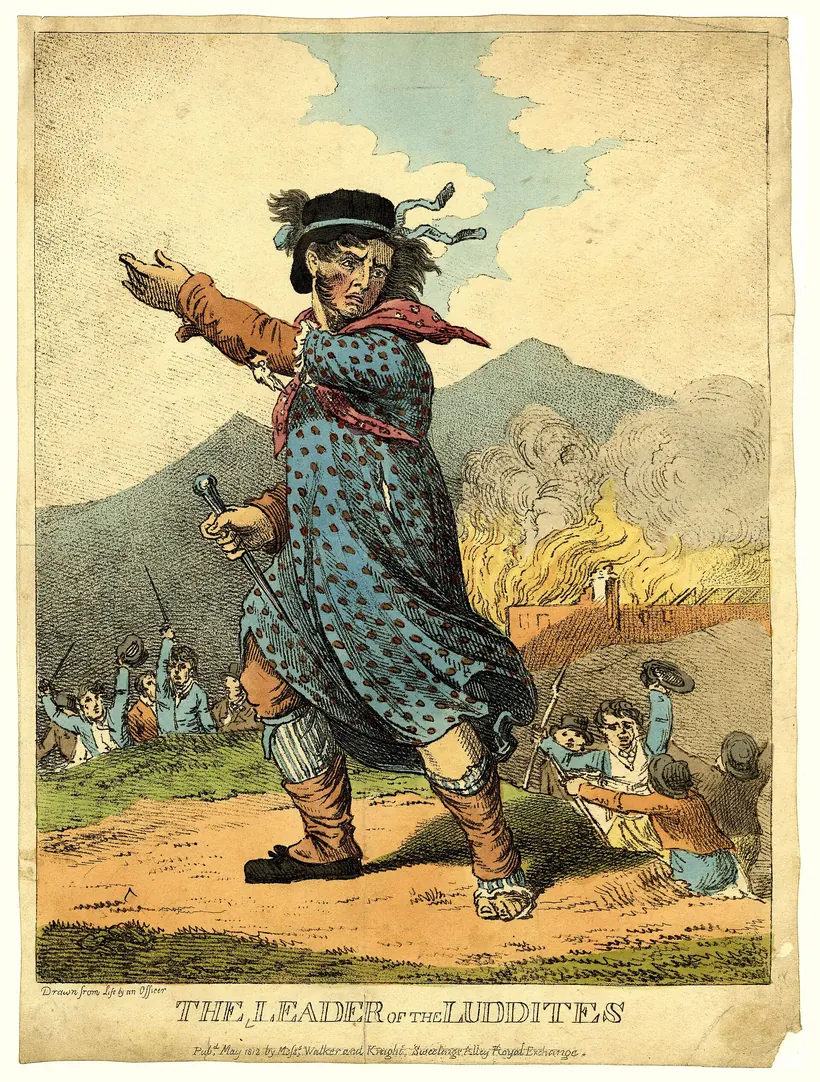
Who was Ned Ludd?
Nobody. The story said an apprentice named Ned Ludd smashed two stocking frames in 1779 after being scolded. Whenever a frame broke, people joked that Ned Ludd did it.
By 1812 the name was a mask. Letters came from General Ludd, King Ludd, and Ned Ludd Clerk. No real leader by that name ever existed, which made the movement very hard to catch.
Trade unions were illegal in Britain from 1799 to 1824. Workers had no legal way to bargain as a group, so they swore secret oaths instead.
Piece 5Parliament, LondonFebruary 1812
Machine breaking becomes a hanging crime
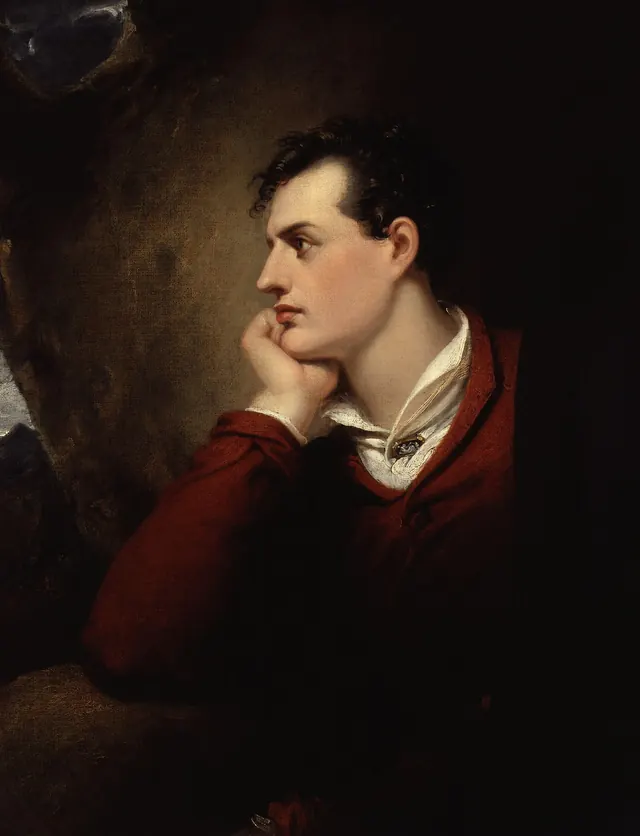
Parliament answered with the Frame Breaking Act in February 1812. A man caught smashing a machine could now be put to death.
The government sent 12,000 soldiers into the textile districts of northern England.
One lord stood up against the law. Lord Byron was 24 years old, a famous poet, and he had seen the hungry towns near his family home in Nottinghamshire. It was his first speech in the House of Lords.
"Can you commit a whole country to their own prisons? Will you erect a gibbet in every field, and hang up men like scarecrows?"Lord Byron, House of Lords, February 27, 1812. A gibbet is a gallows.
The law passed anyway.
Piece 6Northern England1811 to 1813
Twenty two months
Drag the slider to move through the uprising. Every stop on the map is a real place.
Piece 7Testimony to Parliament1834
What a week's pay could buy
The hangings ended the uprising. They did not save the trade. In 1834 a handloom weaver described his life to a committee of Parliament. Switch between the two years.
Each sack is 10 pounds of flour.
12 pence made 1 shilling.
Source: House of Commons debate on handloom weavers, July 28, 1835, quoting the weaver's evidence to the 1834 committee.
Piece 8Lancashire and Leeds1820 to 1841
The weaver's son
Why didn't the weavers just switch jobs? There were not enough jobs to switch to. Some men found work fixing power looms, but far fewer than the number who lost their trade.
Handloom weavers still outnumbered factory workers in Britain until 1833. Hundreds of thousands stayed at the loom while their pay kept falling.
Many families were so poor they put their own children to work at the hand loom. A new generation learned a trade that was already dying.
In 1838, Manchester weavers surveyed 856 of their own families. The average family member lived on about 2 shillings a week.
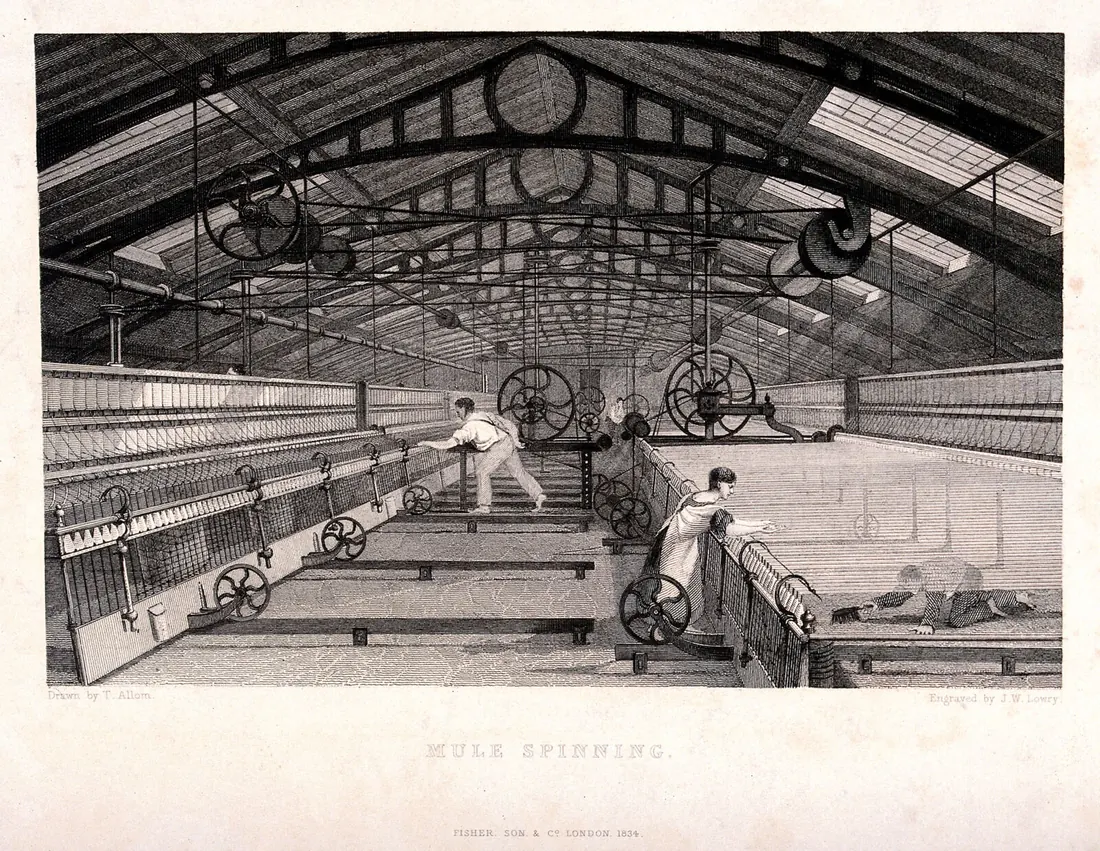
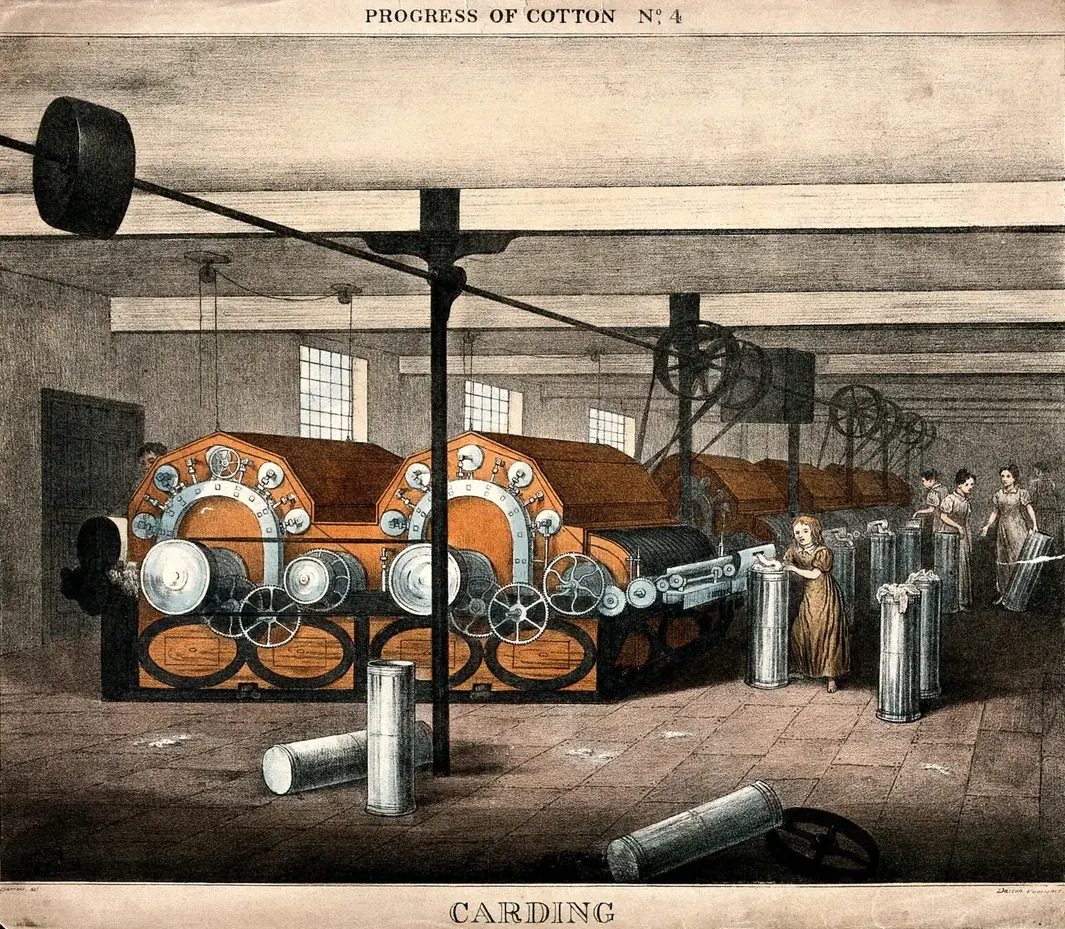
The croppers fell even faster. Leeds had 1,733 croppers in 1814. A report from 1841 said the cloth there was now finished by a small number of workers, chiefly boys aged five to eight.
Former croppers took whatever work they could find. Some became bailiffs, water carriers, or scavengers. Others sold oranges and cakes in the street.
The children at the machines did not win either. Factory pay was low, the hours were long, and the machines could take a hand.
Piece 9Britain1815 to 1850
So who came out ahead?
Britain made far more cloth than ever before. Somebody got richer. For each person, decide what you think happened, then check the record.
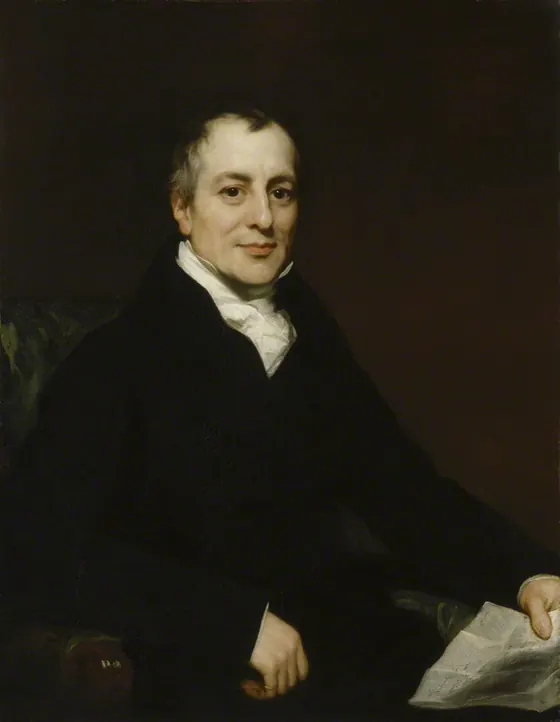
"I am convinced, that the substitution of machinery for human labour, is often very injurious to the interests of the class of labourers."David Ricardo, economist, 1821. He had believed machines always helped workers. After watching weavers' pay collapse, he added a new chapter to his famous book admitting he was wrong. Portrait by Thomas Phillips, public domain.
Pay for most British workers did not clearly rise until about 1850. That is a full generation after the hammers.
Piece 10Your schoolNow
Now it's your trade
Today the new machine writes, summarizes, and answers questions. People are making the same choices the weavers made. Here is what the newest research says.
Extra pay, on average, for jobs that require AI skills. Those jobs grew 69 percent in a year, while all jobs grew 9 percent.
PwC Global AI Jobs Barometer, 2026. More than 1 billion job ads in 27 countries.People in an MIT study who wrote an essay with ChatGPT and then could not quote a single sentence of it. In the groups that wrote without it, 11 percent could not.
Kosmyna and others, MIT Media Lab, 2025. A small study of 54 people, not yet peer reviewed when released.Which worker from 1812?
Read each student. Pick the worker from this story they are acting most like. Nothing here is graded.
The people who did well after 1812 understood the work well enough to direct the machines and fix them.
Glossary
Words you already met
Note repair
Fix the notes
Each of these is something people often believe about the Luddites. Fix it, then check your own notes.