WHY A PICTURE BEAT A PARAGRAPH
Imagine reading this sentence: a family of seven lives in one room with no window. You probably nodded and kept going. That's the problem Jacob Riis had for ten years. He wrote about tenement rooms in the newspaper over and over, and readers believed him about as much as you believe a stranger telling you a sad story. They could always tell themselves he was exaggerating.
A photograph took that escape away. A camera doesn't have an opinion, or at least that's what people in 1890 believed. If the picture showed twelve people asleep on a floor, then twelve people were asleep on that floor. The catch was that cameras needed light, and tenement rooms had none. Until 1887 nobody could photograph them at all. What you just did with that button is the reason this lesson exists.
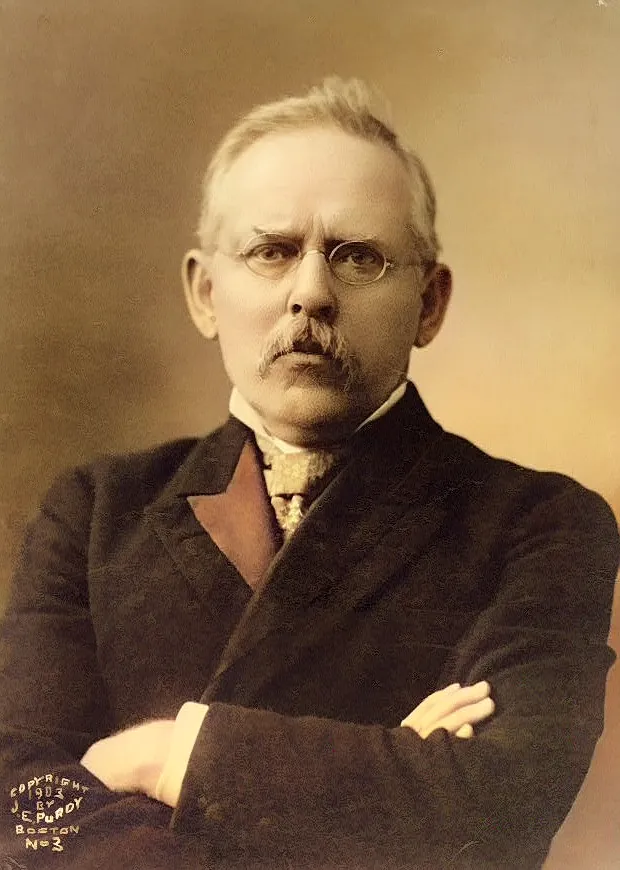
He slept on the floor first.
Riis sailed from Denmark to New York in 1870, 21 years old and nearly broke. For years he took whatever work he could find, and on bad nights he slept in police station lodging rooms, where the city let homeless people lie on bare planks for free. In 1877 he became a police reporter for the New York Tribune. His office faced police headquarters at 300 Mulberry Street, at the edge of the worst slum in the city.
In 1887 two German chemists published a way to photograph in the dark by burning magnesium powder. Riis read a short news item about it and understood immediately what it meant. He went out after midnight with two amateur photographers and a police escort, and he fired the powder inside rooms where people were sleeping. By his own account he set fires more than once.
Twelve people. One room.
Lodging houses rented floor space by the night. Riis visited one on Bayard Street with a police sanitary inspector around midnight, when it was fullest, and wrote down what he found.
In a room not thirteen feet either way slept twelve men and women, two or three in bunks set in a sort of alcove, the rest on the floor.Jacob Riis, How the Other Half Lives, 1890
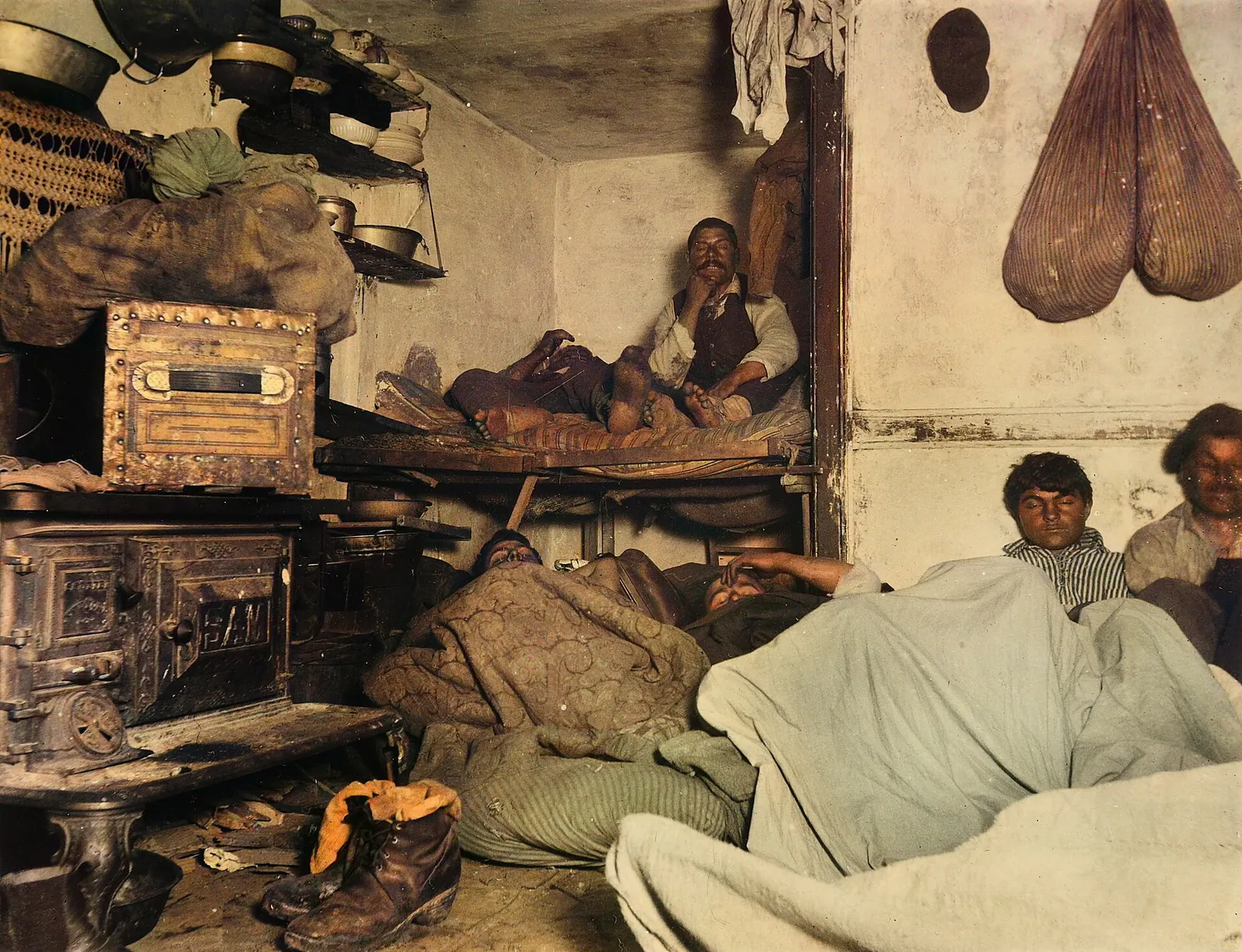
A sleeping adult needs a space about two feet wide and six feet long. Below is the room drawn to scale, one square for every square foot. Put the lodgers down one at a time and watch what happens to the floor.
Bar scale tops out at 120 square feet.
Twelve sleepers cover the floor wall to wall. The only open space left is a strip one foot wide along two walls, and that strip is the path to the door. Each person gets 14 square feet, less than a twin mattress. This is what Riis counted, and in 1890 it was legal.
The foul core.
That is what Riis called Mulberry Bend, a crooked stretch of Mulberry Street packed with rear tenements built in old backyards. Thousands of immigrants lived there, many from southern Italy. Death rates in these blocks ran far above the rest of the city, and the worst of it fell on babies. Pushcarts filled the street because the rooms upstairs were too small to hold anything worth selling. When Riis finally got the Bend torn down, the city did not build new housing. It built a park.
The dumbbell.
In 1879 New York required every bedroom in a new tenement to have a window. Builders obeyed with a design shaped like a dumbbell. The building filled a lot 25 feet wide and 100 feet deep, usually five or six stories tall with four apartments on every floor. It pinched in at the middle, and that pinch left a narrow shaft between it and the next building. Every middle room got its window, and the window opened onto that shaft.
WHAT AN AIR SHAFT ACTUALLY DID
Picture a gap between two six story buildings that's only a couple of feet wide on each side. Sunlight never reaches the bottom. Air doesn't move, it just sits. Now picture forty families with no garbage service and a window right there. The shaft filled with trash and smell. Worse, when a fire started on a low floor, that tall narrow gap worked exactly like a chimney and pulled the flames upward past every window. The 1879 law got what it asked for, a window in every bedroom. It didn't ask whether the window led anywhere.
In 1901, after Riis and other reformers had spent a decade pushing, New York passed the Tenement House Act and banned new dumbbells. Press each rule of the 1901 law and see which part of a dumbbell floor breaks it.
The law only covered new construction. Thousands of old dumbbells stayed full of tenants for decades. The city created a Tenement House Department in 1902 to inspect and enforce.
A reformer with blind spots.
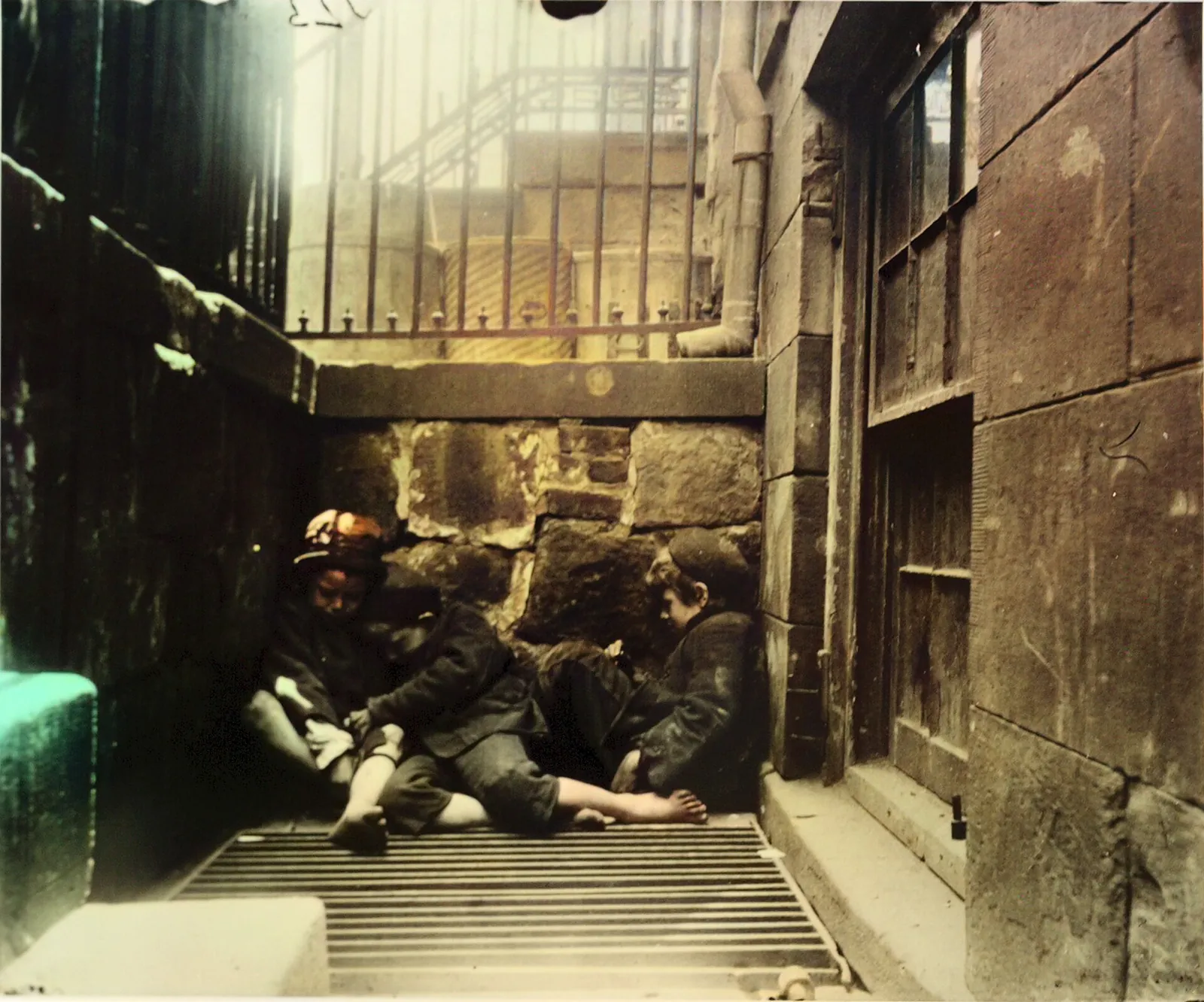
How the Other Half Lives describes Italian, Jewish, Chinese and Black New Yorkers using the ugly stereotypes common among native born Americans in 1890. Riis sometimes blamed poor people for habits he disliked in the same chapter where he blamed landlords. None of the people in his photographs agreed to be shown. Many were startled awake by an explosion of white light in the middle of the night.
What his photographs can prove
The size of the rooms. How many people slept in them. The absence of light, beds and toilets. Conditions nobody else bothered to record.
What they cannot prove
Who the people were, what they thought, or whether a scene was typical. A caption tells you what the photographer wanted you to believe. That is evidence too, but it is evidence about Riis.

Theodore Roosevelt read the book in 1895 when he took over New York's police board. He went to find Riis, and the two walked the tenement streets together after midnight. In February 1896 Roosevelt shut down the police lodging rooms. Mulberry Bend was torn down beginning in 1895, and a park opened on the spot in 1897. It is still there today, called Columbus Park.
A photograph can shame a city. Can a stack of paper break the richest company on earth?
- Jacob A. Riis, How the Other Half Lives: Studies Among the Tenements of New York, Charles Scribner's Sons, 1890. Bayard Street lodging room quotation from the chapter on lodging houses.
- Jacob A. Riis, The Making of an American, Macmillan, 1901. Arrival in 1870, police lodging rooms, flash photography and fires.
- New York State Tenement House Act of 1901, and Lawrence Veiller and Robert DeForest, The Tenement House Problem, 1903.
- Photographs: Jacob A. Riis, Bandits' Roost, about 1888, Lodgers in a crowded Bayard Street tenement and Street Arabs in sleeping quarters, about 1889, Museum of the City of New York. Mulberry Street, about 1900, Detroit Publishing Company, Library of Congress. Portraits of Riis and Roosevelt. All public domain, via Wikimedia Commons. Colorized for this lesson with the DDColor model, so colors are an educated guess, not a record.