Promontory Summit, Utah, May 10, 1869
U.S. History  ·  Part One of Two

Who PaidFor It

The Fortunes, 1862 to 1901
Rails/Oil/Steel

In 1873 Mark Twain and his neighbor Charles Dudley Warner published a novel called The Gilded Age. Something gilded is not solid gold. It is cheap metal with a coat of gold paint so thin you could scratch it off with a fingernail.

The name stuck to the years after the Civil War. The United States laid track across a continent, pumped oil, poured steel and built the richest fortunes the world had ever seen. Every one of those fortunes was built by somebody's hands, and most of those hands did not end up rich.

This is Part One. It follows three fortunes, the railroad, the oil and the steel. Part Two picks up with the law of 1882 and the Model T.

Read every source. Answer in complete sentences. Name the source letter when you use it.

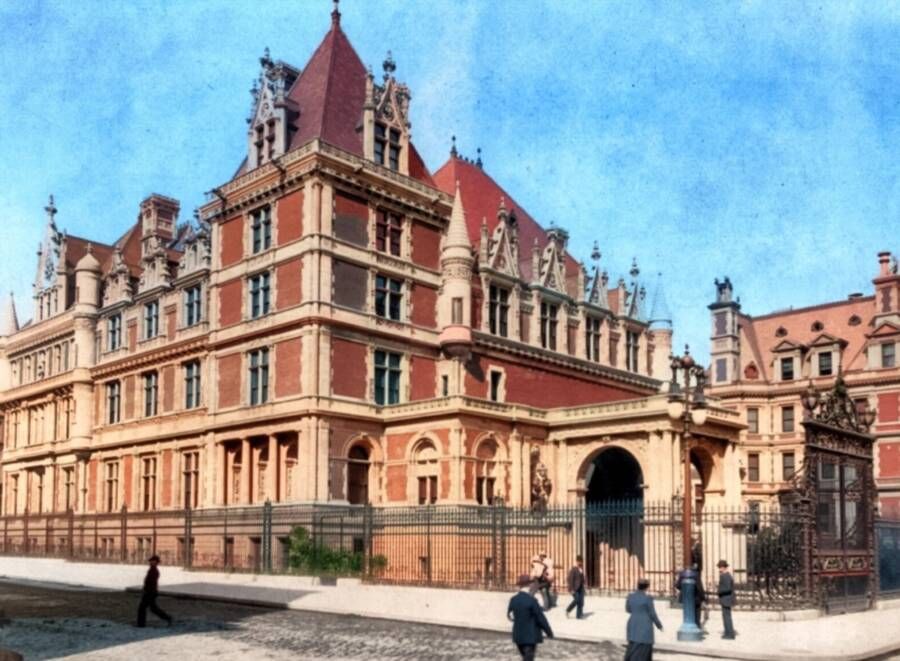
A huge red brick mansion with towers taking up a full city block on Fifth Avenue in New York.
Cornelius Vanderbilt II's house on Fifth Avenue took up the whole block between 57th and 58th Streets. It was the largest private home ever built in New York City.Vanderbilt mansion, New York, 1880s · colorized
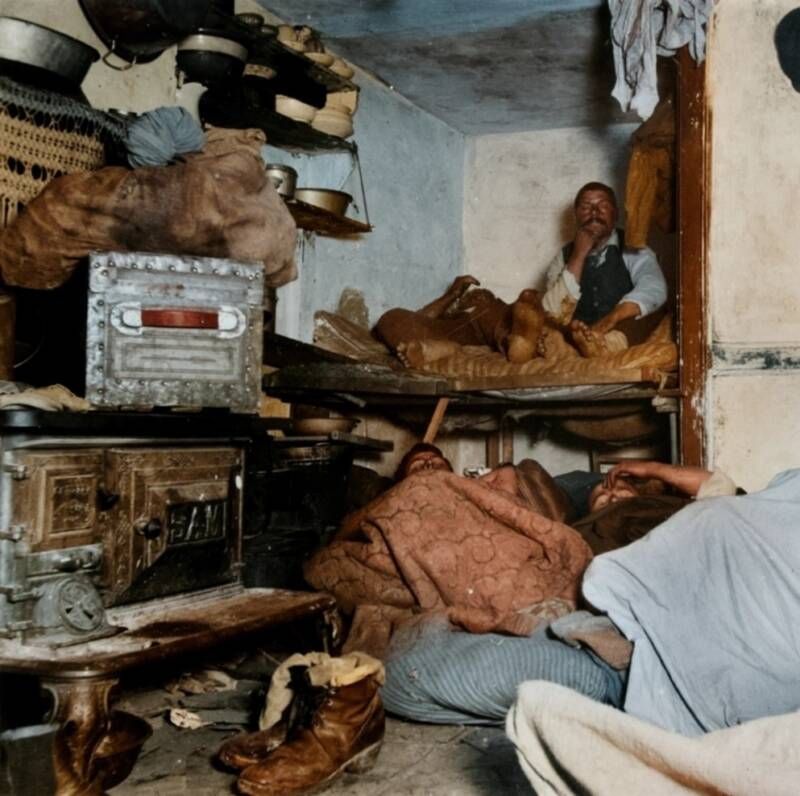
A cramped room with bunks and men sleeping among bundles and pots.
About four and a half miles south, Jacob Riis photographed a Bayard Street room under 13 feet across where twelve men and women slept. Each paid five cents a night for a spot on the floor.Jacob Riis, Bayard Street lodging room, about 1889 · colorized
Step One · The SourcesThree sources, 1862 to 1901
A
The Railroad1862 to 1869

On July 1, 1862, in the middle of the Civil War, President Abraham Lincoln signed the Pacific Railway Act. Two companies would build a railroad to connect the country. The Central Pacific started in Sacramento, California, and built east. The Union Pacific started in Omaha, Nebraska, and built west.

The government paid them with land and loans. For every mile of track, a company got 10 square miles of public land, and Congress doubled that to 20 in 1864. It also lent them $16,000 a mile on flat ground, $32,000 in the high plains and $48,000 in the mountains.

Who laid the track

The Central Pacific had the Sierra Nevada mountains in front of it and almost nobody willing to work there. In 1865 it hired its first crews of Chinese immigrants. By February 1867 more than 11,000 Chinese men worked for the company, about 90 out of every 100 workers it had.
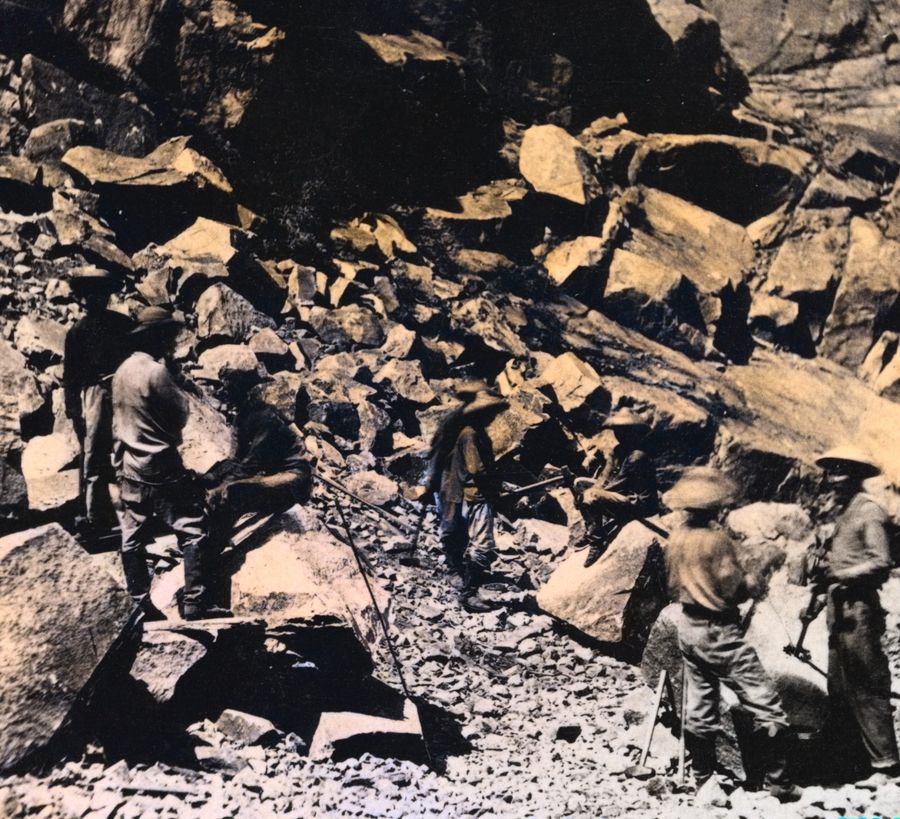
Chinese laborers in wide hats working among huge broken boulders on a mountainside.
Near the Summit Tunnel, 7,000 feet up. Crews cut the 1,659 foot tunnel through solid granite with hand drills and black powder. It took about two years.Alfred A. Hart, 1865 to 1867 · Library of Congress · digitally colorized
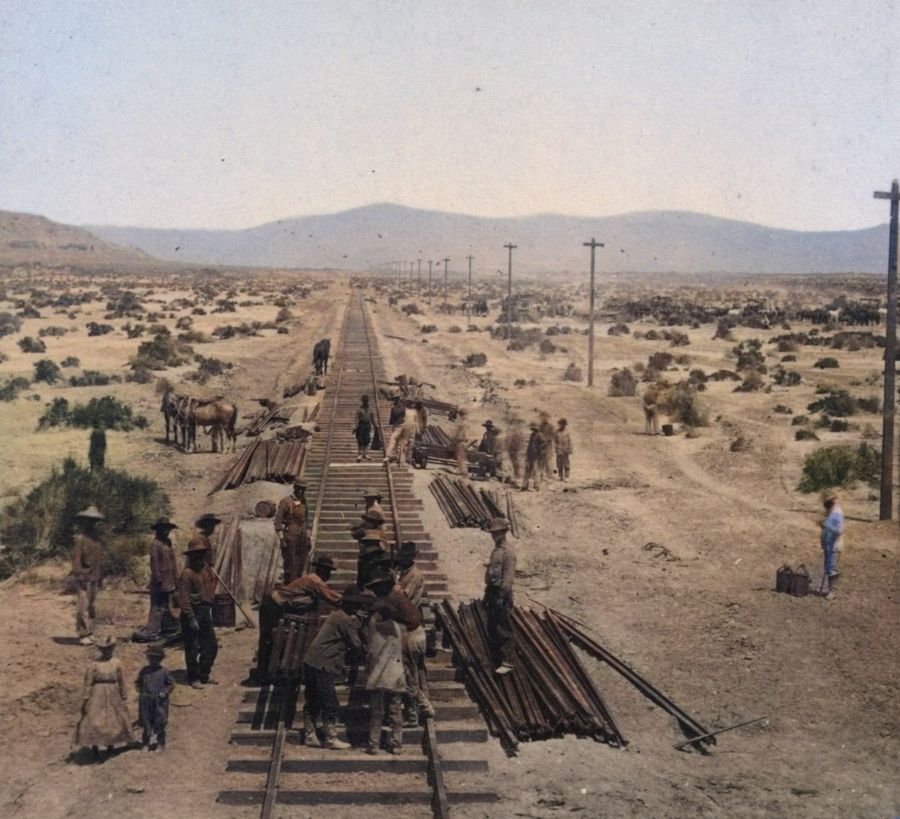
Workers unloading rails at the end of the track on a flat desert plain.
End of the track on the Humboldt Plains, Nevada. Once the crews got out of the mountains, they laid rail as fast as the supply trains could bring it.Alfred A. Hart, 1868 · Library of Congress · digitally colorized
Same Job, Different PayCentral Pacific, 1866 to 1867
WHITE WORKERS CHINESE WORKERS $35 PLUS FOOD, PAID BY THE COMPANY $26 to $35 FOOD CAME OUT OF THEIR OWN PAY MONTHLY WAGES
Chinese crews also took the most dangerous jobs, including blasting tunnels with black powder and nitroglycerin. The company did not keep a count of how many of them died.

In June 1867 about 3,000 Chinese workers put down their tools. They asked for $40 a month and a shorter workday. Charles Crocker, the boss in charge of construction, cut off their food and supplies at the camps high in the mountains. The strike ended in about a week. The workers went back without a raise.

On April 28, 1869, a Central Pacific crew of Chinese workers, with eight Irish rail handlers, laid 10 miles and 56 feet of track in one day. It is still the record for track laid by hand in a single day.

May 10, 1869

The two railroads met at Promontory Summit, Utah. Leland Stanford, president of the Central Pacific, swung a silver hammer at a golden spike and, by most accounts, missed. A telegraph operator sent one word to the whole country: DONE. A trip from New York to San Francisco that took around six months by wagon or ship now took about a week.

Look at the photo at the top of this page. It was taken that day and it became the most famous picture of the railroad. Chinese workers had laid the last rails that morning, but almost none of them appear in it.
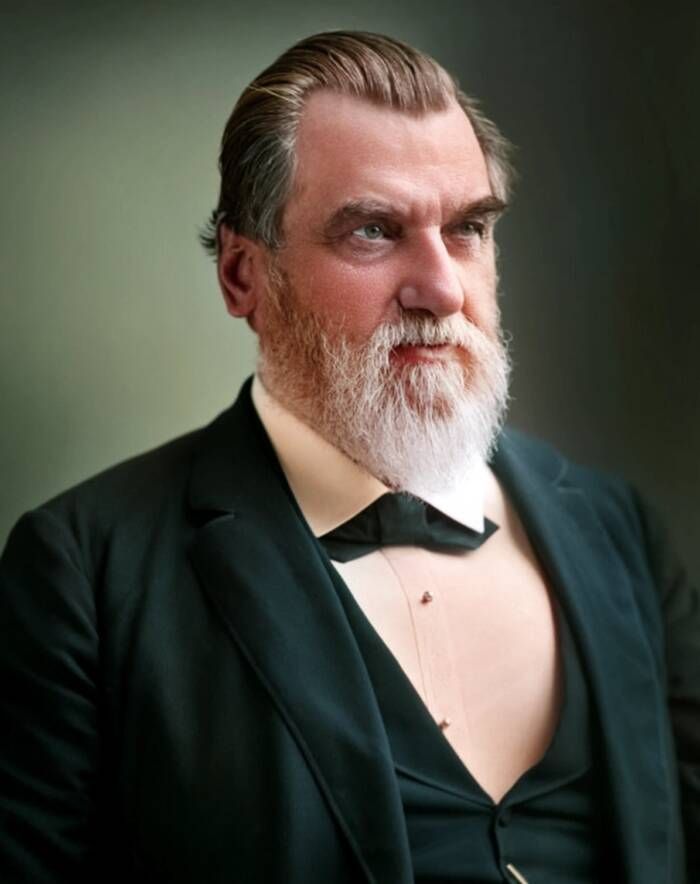
Portrait of Leland Stanford, a heavy set man with a gray beard in a dark suit.
Leland Stanford became governor of California, a U.S. senator, and rich enough to found a university in 1885.Leland Stanford · colorized

One hundred years later, at the 1969 anniversary ceremony, the U.S. Secretary of Transportation, John Volpe, gave a speech praising the builders. Descendants of Chinese railroad workers were in the audience. He said:

Who else but Americans could have laid ten miles of track in 12 hours?

John Volpe, Promontory Summit, May 10, 1969
A1Give two ways the government helped the railroad companies. Use numbers from the source.
A2Volpe meant his speech as praise. Why would the Chinese workers' descendants in that audience hear it differently?
B
The Oil1870 to 1911 · Cleveland, Ohio
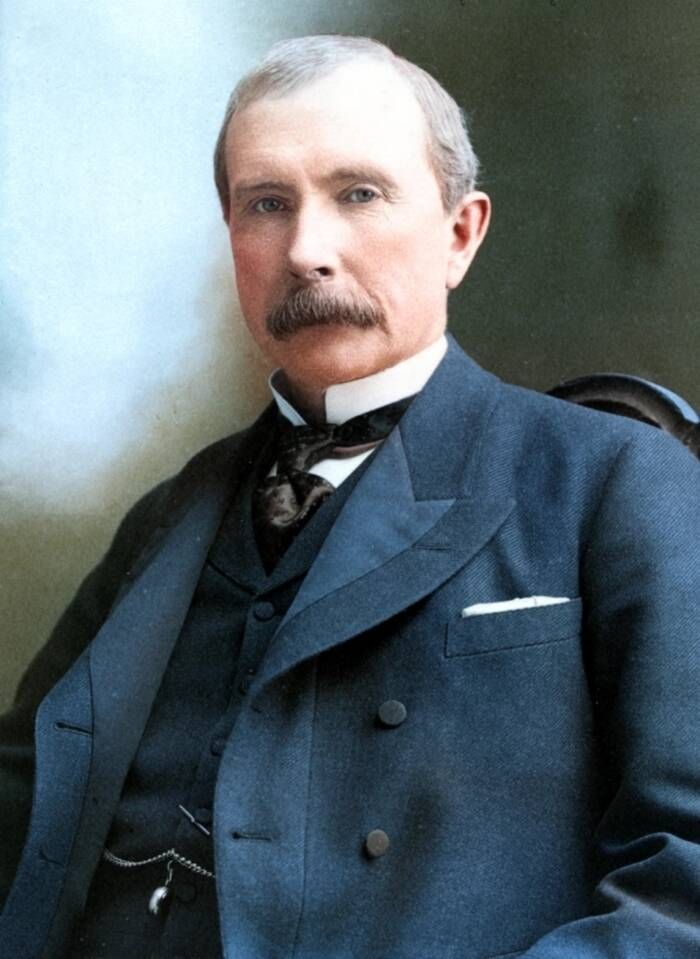
Portrait of John D. Rockefeller with a gray mustache in a dark suit.
John D. Rockefeller started Standard Oil in Cleveland in 1870, when he was 30. Most homes then lit their lamps with kerosene made from crude oil.John D. Rockefeller · colorized
Portrait of Ida Tarbell, a woman with her hair pinned up, in a dark high collared dress.
Ida Tarbell grew up in the Pennsylvania oil fields. Her father's oil business was squeezed when Rockefeller made secret deals with the railroads in 1872.Ida Tarbell · colorized

Cleveland was full of oil refineries in the early 1870s, and they were all fighting each other on price. Rockefeller made a secret deal with the railroads. Standard Oil got a cheaper shipping rate than everybody else. Then he went to his competitors one at a time with an offer to buy them out. Owners who said no found out they could not compete with his prices.

Horizontal integrationBuying up your competitors, the companies that do the same thing you do, until you control the whole market.
Cleveland, Early 1872Standard Oil and its 26 rivals
0 of 26competitors bought
Each square is a refinery in Cleveland. The bright one is Standard Oil.
By the spring of 1872 Standard Oil had bought 22 of its 26 rivals in Cleveland, most of them in about six weeks. By 1880 it refined about 90 percent of the oil in the United States.

The day of combination is here to stay. Individualism has gone, never to return.

John D. Rockefeller, 1880 · quoted in Allan Nevins, John D. Rockefeller
What a Gallon of Kerosene Cost1870 to 1885
ABOUT 1870 26¢ 1885 PRICE PER GALLON
Standard Oil was huge enough to refine oil more cheaply than anyone. Families paid less to light their homes. Competitors who could not match that price went out of business.
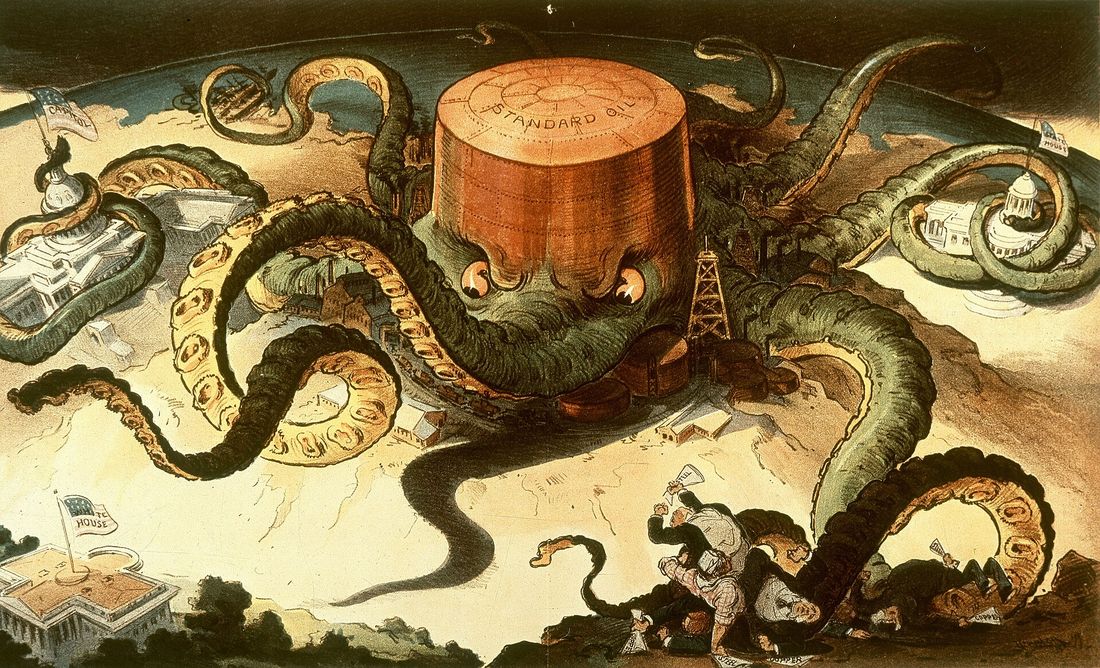
Color cartoon of a giant octopus with a Standard Oil tank for a head, its tentacles wrapped around the Capitol and a state house and reaching for the White House.
Standard Oil drawn as an octopus. One tentacle holds the U.S. Capitol, another a state house, and one reaches for the White House.Udo Keppler, "Next!" Puck magazine, September 7, 1904 · printed in color

Ida Tarbell spent years digging through court records and company papers. Starting in 1902 she published her findings in McClure's magazine, then as a book in 1904, The History of the Standard Oil Company. On May 15, 1911, the Supreme Court ruled that Standard Oil had broken the Sherman Antitrust Act and ordered it split into 34 separate companies. Rockefeller owned shares in all of them and got richer after the breakup.

B1Explain horizontal integration in your own words, using what happened in Cleveland in 1872 as your example.
B2Kerosene got cheaper under Standard Oil. Who gained from that, and who lost?
C
The Steel1848 to 1901 · Pittsburgh, Pennsylvania
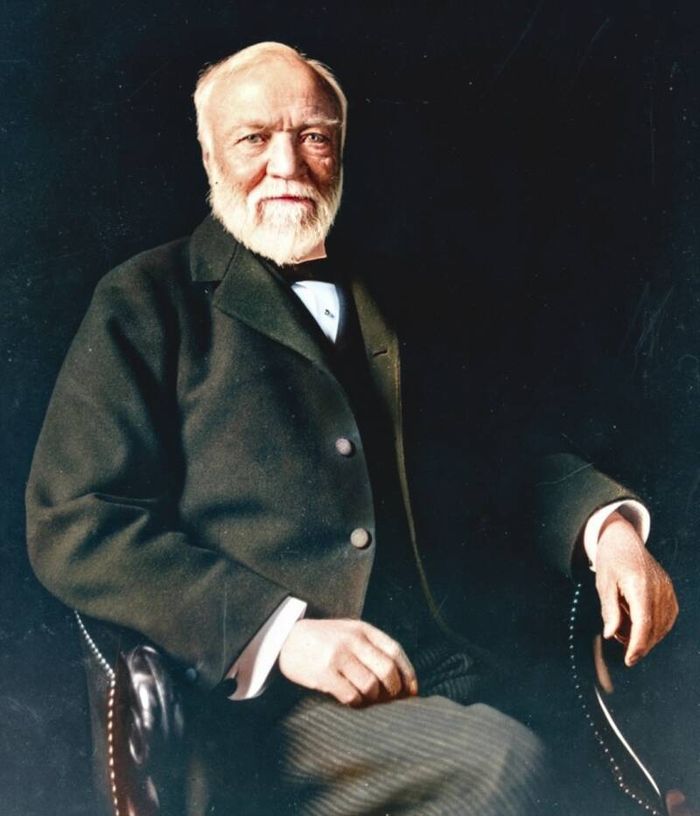
Portrait of Andrew Carnegie, a white bearded man seated in a dark suit.
Andrew Carnegie came from Scotland at 12, in 1848. His first job in Pittsburgh was changing spools in a cotton mill for $1.20 a week.Andrew Carnegie · colorized
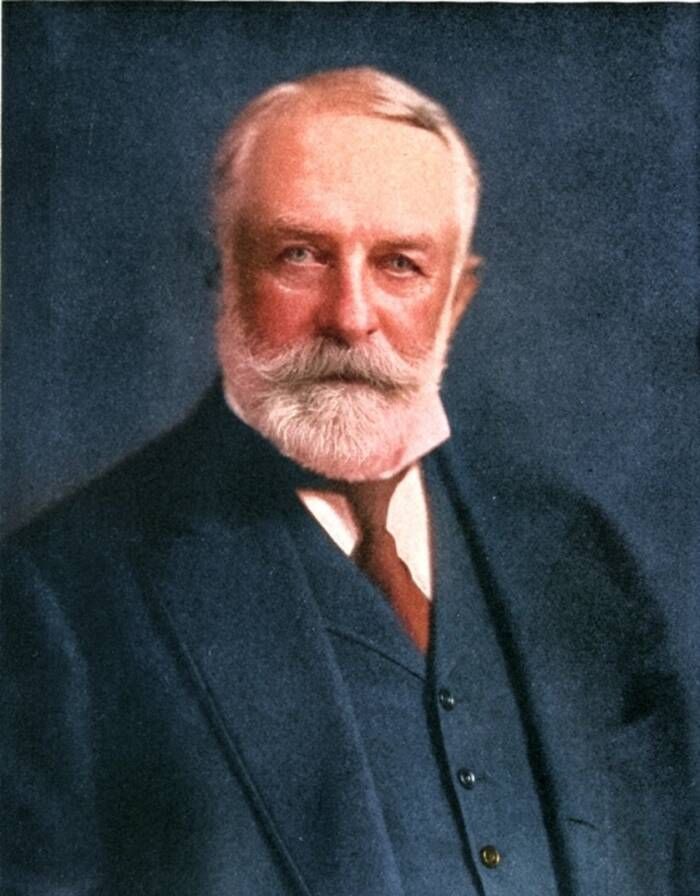
Portrait of Henry Clay Frick with a white beard in a dark suit and red tie.
Henry Clay Frick owned the coke ovens that fueled steel furnaces. He became Carnegie's partner in 1881 and ran the company day to day.Henry Clay Frick · colorized

Carnegie opened his Edgar Thomson steel works outside Pittsburgh in 1875. Railroads needed steel rails, and cities needed steel beams for bridges and tall buildings. Rockefeller bought out his competitors. Carnegie did something different. He bought every step it took to make steel, so he never had to pay another company a profit along the way.

Vertical integrationOwning every stage of making your product, from the raw materials in the ground to the finished goods.
Carnegie Steel, Link by LinkTap each step

Start with step 1

Every link you tap turns gold when Carnegie owns it.

Owning every step made Carnegie steel the cheapest in the world. A ton of steel rail cost about $160 in 1875 and about $17 in 1898.

Carnegie also wrote about what rich men owed everyone else. In 1889 he published an essay that became known as "The Gospel of Wealth." A rich man, he wrote, should give his fortune away to build things that help ordinary people improve themselves.

The man who dies thus rich dies disgraced.

Andrew Carnegie, "Wealth," North American Review, June 1889

Homestead, 1892

At the Homestead steel works, men worked 12 hour shifts. Every two weeks, when crews switched between days and nights, they worked a 24 hour shift called the long turn. In 1892 Frick cut pay and locked the union out of the mill. Carnegie was at his castle in Scotland.

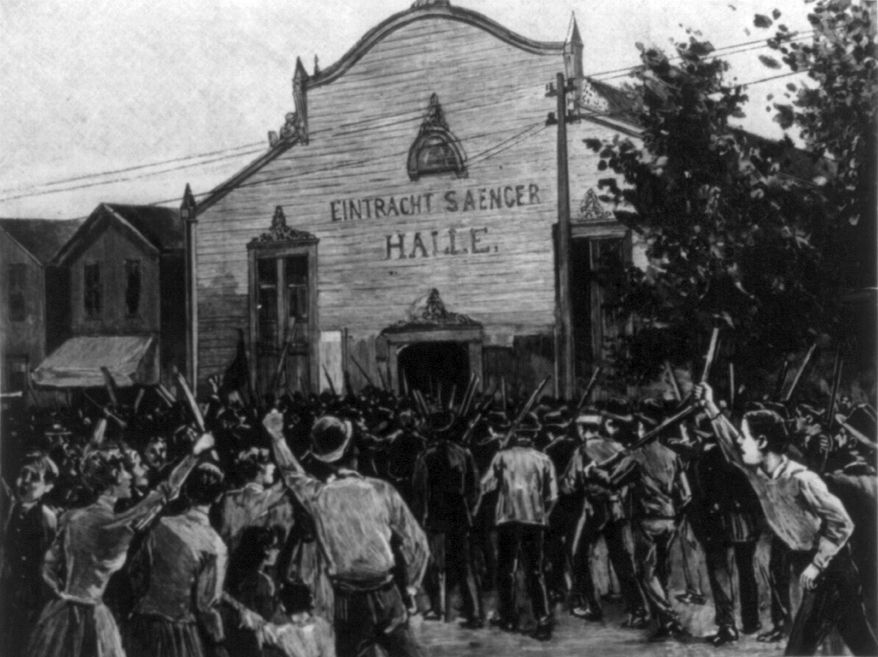
Before dawn on July 6, 1892, about 300 armed guards from the Pinkerton Detective Agency came up the Monongahela River on two barges. Thousands of steelworkers and their families were waiting on the riverbank. The shooting lasted most of the day. Seven workers and three Pinkerton guards were killed before the guards surrendered.

Engraving of a crowd of men in front of a hall, some with raised fists and clubs, surrounding a line of Pinkerton guards.
After they surrendered, the Pinkertons had to walk a gauntlet of angry workers to get out of town.Engraving after a photograph, Frank Leslie's Illustrated Newspaper, July 1892

Six days later, 8,000 Pennsylvania militia soldiers took over the town. The mill reopened with replacement workers, and the union at Homestead was finished. In 1901 Carnegie sold his company to the banker J. P. Morgan for $480 million. Morgan used it to build U.S. Steel. Carnegie spent the rest of his life giving away about $350 million, including money for 2,509 public libraries.

C1What is the difference between how Rockefeller built Standard Oil and how Carnegie built Carnegie Steel? Use the terms horizontal and vertical.
C2Carnegie wrote that a man who dies rich dies disgraced. Does Homestead make that statement harder to believe? Explain.
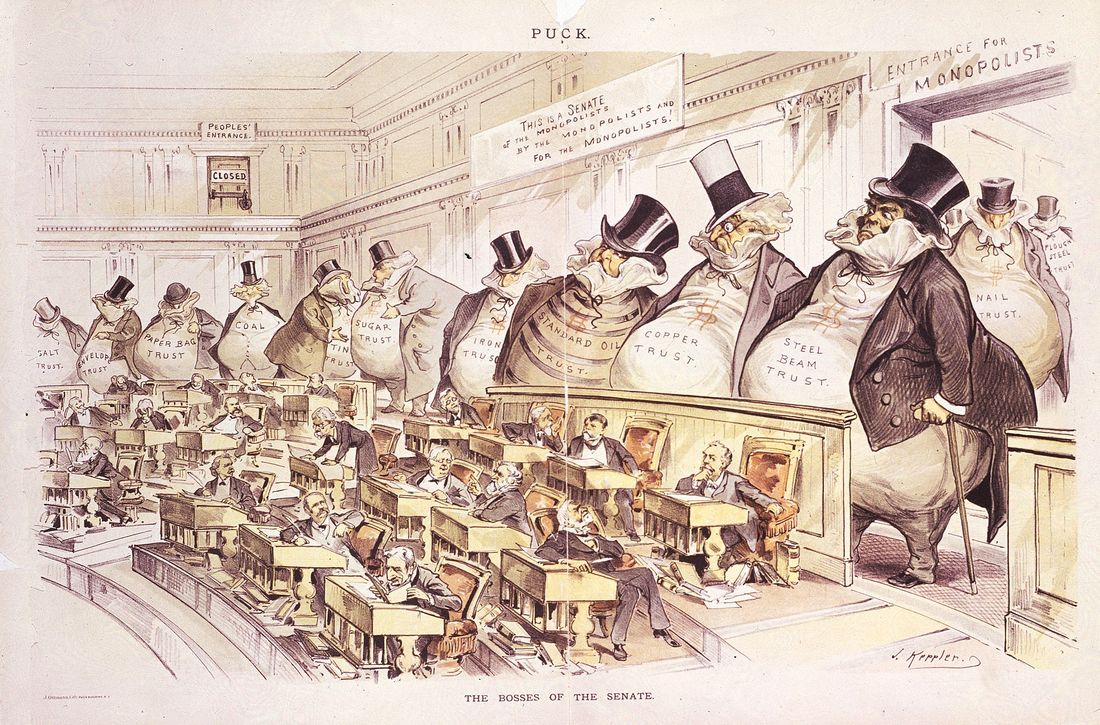
Color cartoon of giant money bags labeled with trusts such as Standard Oil, Copper, Steel Beam and Sugar standing behind small senators at their desks.
The trusts drawn as giant money bags standing over the U.S. Senate. The sign on the wall reads: This is a Senate of the monopolists, by the monopolists and for the monopolists. The door for the public is locked.Joseph Keppler, "The Bosses of the Senate," Puck magazine, January 23, 1889 · printed in color
Step Two · The LedgerThree entries per side

Who got rich, and how

One fact from the sources per line
1
2
3
Step Three · Take a Side100 to 150 words · two sources
Your argumentWords 0 · aim for 100 to 150

When you are finished, copy everything and paste it into the Classroom assignment. Your work saves in this browser as you type.

Up nextPart Two · The Law and the LineThe Chinese Exclusion Act and the Model T
References
Ambrose, S. E. (2000). Nothing like it in the world: The men who built the transcontinental railroad, 1863 to 1869. Simon & Schuster.
Carnegie, A. (1889). Wealth. North American Review, 148(391), 653 to 664.
Chang, G. H. (2019). Ghosts of Gold Mountain: The epic story of the Chinese who built the transcontinental railroad. Houghton Mifflin Harcourt.
Krause, P. (1992). The battle for Homestead, 1880 to 1892: Politics, culture, and steel. University of Pittsburgh Press.
Nevins, A. (1940). John D. Rockefeller: The heroic age of American enterprise. Scribner.
Riis, J. A. (1890). How the other half lives. Scribner.
Standard Oil Co. of New Jersey v. United States, 221 U.S. 1 (1911).
Tarbell, I. M. (1904). The history of the Standard Oil Company. McClure, Phillips.
Saved