For nearly seventy years, American wrestling promoters built their villains out of the evening news. A Soviet who made the crowd stand for his anthem. An Iranian champion in the shadow of the hostage crisis. A Marine drill sergeant who sided with Saddam Hussein while American planes bombed Baghdad.
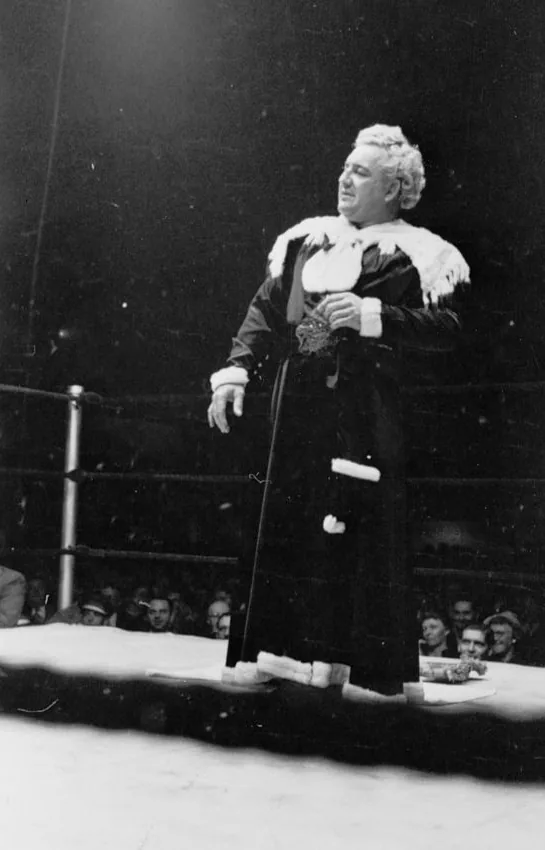
Gorgeous George, the most booed man of early television, in the ring in 1949. Library of Congress.
01
Before the episode
The Man Who Sold the Villains
In 1982 Vince McMahon bought his father's wrestling company, the WWF, and set out to take it national. Episode 1 of the Netflix series Mr. McMahon tells that story.
Halfway through, McMahon explains why he picked the Iron Sheik, an Iranian, to take the championship from Bob Backlund so Hulk Hogan could win it a month later. The segment cuts the Sheik waving his flag against news footage of American hostages in Iran. Bruce Prichard, a longtime WWE executive, says fans could watch an Iranian get beaten up at the arena in a way they could never see in real life.
That moment is the whole project in one scene. A real fear, turned into a ticket.
The villain. The wrestler the crowd is supposed to boo.
Face
Short for babyface. The hero the crowd cheers.
Kayfabe
Presenting the scripted story as real, inside the ring and out of it.
Territory
A regional wrestling company. Before the 1980s, promoters agreed to stay out of each other's turf.
02
Villains from the headlines
How Fast Did Wrestling Answer the News?
Pick a front page. Then see what happened in the ring, and how many days passed in between.
In the news
Militants seize the U.S. embassy in Tehran and hold 52 Americans hostage for 444 days. They come home January 20, 1981, minutes after Ronald Reagan is sworn in.
In the ring
December 26, 1983: the Iron Sheik, billed from Tehran, takes the WWF title from Bob Backlund at Madison Square Garden. On January 23, 1984, Hulk Hogan beats him and Hulkamania is born.
1,513 days
The slowest answer on the board, because the Sheik was already wrestling as an Iranian villain. The crisis made him worth a title run.
In the news
Iraq invades Kuwait in August 1990. On January 17, 1991, the United States and its allies begin bombing Iraq in the Persian Gulf War.
In the ring
January 19, 1991: Sgt. Slaughter, a former American hero now siding with Saddam Hussein, wins the WWF title at the Royal Rumble. Hogan takes it back at WrestleMania VII on March 24.
2 days
The storyline had started in late 1990. The war arrived right on schedule for it.
In the news
The invasion of Iraq begins March 20, 2003. France had refused to back it at the United Nations, and that month the House cafeterias in Washington renamed french fries "freedom fries."
In the ring
April 28, 2003: La Résistance, two arrogant Frenchmen, debut on Raw by attacking Scott Steiner. Both men were actually Canadians.
39 days
WWE had aired vignettes of the pair criticizing America from a fake French news studio before they ever wrestled.
In the news
Russia annexes Crimea from Ukraine on March 18, 2014, and relations between Washington and Moscow fall to their lowest point since the Cold War.
In the ring
By mid May 2014, Rusev, a Bulgarian, is presented as a hero of the Russian Federation who dedicates his wins to Vladimir Putin while Putin's face fills the arena screen.
57 days
Measured to a May 14, 2014 news report describing the act. Rusev had debuted months earlier as "the Bulgarian Brute." Russia was added once the news made it useful.
Days from headline to ring · log scale
Iran 19791,513
Iraq 19912
France 200339
Russia 201457
Three of the four answers came in under two months. Promoters were reading the same newspapers as their fans.
Pick a wrestler, then move through the years. Watch the crowd switch sides even when the man underneath barely changes.
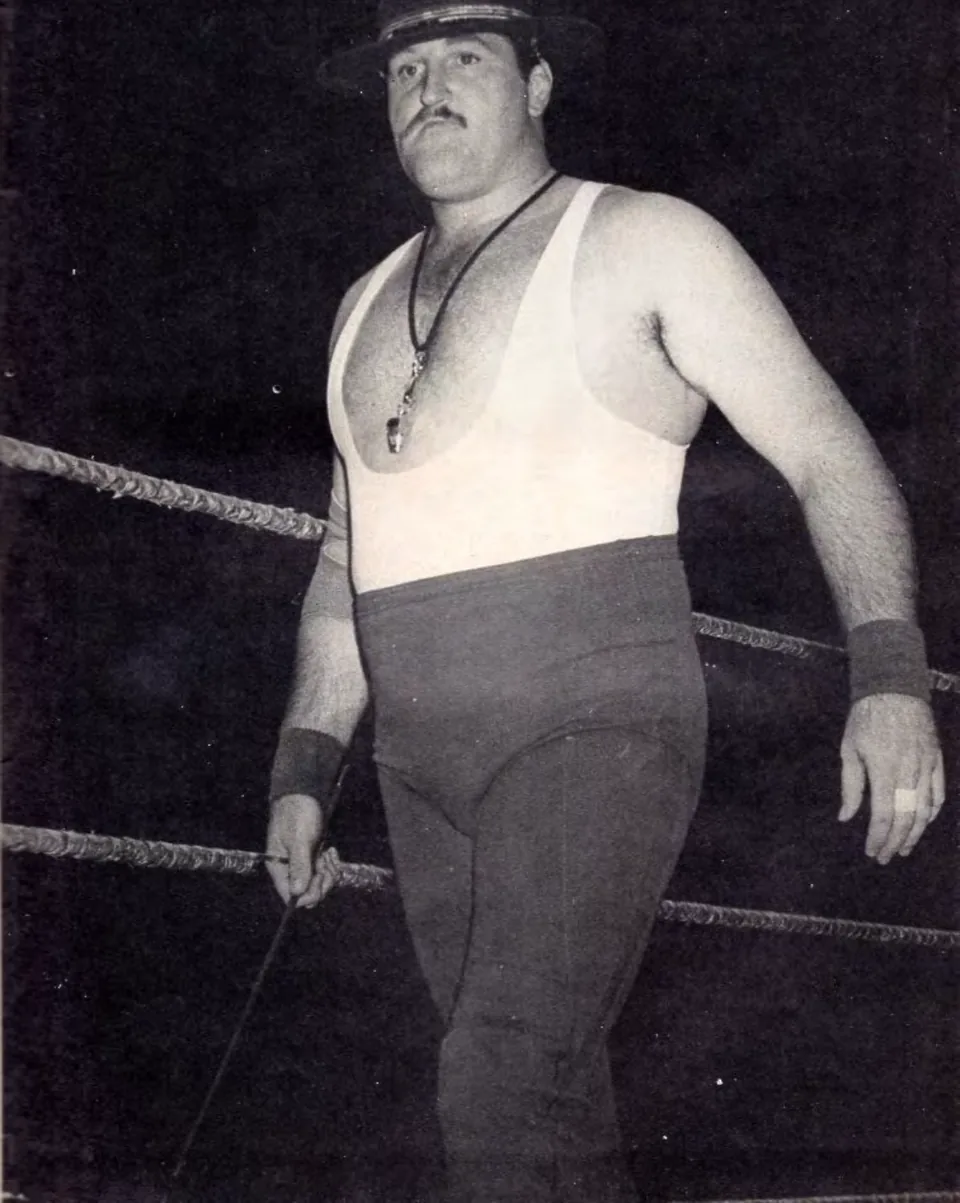
Sgt. Slaughter
Robert Remus, born in Detroit in 1948. Photographed here in 1984.
FACE
A Marine drill sergeant who fights the Iron Sheik for America and becomes a G.I. Joe action figure. Kids salute him.
HEEL
Back from a long absence, he sides with Saddam Hussein, carries the Iraqi flag, and wins the title two days into the bombing of Iraq. He reports death threats.
What changed
The country went to war, and his patriotism became the thing he betrayed.
FACE
After losing to Hogan at WrestleMania VII, he asks the fans to forgive him and returns as an American hero.
What changed
The war ended in February 1991. The story had nothing left to sell.
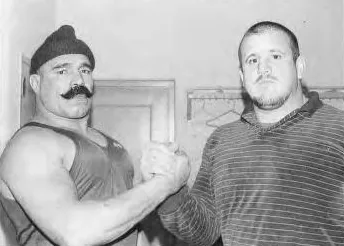
Nikolai Volkoff
Josip Peruzović, born in Croatia, then part of communist Yugoslavia. Shown at right beside the Iron Sheik in 1986.
HEEL
Demands that the crowd stand while he sings the Soviet national anthem. Wins the tag titles with the Iron Sheik at the first WrestleMania on March 31, 1985.
FACE
Sings "The Star Spangled Banner" on television instead, and the boos turn into cheers.
What changed
The Cold War ended. Volkoff had defected from Yugoslavia at a weightlifting meet in 1968 and hated communism. He finally got to play himself.
WethePeople
Jack Swagger
From Perry, Oklahoma. His 2013 catchphrase is set on the poster at left. The video in chapter 04 shows the Russian he faced next.
HEEL
Chants "We the People" under a Don't Tread on Me flag while his manager, Zeb Colter, attacks immigrants. The target is Alberto Del Rio, a Mexican champion. WWE said the story was built to make Del Rio a hero for Latino fans, about 20 percent of its audience.
FACE
Swagger and Colter wave the same American flag against Rusev, the Russian, and the arena cheers them for the first time.
Filter the card by what each villain stood for. Open a bout to see your starter question. Then flip the switch and compare who the poster said the wrestler was with who he really was.
Showing all 15 heels.
01Gorgeous George1947 to 1955
Poster
The Human Orchid, a pampered glamour boy
Record
George Wagner, born 1915 in Nebraska, raised in Houston
Why would curled platinum hair and a valet spraying perfume make crowds of working men furious?
What the promoters built: the ring name, the costume, the flag, the manager and the hometown printed on the poster. Find out where the wrestler was really from, too.
Story two
The history
What was happening in America that made fans want to see this character lose. Find the real event with its dates and what people were afraid of at the time.
Then teach the class in two to three minutes. Your presentation has to answer five questions. Tap the bar to see where the 100 points come from.
60 of the 100 points come from questions 2 through 5, the history behind your heel.
1Who was the heel?10 pts
Ring name, real name, real hometown, and the years the character was on top. Describe the gimmick in two sentences.
Full credit: all of that, stated clearly and correctly.
2What was happening in the world?15 pts
The real event or issue, with dates.
Full credit: accurate dates and at least one hard fact, like a number or a name.
3How did wrestling use that history?15 pts
Entrances, anthems, flags, managers, costumes and rivalries.
Full credit: at least two specific details from the character, such as a named match or a manager.
4Why did the crowd hate this character?15 pts
Connect the boos to what Americans believed or feared at that moment.
Full credit: the reaction is tied directly to that time, not to wrestling in general.
5What does it tell us about America?15 pts
Name the stereotype or prejudice involved and decide whether the character was fair to the people it claimed to represent.
Full credit: a clear position, backed by your evidence.
The other 30 points: 10 for two credible sources, 10 for your research organizer, 5 for one piece of visual evidence and 5 for your delivery.
06
The hardest part
Prove the Connection With Dates
Do not assume an event created a character. Line up the dates and show what changed. Try it: put these four moments in order, earliest first.
November 4, 1979Militants seize the U.S. embassy in Tehran.
January 20, 1981The hostages come home after 444 days.
December 26, 1983The Iron Sheik becomes WWF champion.
January 23, 1984Hulk Hogan beats the Sheik.
The Iron Sheik was already wrestling as an Iranian villain before 1979. The crisis did not invent him. It turned him into the perfect opponent for a new American hero. Your presentation needs this kind of proof.
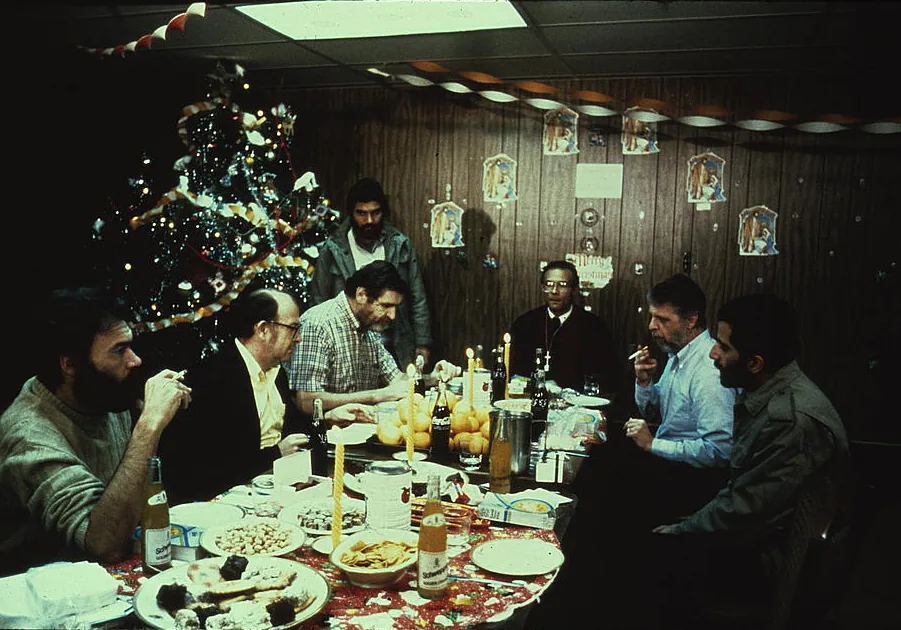
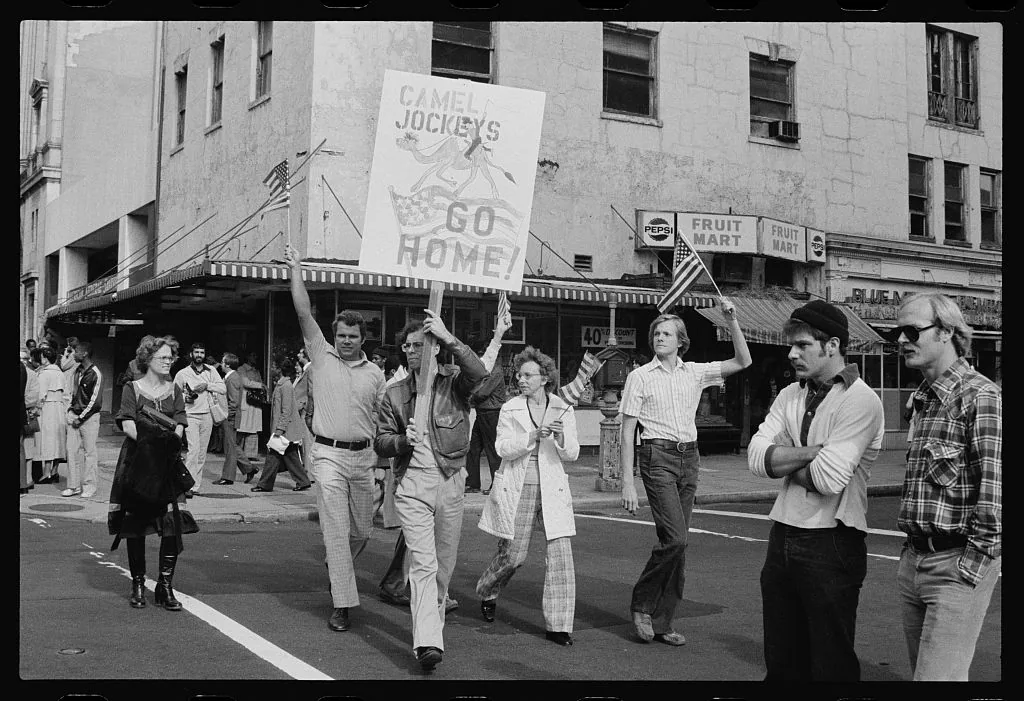
American hostages at a holiday meal inside the embassy in Tehran, 1979. Library of Congress.A demonstration in Washington, D.C., during the hostage crisis, 1979. Library of Congress. The sign uses a slur aimed at people from the Middle East. That is the anger promoters would sell tickets to, and it is the kind of evidence question 5 asks you to name.
07
The rules of the ring
What You Turn In
2
Credible sources
At least one from outside WWE. Newspaper obituaries, NPR stories, books and documentaries all count. Wikipedia is where you start looking, not one of the two.
1
Piece of visual evidence
A historical photograph, or a wrestling clip no longer than 30 seconds.
3
Slides at most
Your slides back up your talk. You do the teaching out loud.
1
Research organizer
Every box filled in and handed in on presentation day.
One firm rule
Do not repeat a slur or act out a hateful promo.
You can describe what a wrestler said and explain why it worked on a crowd. Analyzing it is the job. A presentation that repeats a slur stops right there and loses the 15 points for question 5.
The week ahead
Day 1Watch Mr. McMahon, episode 1, with the viewing guide. Claim your heel before you leave.
Day 2Research. Organizer through question 3. Find both sources.
Day 3Finish the organizer and build your slides. Pick your visual evidence.
Day 4Presentations begin, in timeline order. Fill in the class timeline as each heel goes.
Day 5Last presentations, then the final question.
The case file · interactive research lab
Build the Case.
A wrestler played the villain. Your job is to prove why that character worked in that moment of American history. Work through the five rounds, collect evidence, prepare your argument, then turn in the organizer. You provide the answers.
0 / 5Rounds drafted, not graded
Writing help: Spellcheck is on. Choose Expand below an answer box when you want more room. You can switch automatic capital letters on or off.
Write answers in your own words. You can paste up to 12 words at once. Source boxes allow full links and titles.
Round 1 / Who is the wrestler?
Who did the audience think they were seeing?
Pick one of the fifteen heels. This is a research choice, not an automatic reservation: confirm your selection with your teacher so the class does not repeat a wrestler.
Need a starting point?
Use the 15-wrestler fight card to compare the poster with the real record. Then verify both with sources. The card supplies leads, not all the evidence you need.
The real event needs correct dates and at least one fact you can check. Then put that history beside the character. A headline that came later could not have invented an earlier gimmick.
Enter at least the event date and character date, then compare them. Dates show sequence; you still must prove the connection.
What counts as a hard fact?
A date, named person, documented policy, audience figure, election, war, or other checkable detail. “People were angry back then” is too broad. Try the Iron Sheik chronology activity to see why order matters.
Round 3 / Why did fans boo?
Why did they boo?
The wrestler is only half your story. You need to show how a wrestling company used real events to get a reaction, and what this reveals about the audience.
The ethical rule: Describe racist or hateful material when it is relevant, but do not repeat slurs or perform hateful promos. You can analyze the prejudice without recreating it.
Stuck on the difference between Q4 and Q5?
Q4 explains the historical cause of a crowd reaction. Q5 judges what that reaction and the character reveal about society. One asks why it worked. The other asks what it says about us.
Round 4 / Find proof
Can another person check your claims?
Find two credible sources, including at least one outside WWE. Wikipedia can help you locate leads but cannot count as one of your two. Record enough information for a classmate to find each source.
Source check: Who made it? When? Was the creator actually there, or relying on another account? Can a second source confirm the claim? Primary sources can show what people said, but can also be biased.
Maximum three slides, one meaningful visual, two credible sources. Your slides support your explanation; do not paste your entire research organizer onto them. Your finished organizer is submitted here, separately from your slides.
0:00Aim for 2:00–3:00.
Need slides? Open a new Google Slides presentation. Follow your school's sharing instructions for the slides. The organizer below uses the desk's separate Turn In system.
Prove what you learned
Be ready to explain your research without reading a script. This question is generated from your selected wrestler. Your teacher may ask this or a different source-check question after your presentation.
Choose your wrestler to get a challenge.
Check your work: 100 points
This is a self-check, not an automatic grade. Mark Yes only when you can point to the evidence in your organizer or slides. Empty or weak answers can still lose points.
0 of 100 points self-checked
This total is only the points you personally marked as ready. Your teacher decides the grade after reviewing the evidence and your presentation.
Fill out your organizer, then review the items you have not finished.
Returning to the project? Choose Load My Work and enter the same school Hall Pass PIN you used before. Your saved answers will return, including on another Chromebook. While signed in, your answers save to your account as you write. Before closing the project, choose Save now near the top and wait for confirmation. Use Turn In below when you finish.
Before you submit: Check the organizer, prepare your separate slides, verify your visual and sources, and practice your two-to-three-minute explanation. Turning in the organizer is not the same as presenting or submitting slides in Google Classroom.
Your progress counter checks whether each round has draft content, not whether the historical claims are correct. A real A requires accurate research and a clear argument.
08
The final bell
The Question We End On
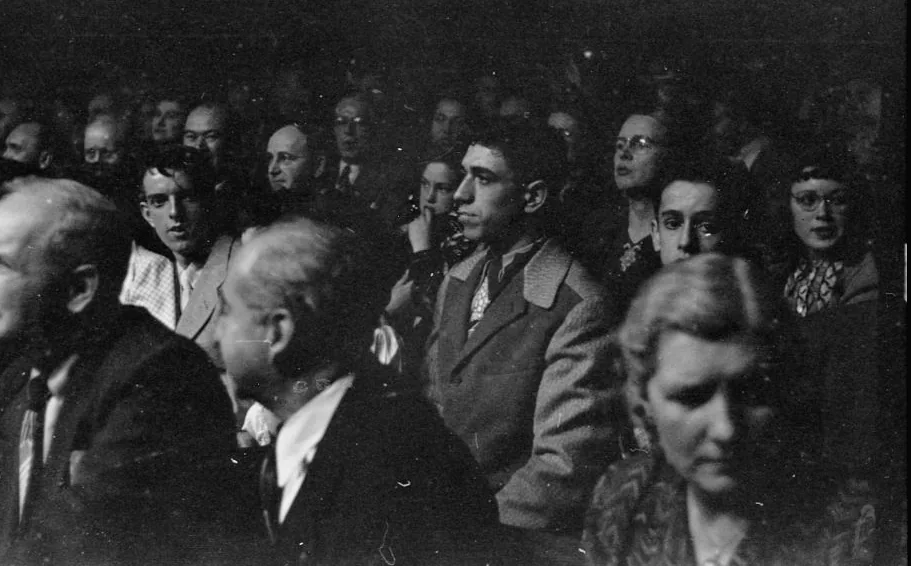
Fans at a Gorgeous George match, 1949. Library of Congress. Every heel on the card needed a crowd like this to work.
Were these wrestlers actually villains, or did wrestling companies teach audiences who the villains were supposed to be?
You will answer with evidence from the whole class timeline. Volkoff, Slaughter and Swagger already gave you a head start.
See a finished example
Fritz Von Erich: The Nazi Villain From Texas
A complete model presentation on a heel who is not on the card, with every rubric point marked.