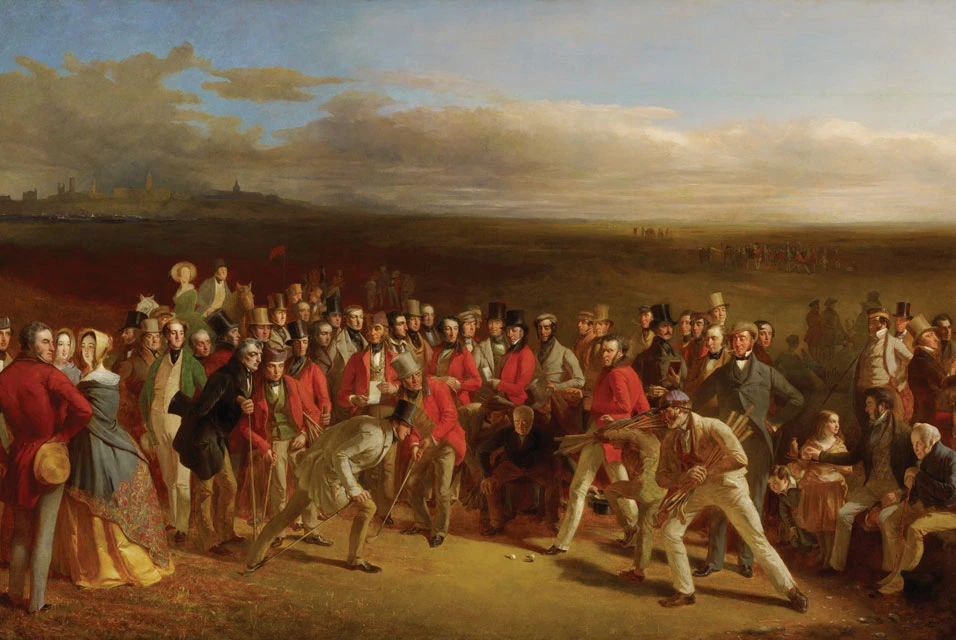
Charles Lees · The Golfers · 1847 · public-domain painting
Read this first · Mr. Grant’s 5th hour
You have the whole lesson here.
You do not need to know golf. You do need to read carefully, test ideas, and explain what you found. This is a test-grade investigation, so a few copied facts will not finish it.
What you are investigating
Which barrier most shaped who could participate in golf: money and time, discriminatory rules, or control of land and institutions? Follow how those barriers changed. At the end, defend one answer with your own evidence.
What you need
A Chromebook, this page, a pencil, and notebook paper. Work independently. No paid accounts, golf equipment, video subscriptions, or outside research are required. Use your school’s read-aloud tools if they help. All essential evidence is on this page. Keep answers within the space provided; clear, specific sentences are enough.
Your first four moves
Read the scorecard and session plan.
Go to Save / recover, enter your PIN, and check your name.
Recover your existing card. Create a card only if this is your first session.
Begin Hole 1, or return to your saved stopping point. Read a chapter, write its numbered note, and complete any lab beneath it before moving on.
How a round works
A stroke is one attempt to hit the ball. Players aim to finish each hole in fewer strokes. Par is the number of strokes a skilled player is expected to need for a hole. A birdie is one below par, a bogey one above. Golfers use different clubs for distance and control. A caddie helps carry equipment and may advise the player. In this assignment, “holes” are chapters, not a game you have to win.
Words that help with every chapter
Access / participation
The chance to take part / actually taking part. Permission alone may not provide the money, time, or place needed.
Barrier
Something that blocks or makes participation harder.
Institution
An organization with established rules and authority, such as a club or sports association.
Claim / evidence / reasoning
What you argue / a specific fact or observation / your explanation of how it supports the claim.
Infer / observe
Infer: reach a conclusion from evidence. Observe: describe what is directly visible or stated.
Tradeoff
Giving up some of one benefit to gain another.
Counterargument / limitation
A reasonable challenge to your argument / something your evidence cannot establish.
Era
A period of history. Earlier Scottish golf, early American championships, and post-1950 professional golf are examples of different eras.
Your 100-point scorecard
18 evidence notes · N01–N18
36
4 labs · two runs + explanation each
24
2 image investigations
10
2 source corrections
10
Draft + revised final argument
15
Handwritten verification slip
5
The score is for historical reasoning. More clicks do not earn more points. Short answers can earn full credit when the evidence and explanation are specific. The counter below tracks started responses, not your grade.
These are planning estimates, not a timer or a speed grade. Continue at home or next class if assigned. If class ends early in your work, record your stopping point below and save. Do not rush eighteen chapters into one period.
Working independently and using help
Write your own answers. Do not use a chatbot or another person to produce them. Built-in read-aloud, translation, spelling support, and required accommodations are allowed. If you use a support tool, record what it helped you do. You will explain your own lab results and a source on a short handwritten slip. If a response does not match your recorded work, Mr. Grant may ask you to explain or redo that part.
There are no hidden trick instructions and no automatic AI score. Your visible evidence matters. Keep a draft when you change your mind, and be honest about help.
Start here · come back here before leaving
Pick up where you left off.
At the start of every session, enter your six-digit hall pass PIN, even if your name is already showing. The same PIN on the same lesson restores your answers and recorded investigations on another Chromebook or at home. Check your name and class. Choose 5th hour if the system asks which class this is for.
If your PIN or connection is not working
Tell the substitute privately. Do not announce or write down your PIN. You can read and write notes in this tab while waiting, then download a backup. Wait for a card or ask for a paper card before doing the labs. When access returns, download your current work before recovering an account copy if you need to keep both. If home access is blocked, bring the backup file to school and use Recover a downloaded backup.
Saving: text saves in this tab as you type. After signing in, account saves happen after about 15 seconds without edits, or about every 30 seconds during continuous typing, when the connection and service are available. Before closing the tab, press Save now and wait for an account-save confirmation. “Saved in this tab” by itself does not mean the account has your newest work.
If an older school tab differs from work you did at home, PIN recovery asks before replacing it. Download a backup first if you need both versions. Avoid editing the same assignment on two devices at once. If the connection fails, keep the tab open and use Download backup. Save confirmation matters more than a spinning button. A private-window session or cleared browser storage can remove the tab copy; your confirmed account copy is what lets you continue elsewhere.
Sign in first. If you already began, wait for your saved card to return. A new card is only for a new investigation.
Your evidence notebook is ready.
01
1457 · Scotland
The government wanted them practicing archery.
A law banning a game proves people already knew it. It does not tell us who invented it.
Imagine getting in trouble because you spent the afternoon playing a sport instead of preparing for war. In 1457, the Scottish Parliament banned golf and football. Authorities wanted men practicing archery. Archery means using a bow and arrows. The king wanted men ready for military service. An afternoon spent chasing a ball looked like a problem for national defense.
This is an early written record of golf in Scotland. Read that carefully. A written record is evidence that a game existed by a particular date. It is not a birth certificate. The law does not identify an inventor, announce the first round, or explain every rule. If a government tells people to stop doing something, those people were probably doing it already.
Other societies had games involving sticks and balls. Historians connect the development of modern golf especially to Scotland, where the club-and-ball game played toward holes became deeply established. That is a more careful claim than pretending one person woke up one morning and invented every part of golf. Games usually develop as people borrow ideas, change equipment, argue over rules, and teach the next group.
A ban also tells us about power. Officials were deciding how people should spend their time. Players had their own reasons to enjoy a game. That conflict appears throughout sports history: the activity people want to do may not be the activity a government, employer, or school wants them doing. Your job is to notice the conflict without inventing a scene we cannot document.
Documentary evidence: a surviving written or recorded source. Earliest surviving record does not automatically mean first occurrence.
Evidence notebook · 2 pointsWhat a complete note needs
Answer the exact question. Use a named event, date, visual detail, or chapter fact. Explain the relationship in your own words. Usually 2–4 sentences are enough; brief labeled entries work for a sequence. N means evidence note, so N07 is the note for Hole 7. A source ID such as S07 identifies the source link beneath that chapter. For a citation, write “Hole 7 / S07.” No outside citation format is required. A fact with no explanation is unfinished.
02
1552 onward · The links
The ground helped write the game.
A sport grows differently when its playing surface is coastal land rather than a court with fixed measurements.
A basketball court has measured lines. Early golf had coastal land. The word links refers to sandy coastal ground. Wind, uneven surfaces, natural hollows, and drainage helped shape the shots people played. A ball could bounce, roll, or disappear into trouble. Golfers had to read the place rather than expect every playing field to behave the same way.
A 1552 charter reserved the use of the St Andrews links for activities including golf. This matters because a course begins with a question about land: who can use it? The famous Scottish links were not simply identical versions of the modern American private country club. Public use and local custom belong in this history too. You should be suspicious whenever someone treats every course in every century as the same institution.
Look at Charles Lees's painting, The Golfers, completed in 1847. It is a historical painting, not a photograph of 1552. It offers evidence about how a later artist represented golf and its spectators. In the lower center, a player bends over a ball. A closely packed crowd in coats and hats surrounds the players, while open land stretches toward the horizon. Clothing, posture, and placement can support observations. They cannot reveal every person's income, beliefs, or membership status.
Land also makes a sport expensive in ways a television broadcast can hide. Someone has to obtain space, prepare it, and keep it usable. A course may be public, private, or part of a resort. Those arrangements affect fees and access. A fairway is the closely cut route toward a hole. When you see one on television, remember that the view is also a managed place with workers, rules, and a bill.
Links: sandy coastal land associated with early Scottish golf. A charter is an official grant of rights.
The Golfers, Charles Lees, 1847. A painting representing a golf match, not a photograph of the 1400s. Charles Lees / National Galleries of Scotland · Public domain / source. Image description: Lower center: a player bends over a ball. A close crowd in coats and hats surrounds the play. Beyond them, open land stretches toward the horizon. Resized and compressed; optional on-page color treatment changes presentation only.
Evidence notebook · 2 pointsWhat a complete note needs
Answer the exact question. Use a named event, date, visual detail, or chapter fact. Explain the relationship in your own words. Usually 2–4 sentences are enough; brief labeled entries work for a sequence. N means evidence note, so N07 is the note for Hole 7. A source ID such as S07 identifies the source link beneath that chapter. For a citation, write “Hole 7 / S07.” No outside citation format is required. A fact with no explanation is unfinished.
03
1744–1800s · Making common rules
Eighteen holes was a choice.
Rules and standards develop through decisions. They are not natural laws.
Try playing a sport against a group that has different rules. One side says a particular move is legal. The other side says it is cheating. Before anyone can decide who won, somebody has to settle what game they are playing. Golf clubs faced versions of this problem as organized competition grew.
In 1744, Edinburgh golfers drew up thirteen articles for a competition on Leith Links. These are the earliest known written rules of golf. A surviving rule sheet can show what organizers thought needed explaining. It cannot prove that nobody had used spoken rules before. People do not need a printed handbook to disagree about whether a shot should count.
The familiar eighteen-hole round also took time to develop. In 1764, golfers at St Andrews reduced a round from twenty-two holes to eighteen by combining some short holes. Other courses still had different layouts. Eighteen became an increasingly influential standard as golf expanded. The change was a process, rather than a worldwide command obeyed on the same afternoon.
Standardization means agreeing on common measures or procedures. It helps compare performances and organize events. It also raises a power question: whose local practice becomes the standard everybody else is expected to follow? A club with prestige can influence decisions far beyond its own property. When people say a sport has always done something a certain way, ask when that practice started and who made it stick. That question is useful well beyond golf.
Standardization: adopting common rules or measures. An institution is an organization with established procedures and authority.
Evidence notebook · 2 pointsWhat a complete note needs
Answer the exact question. Use a named event, date, visual detail, or chapter fact. Explain the relationship in your own words. Usually 2–4 sentences are enough; brief labeled entries work for a sequence. N means evidence note, so N07 is the note for Hole 7. A source ID such as S07 identifies the source link beneath that chapter. For a citation, write “Hole 7 / S07.” No outside citation format is required. A fact with no explanation is unfinished.
04
1800s · Equipment and cost
A better ball changes more than a score.
Technology can change the cost of entry, the work of making equipment, and the land a sport needs.
A golf ball seems like a small part of the story until you have to buy another one. Older feather-filled balls, often called featheries, required skilled work by hand. A leather cover held tightly packed feathers. Later, molded gutta-percha balls offered a different manufacturing process. Gutta-percha came from a tree product. A change in material could affect durability, production, and price.
The rubber-wound Haskell ball developed near the end of the nineteenth century brought another change. Equipment that travels differently can make old distances feel different. A player gains possibilities, while a course designer has to consider where shots now land. The history of golf technology includes a recurring argument about whether equipment helps people enjoy the game or changes the challenge too much.
Do not turn this into a simple story where invention automatically makes a sport fair. A cheaper ball does not give someone free time, provide transportation, or remove a discriminatory entry rule. Discriminatory means treating a group unfairly, such as excluding players because of race. Equipment is one barrier among several. A person may afford the ball and still be unable to reach the course.
The laboratory below isolates one part of that problem. Its prices are classroom units, not historical currency or reconstructed shop records. You will compare how a fixed budget behaves when the ball changes. That lets you test an economic relationship without pretending our made-up numbers are archival facts. Afterward, explain what the model leaves out. A useful model helps you think and gives you reasons to question its limits.
Manufacturing: producing goods. A model simplifies reality to test a relationship; its numbers are not automatically historical data.
Evidence notebook · 2 pointsWhat a complete note needs
Answer the exact question. Use a named event, date, visual detail, or chapter fact. Explain the relationship in your own words. Usually 2–4 sentences are enough; brief labeled entries work for a sequence. N means evidence note, so N07 is the note for Hole 7. A source ID such as S07 identifies the source link beneath that chapter. For a citation, write “Hole 7 / S07.” No outside citation format is required. A fact with no explanation is unfinished.
Field lab 01 · 6 points
The ball-maker’s budget
Change one variable; follow what happens to access.
Your card supplies a budget of classroom units. Each practice visit costs 4 units. A featherie costs 12, a guttie costs 3, and a rubber-wound ball costs 5. In this simplified model, you replace the selected number of balls per visit. Cost per visit = 4 + ball price × replacements. Divide your card budget by that cost, then round down to a whole number of visits. Leftover = budget − visits × cost per visit. You may use a calculator.
Before running: write your prediction in the L01 response box below before clicking Record this run. Then record Run 1. Change the ball type while keeping replacements fixed and record Run 2. Compare the visits and leftover budget. These prices and replacement assumptions are invented. They demonstrate a relationship; they do not reconstruct a historical household.
Classroom model. The generated card and saved records make this your investigation. Write your prediction in the response box first. Two useful runs with a meaningful change or comparison, plus an explanation, are required. Clicking twice with identical settings does not create a comparison. You may add to your prediction afterward, but keep the original idea visible. You may explore up to eight recorded runs.
Create or recover your assignment card above to start this lab.
Current settings saved with your work
Paper fallback: if a PIN or connection problem prevents a card, ask the substitute for a paper card. Use your card’s numbers and the formula above to calculate two runs by hand. Label both runs and show your arithmetic.
05
1860 · Prestwick
The champion also had a job.
Early professionals often earned their living through several kinds of golf work.
Old Tom Morris was a golfer and a keeper of the greens. That combination matters. Professional golf grew alongside work such as maintaining a course, making equipment, teaching, and caddying. A person could know the game because working around it was how he paid his bills. The division between athlete and worker was not as tidy as a modern endorsement commercial might suggest.
The first Open Championship took place at Prestwick in 1860. Its eight competitors played three rounds of a twelve-hole course in one day. Willie Park Sr. won. Morris finished second. That format is a useful reminder that a major championship did not always mean the enormous four-day event you might picture now. Institutions that look permanent often began on a small scale.
Morris later won four Opens. His son, Young Tom Morris, won the championship as a teenager and became another famous player. Their story connects family knowledge, practice, work, and public reputation. Talent mattered, but the environment in which someone learned also mattered. Being around experienced people and playable ground creates opportunities that a beginner elsewhere may not have.
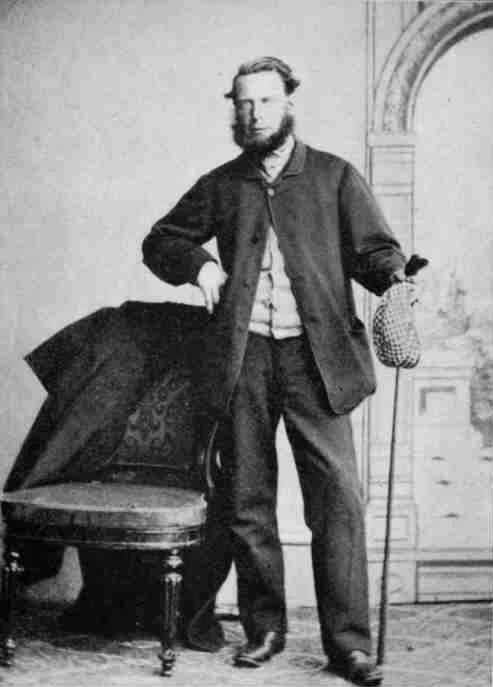
Look at the surviving portrait of Old Tom. Use it to attach a real face to the name. Do not assume that a portrait captures every part of his life. When a famous sports story names only the winner, it can hide the people who built the playing surface, maintained the equipment, and taught the skills. This chapter puts some of that work back into view. Later, you will return to the same issue with caddies and course crews.
Professional: someone paid for work in a field. In golf, teaching and club work also belong to the professional story.
Old Tom Morris, circa 1860. University of St Andrews Library Photographic Archive · Public domain / source. Resized and compressed; optional on-page color treatment changes presentation only.
Evidence notebook · 2 pointsWhat a complete note needs
Answer the exact question. Use a named event, date, visual detail, or chapter fact. Explain the relationship in your own words. Usually 2–4 sentences are enough; brief labeled entries work for a sequence. N means evidence note, so N07 is the note for Hole 7. A source ID such as S07 identifies the source link beneath that chapter. For a citation, write “Hole 7 / S07.” No outside citation format is required. A fact with no explanation is unfinished.
06
1800s–1894 · Across borders
A traveling game brings institutions with it.
Golf spread through people, travel, clubs, and governing organizations. Its expansion was uneven.
Golf did not cross oceans by itself. Travelers and migrants carried skills, equipment, and expectations with them. Clubs connected people who had the money, time, or employment to take part. The spread of the game followed connections between places, including those created by Britain's international influence. That does not mean every new golfer had the same background or every country copied Scotland exactly.
In the United States, several clubs became important organizers of competition. The United States Golf Association was founded in 1894. A governing organization could help establish championships and common procedures. Its existence did not make every private club a branch office. Distinguishing organizations is essential: a national championship, a professional association, a touring circuit, and a particular club are different things.
A governing organization helps make or enforce rules. A club is an organization based around a particular place or membership. The word open can be especially confusing. A championship described as open may admit both professionals and amateurs who meet its requirements. It does not mean any person can wander onto the course whenever they want. A club might host an open competition while limiting ordinary membership. A player might be eligible for one event and excluded from another institution.
Integrated means people from groups once kept apart can take part together. This is why the question “Was golf integrated?” needs more detail. Ask which event, which club, which membership rule, and which year. The next chapter follows a Black golfer and a Shinnecock golfer into the 1896 U.S. Open. Their participation is important evidence. It is also evidence about a specific championship, rather than proof that every part of American golf offered equal access. Keep that distinction in your notes.
Amateur: a competitor who plays under amateur-status rules. Eligibility means meeting the conditions required to enter.
Evidence notebook · 2 pointsWhat a complete note needs
Answer the exact question. Use a named event, date, visual detail, or chapter fact. Explain the relationship in your own words. Usually 2–4 sentences are enough; brief labeled entries work for a sequence. N means evidence note, so N07 is the note for Hole 7. A source ID such as S07 identifies the source link beneath that chapter. For a citation, write “Hole 7 / S07.” No outside citation format is required. A fact with no explanation is unfinished.
07
1896 · Shinnecock Hills
John Shippen belonged on that tee.
An individual breakthrough can challenge exclusion while leaving larger barriers in place.
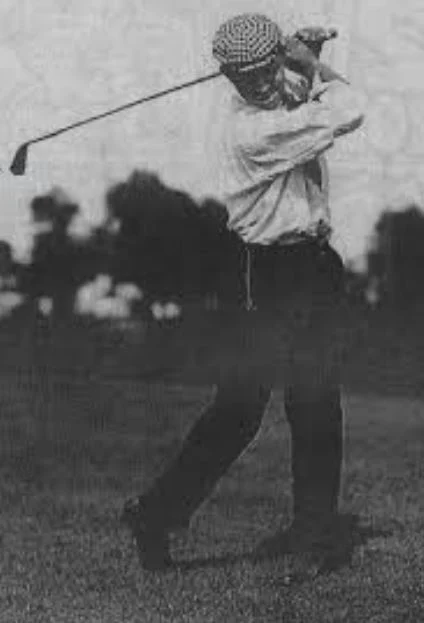
John Shippen learned golf while working at Shinnecock Hills. In 1896, he entered the U.S. Open there. He became the first African American to compete in the championship. Oscar Bunn, a member of the Shinnecock Nation, also played. These were skilled people entering a competition, rather than symbols waiting for someone else to put them in a history book.
Some professionals objected to competing alongside Shippen and Bunn and threatened not to play. USGA president Theodore Havemeyer said the championship would proceed even if those objecting players withdrew. The tournament went ahead with Shippen and Bunn in the field. The choice shows that an official could uphold their participation instead of accepting the threatened boycott.
The course's name also points to a history beyond the tournament. The Shinnecock people were connected to the land and to the labor involved in the course. A sports venue can be a place of achievement and a place where questions about land, work, and power remain. A leaderboard alone will not answer those questions.
When you write about Shippen, avoid saying that golf's racial barriers ended in 1896. Later chapters would make no sense if they had. His entry shows that a barrier could be challenged in one setting. It does not demonstrate that Black golfers had equal access to clubs, instruction, housing during travel, or professional opportunities everywhere. A strong historical explanation can recognize his achievement and identify what remained unresolved. Those two claims can be supported at the same time.
Boycott: refusing to take part as a form of pressure. A breakthrough changes a particular situation; its reach must be investigated.
John Shippen, circa 1899. This later photograph is not a view of the 1896 U.S. Open. Photographer unrecorded · Public domain / source. Resized and compressed; optional on-page color treatment changes presentation only.
Evidence notebook · 2 pointsWhat a complete note needs
Answer the exact question. Use a named event, date, visual detail, or chapter fact. Explain the relationship in your own words. Usually 2–4 sentences are enough; brief labeled entries work for a sequence. N means evidence note, so N07 is the note for Hole 7. A source ID such as S07 identifies the source link beneath that chapter. For a citation, write “Hole 7 / S07.” No outside citation format is required. A fact with no explanation is unfinished.
08
1899 · An inventor’s record
Read the patent, then check the story.
An invention document supports specific claims. Popular stories often stretch those claims.
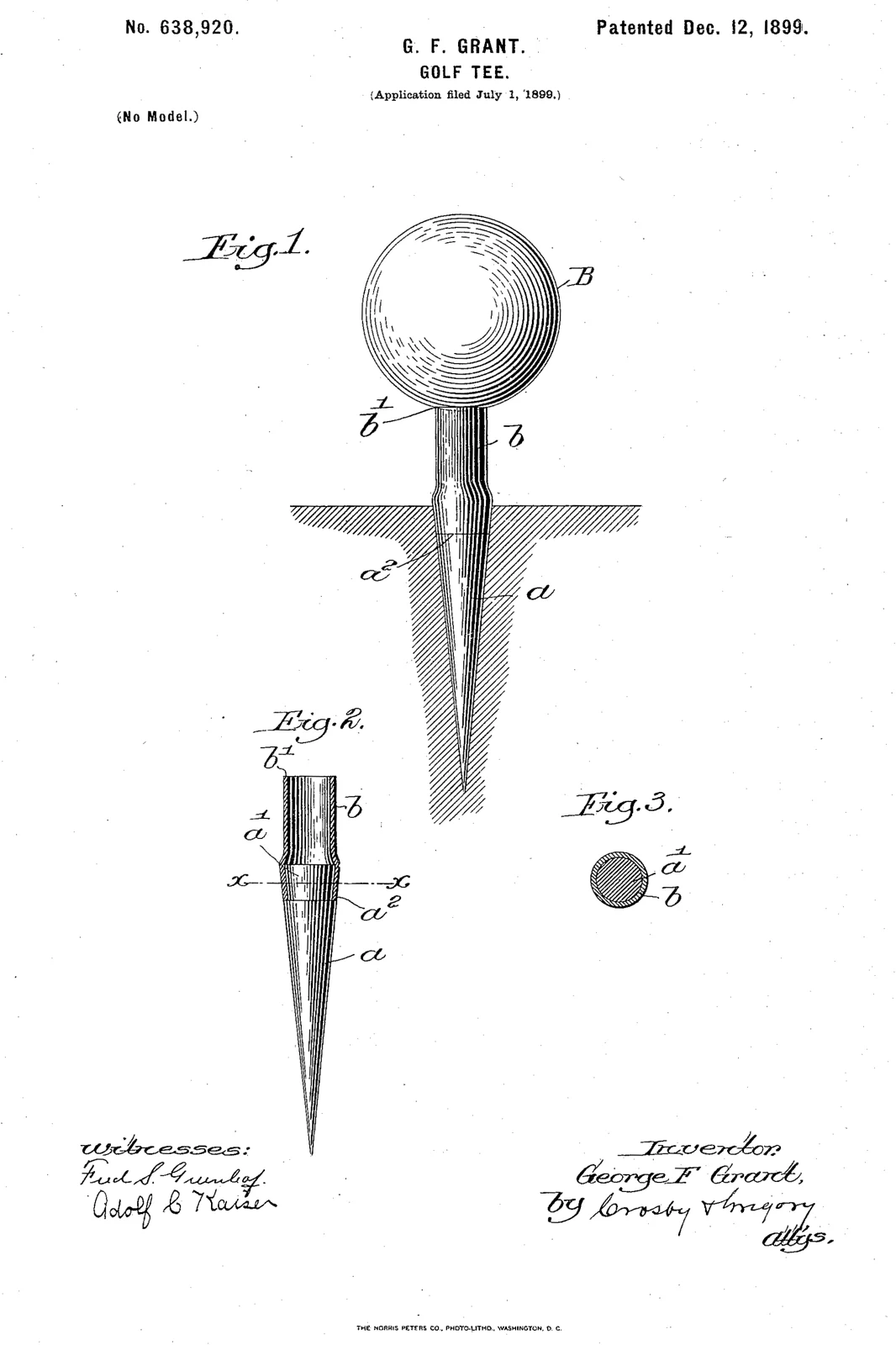
Before a small peg became familiar golf equipment, players often made a little mound of sand to support a ball at the start of a hole. Boston dentist George Franklin Grant patented an improved golf tee in 1899. His design used a wooden support with a flexible top. It is a practical invention aimed at a small, repeated problem.
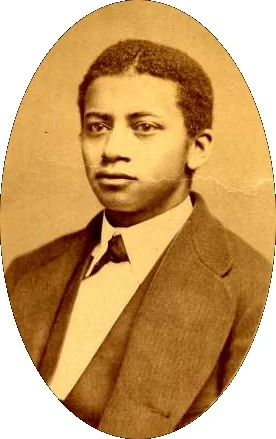
Grant was a Black dentist and a member of Harvard's faculty. His place in golf history makes a useful correction to a narrow picture of who contributed to the sport. Players, inventors, teachers, and workers all shaped the game. Fame on a leaderboard is only one way to matter.
The patent drawing below is a primary source. It shows what Grant submitted as a design. You can inspect the parts, labels, and shape. The document does not, by itself, prove how many people bought the tee, how widely it was used, or that no earlier tee design existed. A patent for an improvement is not the same claim as inventing every version of an object.
Grant did not turn his design into a widely marketed product. That makes his case useful for separating invention from commercial success. An idea can be important without immediately becoming the familiar item in every shop. Distribution, manufacturing, promotion, timing, and investment influence which version spreads. When you hear that a person “invented the modern world” with one object, slow down and identify exactly what their evidence supports. Here, you have the drawing in front of you. Start there.
Patent: a legal grant concerning an invention. Primary source: evidence created during the events or processes being studied.
George Franklin Grant, 1870. A portrait from before his 1899 patent. Historical portrait / photographer unrecorded · Public domain / source. Resized and compressed; optional on-page color treatment changes presentation only.
George Franklin Grant’s golf-tee patent drawing, U.S. patent 638,920, issued December 12, 1899. George F. Grant / U.S. Patent Office · Public domain / source. Image description: The large central drawing shows a ball above a narrow support and a pointed base extending below the ground line. Two smaller views show parts of the support. The heading names G. F. Grant and dates the patent December 12, 1899. Resized and compressed; optional on-page color treatment changes presentation only.
Evidence notebook · 2 pointsWhat a complete note needs
Answer the exact question. Use a named event, date, visual detail, or chapter fact. Explain the relationship in your own words. Usually 2–4 sentences are enough; brief labeled entries work for a sequence. N means evidence note, so N07 is the note for Hole 7. A source ID such as S07 identifies the source link beneath that chapter. For a citation, write “Hole 7 / S07.” No outside citation format is required. A fact with no explanation is unfinished.
09
1913 · Brookline
The former caddie beats the famous professionals.
Francis Ouimet’s victory challenged expectations about who could become a champion.
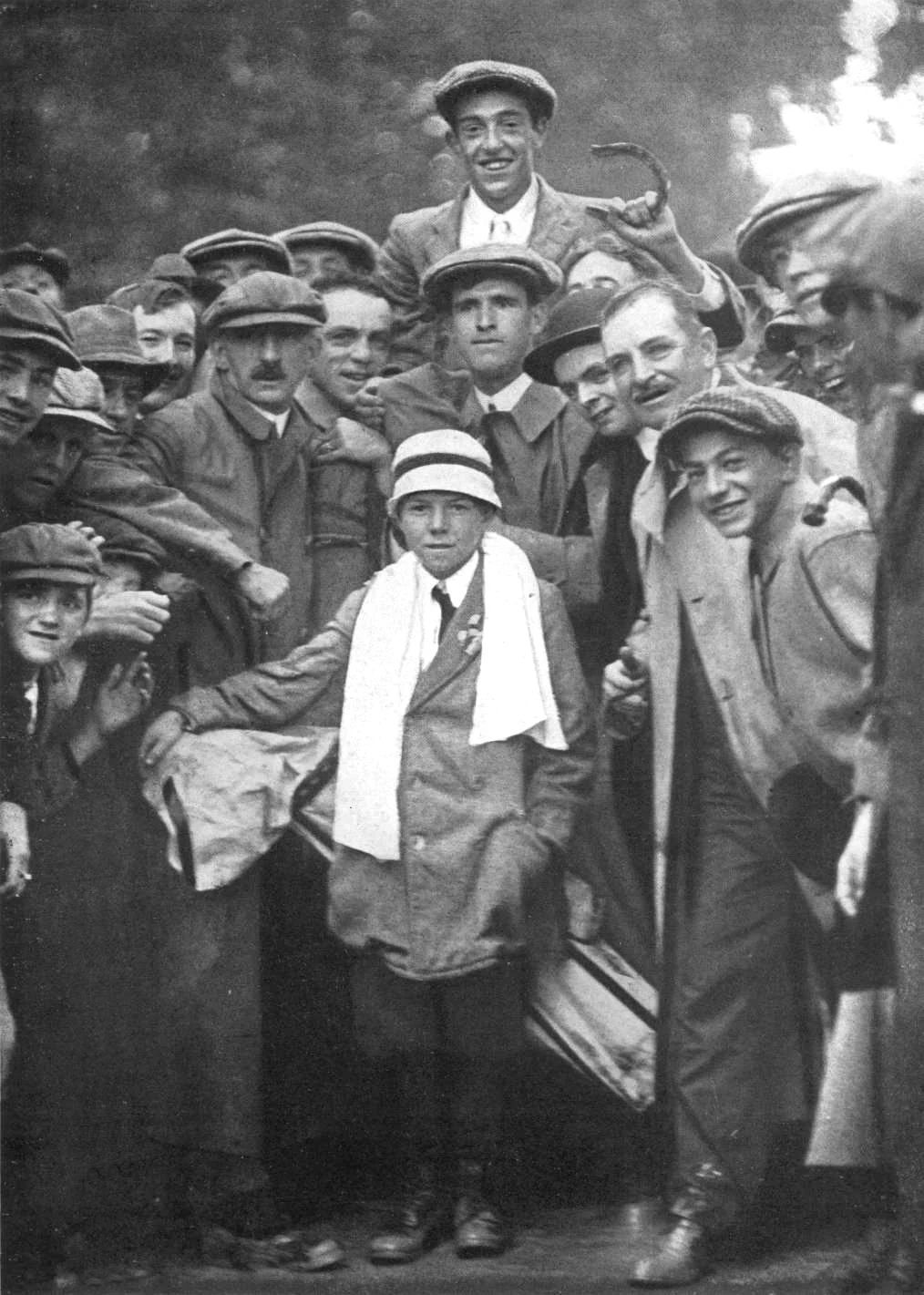
Francis Ouimet was a twenty-year-old amateur and former caddie when the 1913 U.S. Open came to The Country Club in Brookline, Massachusetts. He had grown up near the course. Knowledge gained around a workplace became part of the story of an athlete. His caddie during the championship was ten-year-old Eddie Lowery.
Ouimet finished tied with two established British professionals, Harry Vardon and Ted Ray, after the scheduled rounds, before any tiebreaker. He then beat them in an eighteen-hole playoff. It was a result that challenged the assumption that the famous experts would handle the young local amateur. The upset helped draw attention to golf in the United States.
In the photograph, Ouimet is raised above the crowd near the top center. Lowery stands in the lower center with a light-colored towel around his neck. The foreground is the part of a picture closest to the viewer. Look carefully before you explain it. The picture supports claims about a public celebration and the people visibly present. It cannot prove that everybody in the country suddenly gained access to a course. A memorable win can change public interest more quickly than it changes wages, fees, or club rules.
Caddying also deserves attention as skilled work. A caddie carries equipment, but can also help read distances, conditions, and decisions. That knowledge does not guarantee a good shot. It improves the information available to a player. In the next lab, you will make a decision with incomplete information, inspect the model's result, and revise. You are not reenacting Ouimet's actual shots. You are examining the difference between a choice, an outcome, and the quality of the reasoning behind it.
Stroke play: counting total strokes, where the lower total wins. A playoff is an extra competition used to break a tie.
Francis Ouimet carried by spectators, September 1913. Caddie Eddie Lowery is in the foreground with a towel around his neck. Underwood & Underwood; published in Golf Illustrated & Outdoor America, April 1914 · Public domain in the U.S. / source. Image description: Near the top center, Ouimet is raised above a dense crowd. Lowery stands in the lower center with a light-colored towel around his neck. Spectators around him wear varied hats. Resized and compressed; optional on-page color treatment changes presentation only.
Evidence notebook · 2 pointsWhat a complete note needs
Answer the exact question. Use a named event, date, visual detail, or chapter fact. Explain the relationship in your own words. Usually 2–4 sentences are enough; brief labeled entries work for a sequence. N means evidence note, so N07 is the note for Hole 7. A source ID such as S07 identifies the source link beneath that chapter. For a citation, write “Hole 7 / S07.” No outside citation format is required. A fact with no explanation is unfinished.
Field lab 02 · 6 points
The caddie’s decision
A choice can be reasonable even when one outcome goes wrong.
This is a decision model, not a reconstruction of Ouimet’s playoff. You face a choice between laying up and carrying a hazard. Your card sets the chance of a successful carry. Laying up means choosing a shorter, safer shot. Carrying means hitting over a hazard, an obstacle such as water. Laying up gives a 70% chance of 5 strokes and a 30% chance of 6. Carrying gives your card’s success chance of 4 strokes and otherwise 7. Expected strokes means the long-run average if you faced this situation many times. Lower is better. Calculate it by multiplying each possible score by its chance, then adding: the lay-up average is (5 × 0.70) + (6 × 0.30) = 5.30. A 70% chance becomes 0.70 in the calculation. A single round cannot actually end with 5.30 strokes.
Before running: write your prediction in the L02 response box before recording any runs. Record both choices, then increase the practice setting and test again if helpful. Each practice step adds 10 percentage points to carry success, up to 95%. For example, 60% becomes 70%, not 66%. The lay-up average stays the same. A weighted average gives more influence to the more likely result. The displayed number is this calculated average, not a random shot or an actual round. Explain why expected performance and the outcome of one shot are different ideas.
Classroom model. The generated card and saved records make this your investigation. Write your prediction in the response box first. Two useful runs with a meaningful change or comparison, plus an explanation, are required. Clicking twice with identical settings does not create a comparison. You may add to your prediction afterward, but keep the original idea visible. You may explore up to eight recorded runs.
Create or recover your assignment card above to start this lab.
Current settings saved with your work
Paper fallback: if a PIN or connection problem prevents a card, ask the substitute for a paper card. Use your card’s numbers and the formula above to calculate two runs by hand. Label both runs and show your arithmetic.
Archive desk · 10 points
A photograph is evidence. It also has limits.
Complete both image investigations. Return to the full images in Holes 2 and 9. Switch off the color treatment if it helps. You may use the descriptions and captions as accessible evidence. Separate what you can observe from what you infer.
Image A · the 1913 celebration
Use the Ouimet photograph. Identify its event and date from the caption. Locate two details by position, such as foreground, center, or upper edge. Describe each, then explain what it suggests about public attention or caddie work. Finish with one claim about equal access that the image cannot prove.
Image B · the 1847 painting
Use Lees’s painting. Locate two visible details about spectators, clothing, or the setting. Explain how the artist presents golf. Compare this with Image A and state why a painting of a match is not direct evidence of the sport’s invention.
A useful sentence pattern: “In the ___, I can see ___. This suggests ___ because ___. It does not prove ___.” Do not invent the names, thoughts, or income of unidentified people.
10
1930 · Amateur celebrity
Playing without prize money still takes resources.
Amateur status and economic access are different questions.
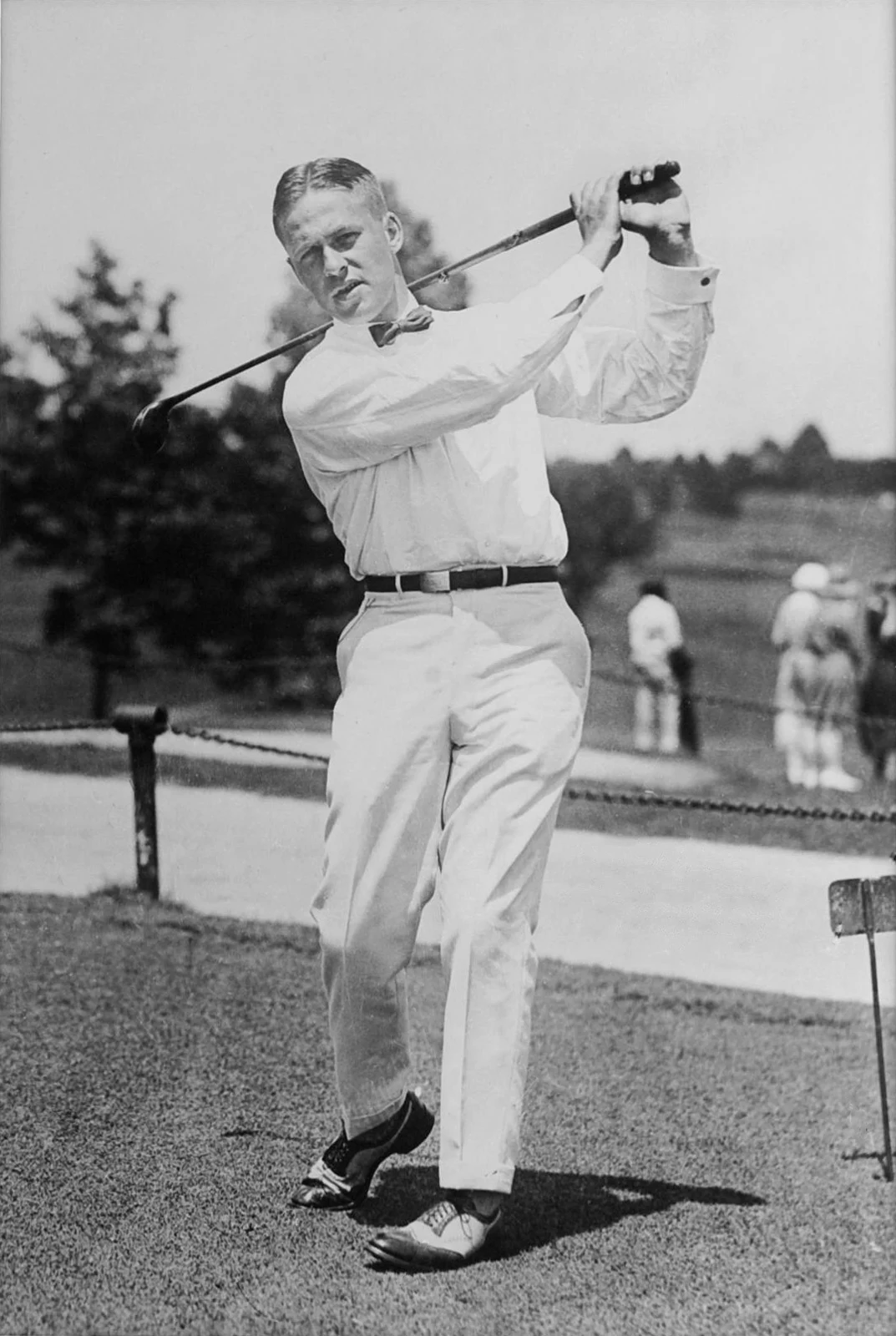
Bobby Jones completed a remarkable set of victories in 1930: the British Amateur, the Open Championship, the U.S. Open, and the U.S. Amateur. This became known as his Grand Slam. Do not substitute today's four men's professional majors into the sentence. The Masters did not yet exist. A label can stay familiar while its historical meaning changes.
Jones remained an amateur. That did not make him an ordinary weekend player with no advantages. Amateur status describes a set of competition rules. It does not tell you whether someone can afford equipment, travel, instruction, or time away from work. A person could avoid accepting a tournament prize and still need substantial resources to compete.
The distinction raises a wider sports-history question. When a sport honors athletes for not being paid, which people can afford to meet that ideal? Someone who must earn wages every day has a different problem from someone with financial support. This is an analysis of opportunity, rather than an accusation that every amateur was wealthy or that professionals lacked pride.
Jones's achievements deserve to be described accurately. They also belong inside a system that assigned status to different kinds of competitors. That is the BTS move: explain a sporting achievement and then examine the institutions around it. You are allowed to admire an athlete and still ask how the competition was organized. A complete answer should identify what the word amateur tells you, what it leaves out, and why that missing information could matter to a talented person trying to enter the sport.
Status: an officially recognized category. Economic access concerns the resources needed to participate, beyond permission alone.
Bobby Jones, circa 1921. An earlier photograph, not a photograph of the 1930 Grand Slam. Photographer unattributed / Heritage Auctions · Public domain / source. Resized and compressed; optional on-page color treatment changes presentation only.
Evidence notebook · 2 pointsWhat a complete note needs
Answer the exact question. Use a named event, date, visual detail, or chapter fact. Explain the relationship in your own words. Usually 2–4 sentences are enough; brief labeled entries work for a sequence. N means evidence note, so N07 is the note for Hole 7. A source ID such as S07 identifies the source link beneath that chapter. For a citation, write “Hole 7 / S07.” No outside citation format is required. A fact with no explanation is unfinished.
11
1950 · Building the LPGA
The players helped build their own tour.
Women’s professional golf required organizing work as well as strong performances.
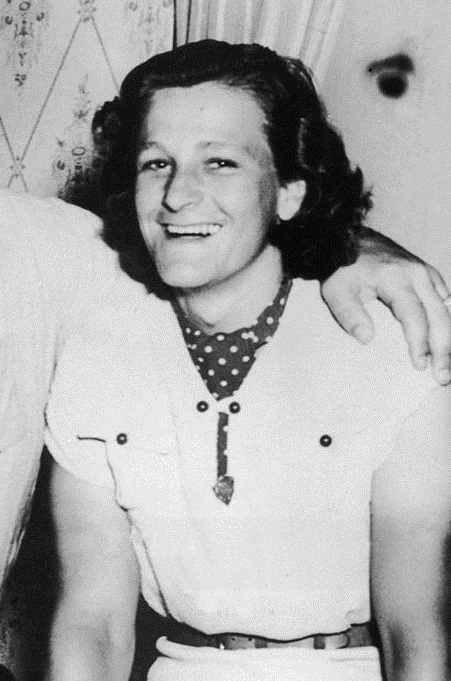
Women played golf long before television made professional stars familiar. The founding of the Ladies Professional Golf Association in 1950 was not the beginning of women swinging clubs. It was a major step in organizing a professional tour. Thirteen founders, including Babe Didrikson Zaharias, Patty Berg, and Louise Suggs, helped create it.
Zaharias had already excelled in other sports before becoming a leading golfer. Her career challenges the idea that there is only one kind of athletic talent or one route into a sport. It also makes clear that being outstanding does not create a schedule of paid events all by itself. Someone still has to organize competitions, attract audiences, and convince sponsors to provide money.
Early tour players took on promotional and administrative work. That work is easy to erase when a sports history focuses only on trophies. A professional tour needs a functioning business structure: places to play, people willing to host, publicity, and dependable arrangements. The founders were helping make the institution through which future players could earn a living.
Do not assume that the creation of a women's tour removed every inequality women faced. A separate opportunity can expand careers while differences in resources, coverage, and treatment continue. Your task is to explain a change without claiming it fixed everything. Compare the founders with the early men who combined golf work and competition. Both examples show that the sporting performance you see rests on additional labor. In this chapter, the players themselves were doing some of that institution-building labor.
Tour: a connected schedule of competitions. A sponsor supplies support, often in exchange for publicity or business benefits.
Babe Didrikson Zaharias, 1938. A portrait predating the LPGA’s founding. ACME press photograph · Public domain in the U.S. / source. Resized and compressed; optional on-page color treatment changes presentation only.
Evidence notebook · 2 pointsWhat a complete note needs
Answer the exact question. Use a named event, date, visual detail, or chapter fact. Explain the relationship in your own words. Usually 2–4 sentences are enough; brief labeled entries work for a sequence. N means evidence note, so N07 is the note for Hole 7. A source ID such as S07 identifies the source link beneath that chapter. For a citation, write “Hole 7 / S07.” No outside citation format is required. A fact with no explanation is unfinished.
12
1946–1960s · Fighting exclusion
Permission is only one part of access.
Rules, money, travel, treatment, and ownership can each create a separate barrier.
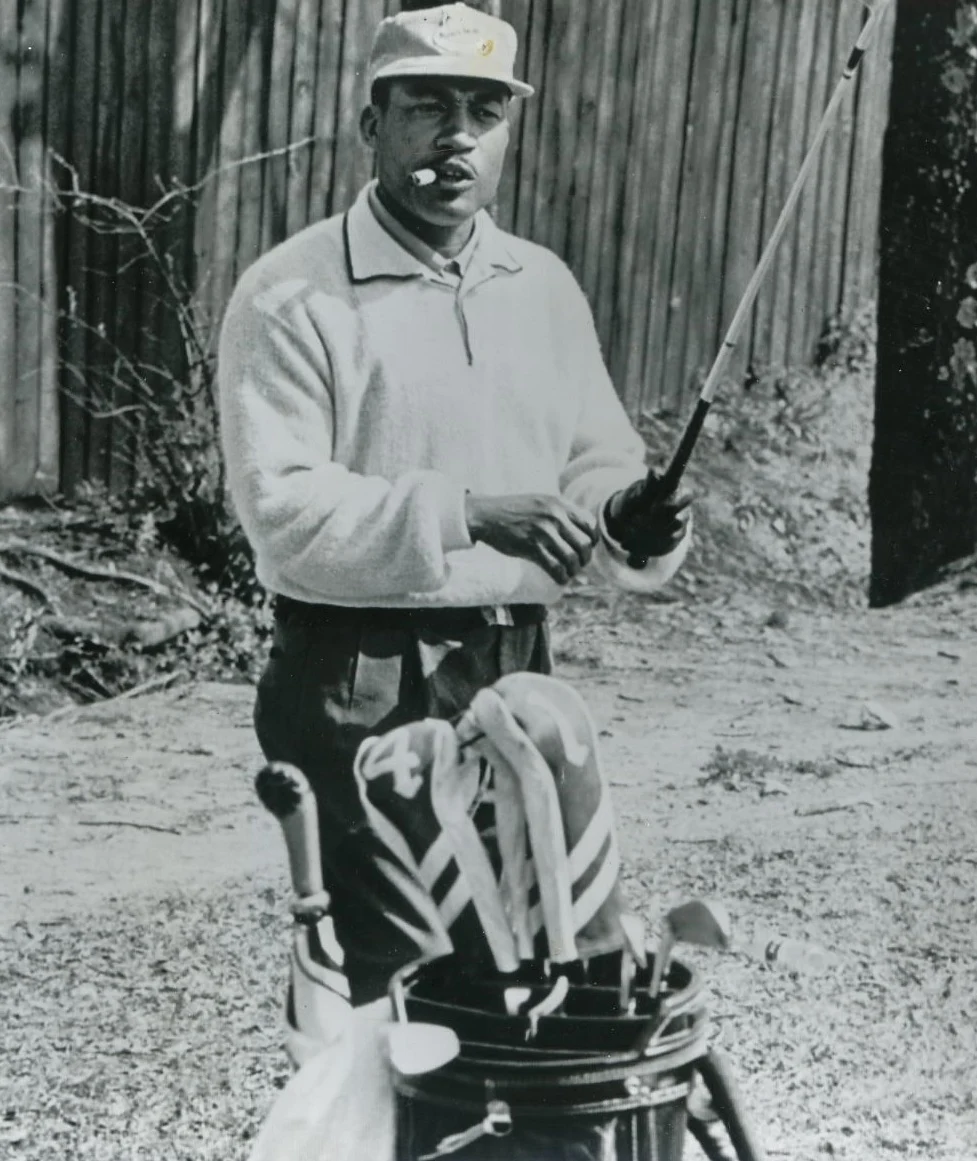
Charlie Sifford pursued a professional golf career while confronting racism in the sport. The PGA of America maintained a Caucasian-only membership clause until 1961. Caucasian was the rule’s term for white people. A clause is one part of a written rule or agreement. That rule made race a formal condition of membership. It was an institutional barrier, rather than a problem that an excluded player could solve simply by practicing harder.
Removing a written restriction mattered. It did not instantly determine who felt welcome at every course, who could book lodging while traveling, or who could afford the next tournament. A rule change can be necessary and still leave practical barriers behind. That is why a timeline of firsts needs explanation alongside the dates.
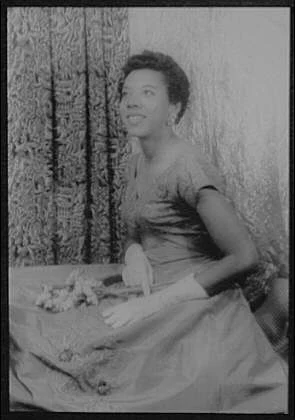
William Powell responded to exclusion by building Clearview Golf Club in Ohio, beginning in 1946. The course created a place where access could be organized differently. His daughter Renee Powell later competed on the LPGA Tour. Althea Gibson, already famous from tennis, became the first Black player on that tour. Their experiences show how the same person could face barriers related to both race and gender.
These stories involve different responses to barriers. Sifford challenged access to an established professional institution. Powell helped create another place to play. Neither response can be reduced to a generic lesson about wanting success badly enough. People made choices within unequal conditions. In the access lab, you will separate written eligibility from the money and time needed to take an opportunity. Keep the invented budget separate from the real people. We are modeling a relationship, not assigning fictional scores to their lives.
Formal barrier: a written restriction. Practical barrier: a condition such as cost or transportation that makes participation difficult.
Charlie Sifford, 1961. A period press photograph. Photographer unrecorded · Public domain in the U.S. / source. Resized and compressed; optional on-page color treatment changes presentation only.
Althea Gibson, 1958. A portrait before her professional golf career. Carl Van Vechten / Library of Congress · Public domain dedication / source. Resized and compressed; optional on-page color treatment changes presentation only.
Evidence notebook · 2 pointsWhat a complete note needs
Answer the exact question. Use a named event, date, visual detail, or chapter fact. Explain the relationship in your own words. Usually 2–4 sentences are enough; brief labeled entries work for a sequence. N means evidence note, so N07 is the note for Hole 7. A source ID such as S07 identifies the source link beneath that chapter. For a citation, write “Hole 7 / S07.” No outside citation format is required. A fact with no explanation is unfinished.
Field lab 03 · 6 points
The opportunity budget
Separate being eligible from being able to take part.
Use the weekly money and free hours printed on your card. Each round costs 18 units and 4 hours, plus the selected travel cost and 1 travel hour. Each lesson costs 12 units and 1 hour. Each free practice session uses 2 hours. Lessons and free practice have no extra travel cost or time in this simplified model. Money spent = 18 × rounds + travel cost × rounds + 12 × lessons − grant used. Hours used = 5 × rounds + lessons + 2 × practice sessions. Subtract each total from your card’s limit to find what remains.
Before running: write in the L03 response box which resource you predict will run out first: money or time. Create a possible week, record it, then change the schedule or apply a 10-unit travel grant and record a revision. Feasible means possible within the limits. Both balances must be zero or higher, and your week must include at least one round, lesson, or practice session. Choosing no activities keeps resources unused but does not provide access. The grant pays up to 10 units of this week’s actual round travel costs; unused grant money cannot buy lessons or create time. A grant changes costs; it cannot repeal a discriminatory rule. These are invented weekly budgets, not biographies of Sifford or Powell.
Classroom model. The generated card and saved records make this your investigation. Write your prediction in the response box first. Two useful runs with a meaningful change or comparison, plus an explanation, are required. Clicking twice with identical settings does not create a comparison. You may add to your prediction afterward, but keep the original idea visible. You may explore up to eight recorded runs.
Create or recover your assignment card above to start this lab.
Current settings saved with your work
Paper fallback: if a PIN or connection problem prevents a card, ask the substitute for a paper card. Use your card’s numbers and the formula above to calculate two runs by hand. Label both runs and show your arithmetic.
13
1950s–1980s · Television
A camera changes who sees the sport.
Media can increase attention and revenue without giving every viewer a place to play.
Arnold Palmer helped make golf a television attraction. Viewers could follow a recognizable personality and watch a round become a story with uncertainty. At the 1960 U.S. Open, Palmer came from seven strokes behind before the final round and shot 65 to win. You do not need to know every golf statistic to understand why a comeback works on television.
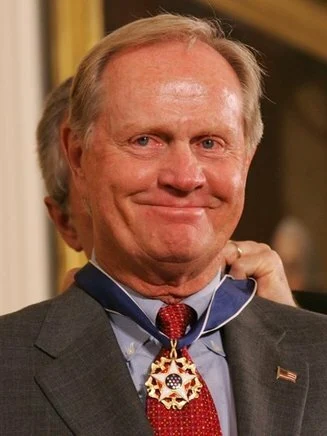
Jack Nicklaus became Palmer's major rival and won eighteen men's professional major championships across his career. Rivalries give viewers a reason to compare styles and return for another event. Producers can build a broadcast around recognizable people, shots that could change the result, and changing scores. That is part of how an individual sport becomes a recurring media product.
Attention has economic effects. Broadcasters want audiences. Sponsors want the people watching to recognize a name or product. Players and tournaments can gain financial support. At the same time, a television schedule shapes what viewers see. A camera usually follows the leaders, rather than the grounds crew, the player who missed qualification, or the person who cannot afford lessons.
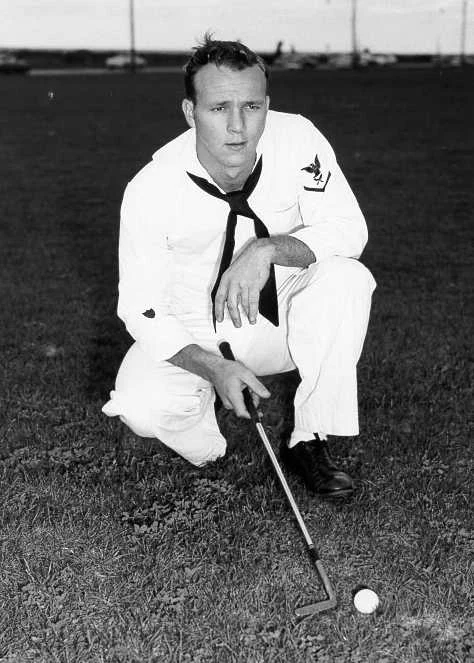
Be precise about cause and effect. Television helped popularize golf; it did not create every new golfer or remove every obstacle to playing. More people can watch a sport than can participate in it. That gap is central to the business of modern sports. As you look at Palmer's earlier Coast Guard photograph and Nicklaus's later award photograph, notice the dates. They are identity anchors from different times, not photographs of the 1960 comeback or of a head-to-head match.
Broadcast rights: permission to transmit an event. Media framing means selecting what to show and how to present it.
Arnold Palmer, April 20, 1953, while serving in the U.S. Coast Guard. U.S. Coast Guard · Public domain / U.S. government / source. Resized and compressed; optional on-page color treatment changes presentation only.
Jack Nicklaus at his Presidential Medal of Freedom ceremony, 2005. A later portrait. Paul Morse / White House · Public domain / U.S. government / source. Resized and compressed; optional on-page color treatment changes presentation only.
Evidence notebook · 2 pointsWhat a complete note needs
Answer the exact question. Use a named event, date, visual detail, or chapter fact. Explain the relationship in your own words. Usually 2–4 sentences are enough; brief labeled entries work for a sequence. N means evidence note, so N07 is the note for Hole 7. A source ID such as S07 identifies the source link beneath that chapter. For a citation, write “Hole 7 / S07.” No outside citation format is required. A fact with no explanation is unfinished.
14
1975–1997 · Augusta
One tournament has its own timeline.
Lee Elder’s entry and Tiger Woods’s win were different milestones in different years.
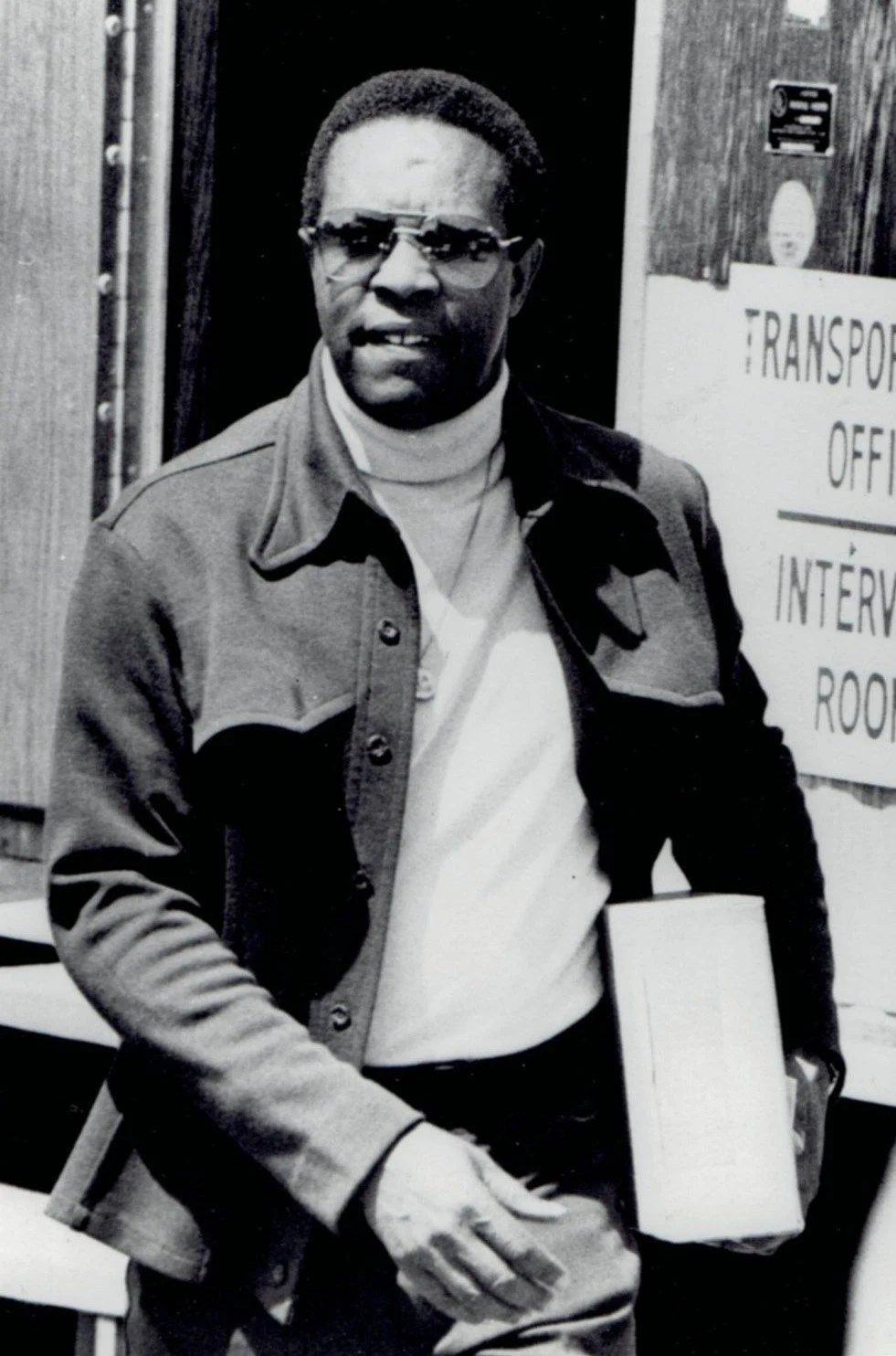
Lee Elder became the first Black golfer to compete in the Masters in 1975. Charlie Sifford's earlier professional breakthrough did not automatically produce an invitation to every tournament. The Masters is a particular championship with its own history and entry procedures. This is why you have been practicing the habit of naming the institution.
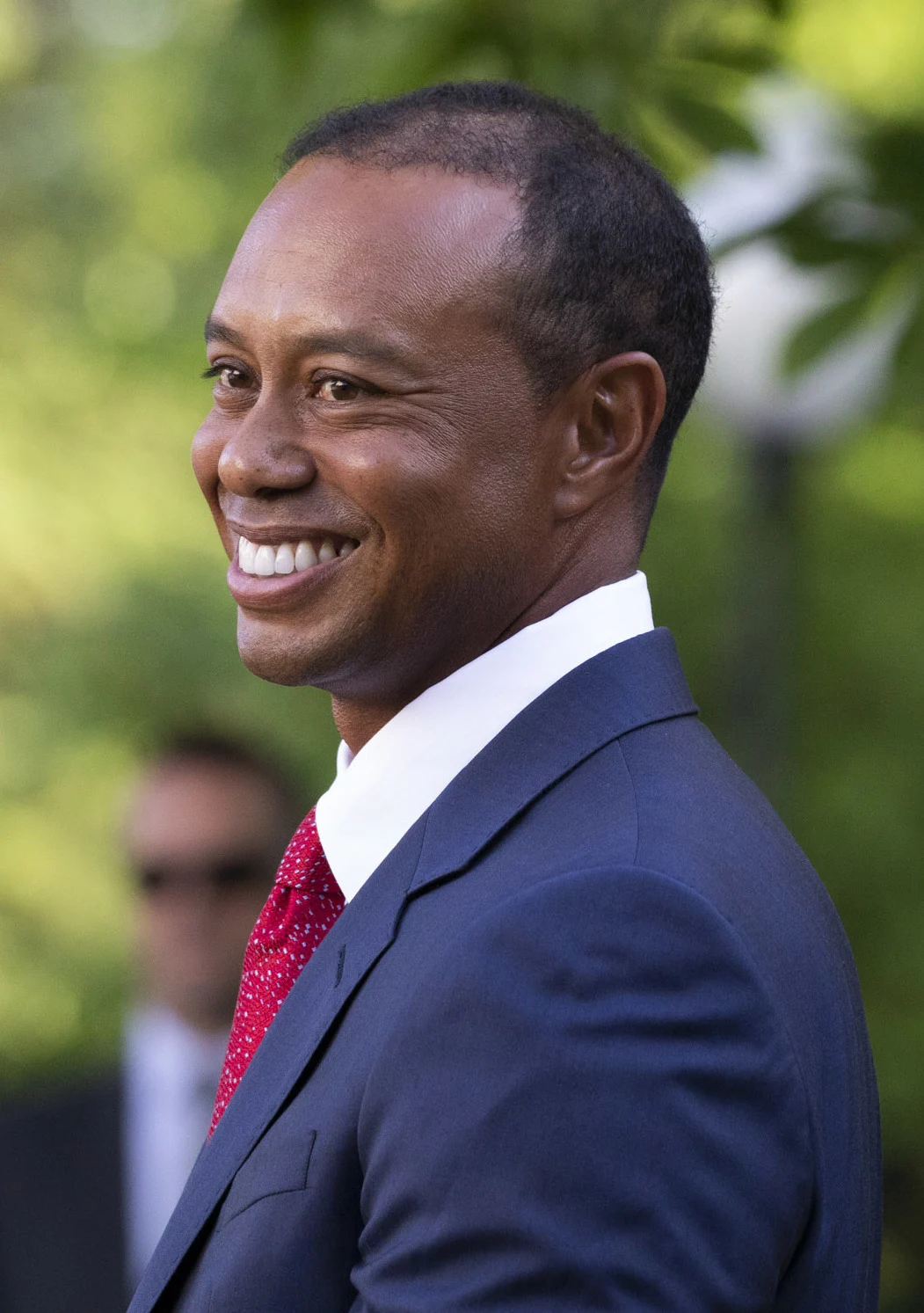
In 1997, twenty-one-year-old Tiger Woods won the Masters by twelve strokes. It was a dominant performance at a tournament whose racial history gave the victory wider significance. Woods's achievement became a major media event. A young champion could change who viewers pictured when they thought of a golfer.
Representation matters because people learn what seems possible partly through the people they see. Yet a famous champion cannot personally create affordable courses in every neighborhood. Seeing someone succeed and having the resources to follow the same path are related but different. A careful explanation recognizes the visibility of the achievement while continuing to investigate actual opportunities, such as money for lessons or a nearby place to play.
Do not write that Woods was the first Black person ever to play golf, the first to play the U.S. Open, or the first to enter the Masters. Those statements erase the people you have already studied. A stronger account explains how his accomplishment connected to earlier efforts without making his story identical to theirs. Put Shippen, Sifford, Elder, and Woods beside the correct institution or event. The dates will then help you explain change instead of becoming a list you memorize and forget.
Representation: who appears visibly within a field and how people are presented. Visibility alone does not measure equal participation.
Lee Elder, 1975. The source dates this press image July 7; it is not labeled as an image of his first Masters round. Associated Press / photographer unrecorded · Public domain in the U.S., published without notice / source. Resized and compressed; optional on-page color treatment changes presentation only.
Tiger Woods at the White House, May 6, 2019. A later portrait, not the 1997 Masters. Joyce N. Boghosian / White House · Public domain / U.S. government / source. Resized and compressed; optional on-page color treatment changes presentation only.
Evidence notebook · 2 pointsWhat a complete note needs
Answer the exact question. Use a named event, date, visual detail, or chapter fact. Explain the relationship in your own words. Usually 2–4 sentences are enough; brief labeled entries work for a sequence. N means evidence note, so N07 is the note for Hole 7. A source ID such as S07 identifies the source link beneath that chapter. For a citation, write “Hole 7 / S07.” No outside citation format is required. A fact with no explanation is unfinished.
15
1998–2016 · A global game
Se Ri Pak changes the picture.
International success grows through role models and the systems that help players follow them.
Se Ri Pak won the 1998 U.S. Women's Open at Blackwolf Run after a playoff against amateur Jenny Chuasiriporn. A Korean player winning a major American championship challenged a narrow picture of whose sport golf was. The victory became an important reference point for later Korean women golfers.
It is tempting to explain a country's later success with one heroic moment. That is incomplete. Inspiration can encourage a young person to begin, but improvement still requires practice space, coaching, equipment, family resources, and competition. A role model is part of a larger pathway. The pathway determines whether interest can become sustained participation.
Golf's international history also includes the Olympics. The sport appeared in 1900 and 1904, then returned in 2016 after a long absence. That gap tells you that a sport's place in a major institution can change. Something does not have to be continuously included in the Olympics to have a long history or a worldwide audience.
Use Pak's later photograph to recognize the person, not as visual proof of the exact 1998 playoff. Then compare her story with Woods's from the previous chapter. Both victories could change public expectations. Each also occurred within a different tour, national setting, and competition history. A useful comparison identifies a shared process, such as increased visibility, and a meaningful difference. Saying both athletes were inspiring is a starting thought. Explaining what changed, for whom, and through which institutions is the historical work.
Pathway: the connected opportunities through which someone develops. Internationalization means participation and institutions expanding across national borders.
Se Ri Pak at the LPGA Championship pro-am, June 9, 2009. A later photograph, not the 1998 playoff. Keith Allison · CC BY-SA 2.0 / source. Resized and compressed; optional on-page color treatment changes presentation only.
Evidence notebook · 2 pointsWhat a complete note needs
Answer the exact question. Use a named event, date, visual detail, or chapter fact. Explain the relationship in your own words. Usually 2–4 sentences are enough; brief labeled entries work for a sequence. N means evidence note, so N07 is the note for Hole 7. A source ID such as S07 identifies the source link beneath that chapter. For a citation, write “Hole 7 / S07.” No outside citation format is required. A fact with no explanation is unfinished.
16
Everyday golf · Public land and labor
The course keeps working after the cameras leave.
Everyday access depends on prices, location, public decisions, and paid work.
You have now met champions. Most golf happens without a championship trophy nearby. People learn at practice ranges, play shorter rounds, join school programs, or use public and municipal courses. Municipal means operated by a local government. Public access generally involves conditions such as an available time and a fee; it does not necessarily mean free.
A Michigan student also faces a calendar. Weather and daylight affect when outdoor play is possible. Transportation determines whether a course or practice area is realistically reachable. Work and family responsibilities affect free time. These are ordinary constraints, but they shape who gets repeated practice. A talent explanation that ignores them is missing part of the story.
A course depends on workers. Grounds crews manage turf and equipment. Staff schedule play, handle payments, teach, and maintain facilities. Caddies provide another form of work at some courses. A golfer sees a playing surface; the people operating it see ongoing tasks and costs. Those perspectives are connected even when the broadcast never mentions them.
Suppose a city has land that could support recreation. Residents might want a golf course, walking paths, sports fields, habitat, or a combination. Choosing involves opportunity cost: using a resource one way means giving up another possible use. There is no universal answer hidden in this chapter. A sound decision identifies who benefits, who pays, what alternatives exist, and what evidence is still missing. Your local connection is a question to investigate, rather than permission to invent facts about a course near your house.
Municipal: operated by local government. Opportunity cost: the next-best alternative given up when a resource is used.
Evidence notebook · 2 pointsWhat a complete note needs
Answer the exact question. Use a named event, date, visual detail, or chapter fact. Explain the relationship in your own words. Usually 2–4 sentences are enough; brief labeled entries work for a sequence. N means evidence note, so N07 is the note for Hole 7. A source ID such as S07 identifies the source link beneath that chapter. For a citation, write “Hole 7 / S07.” No outside citation format is required. A fact with no explanation is unfinished.
17
Modern course management · Water
A green course has a resource bill.
Environmental decisions need local evidence and visible tradeoffs.
Grass needs suitable conditions, and managed playing surfaces can require water. How much a course needs depends on factors including climate, soil, grass type, rainfall, and expectations about appearance. A course in a dry region faces a different water situation from one in a wetter place. One dramatic photograph cannot establish the water use of every course.
The USGA's water-conservation guidance includes reducing irrigated turf, using suitable grass, and improving irrigation decisions. Some water supplies are recycled; others come from sources with competing community demands. A responsible comparison asks which water source is involved and what alternatives are available. The fact that an organization offers guidance does not prove every facility follows it.
There can be tension between the appearance people expect and the resources used to produce it. A television image of a uniformly green course may influence expectations. Managers can also adjust turf areas and maintenance practices. The historical connection is that technologies, business goals, and local decisions keep changing what a course looks like and how it operates.
The council model below lets you change three management choices. Its water units, costs, and playability score are invented for this assignment. They are not measurements from a named course. Your task is to make a plan under a stated limit, test it, and explain what you gave up. Then identify the real information a city would need before acting. This is how you use a model responsibly: report its result, make a claim limited to what your evidence supports, and refuse to present its convenient numbers as real-world proof.
Irrigation: supplying water to land or crops. Sustainability concerns whether practices can continue while managing resources and impacts.
Evidence notebook · 2 pointsWhat a complete note needs
Answer the exact question. Use a named event, date, visual detail, or chapter fact. Explain the relationship in your own words. Usually 2–4 sentences are enough; brief labeled entries work for a sequence. N means evidence note, so N07 is the note for Hole 7. A source ID such as S07 identifies the source link beneath that chapter. For a citation, write “Hole 7 / S07.” No outside citation format is required. A fact with no explanation is unfinished.
Field lab 04 · 6 points
The municipal course hearing
Meet the limit, then explain the sacrifice.
The city gives you a 100-unit improvement budget. Your card sets a maximum water-use index. Baseline means the starting value before changes. Water use begins at an index of 100. An index is a comparison score here, not gallons of water. Irrigated turf means grass that receives supplied water. Each 10% reduction in irrigated turf saves 8 water units and costs 12 budget units. Efficient irrigation saves 18 water units and costs 45. Drought-tolerant grass saves 15 water units and costs 40. These effects add in this classroom model. Total cost = 12 × turf steps + 45 if you change irrigation + 40 if you change grass. For water use, subtract 8 × turf steps, then 18 for new irrigation and 15 for new grass, from 100. A 20% turf reduction is two steps. A real course’s effects would not necessarily add this neatly.
The model’s playability score begins at 100 and falls by 3 for each 10% of irrigated turf removed. It is an invented preference score, not a scientific measure. Before recording, write a prediction in the L04 response box about which change will help meet the water limit. Record an initial plan and a revised plan with at least one changed setting. Aim to stay at or below both your water limit and 100 budget units. A real city would need local measurements and evidence about other uses of the land. Keep your plan’s limitations visible.
Classroom model. The generated card and saved records make this your investigation. Write your prediction in the response box first. Two useful runs with a meaningful change or comparison, plus an explanation, are required. Clicking twice with identical settings does not create a comparison. You may add to your prediction afterward, but keep the original idea visible. You may explore up to eight recorded runs.
Create or recover your assignment card above to start this lab.
Current settings saved with your work
Paper fallback: if a PIN or connection problem prevents a card, ask the substitute for a paper card. Use your card’s numbers and the formula above to calculate two runs by hand. Label both runs and show your arithmetic.
18
2022–2023 case study · Power and money
Who gets to decide what golf becomes?
Modern disputes return to older questions about work, control, money, and access.
In 2022, the launch of LIV Golf created a major conflict in professional men's golf. Saudi Arabia's Public Investment Fund, a state investment fund, backed the new competition. The PGA Tour denied members permission to take part in the opening event under its conflicting-event rules, which limited members’ participation in competing events. Players faced choices involving earnings, tournament access, reputation, and relationships with established organizations.
A June 2023 framework announcement involving the PGA Tour, the DP World Tour, and the Public Investment Fund proposed combining parts of their golf businesses. An announcement of a framework is evidence of what organizations said they intended. It is not proof that every proposed detail became a completed agreement. This chapter is a bounded historical case about 2022 and 2023, rather than a claim about the current status of negotiations or tours.
When a powerful organization describes a deal, consider what it hopes to achieve. It may be trying to reassure players, fans, sponsors, or investors. That does not automatically make every statement false. It does mean you should separate promises, completed actions, and independently verifiable facts. You practiced the same habit with a 1457 ban and an 1899 patent. Different century, same evidence problem.
Across this round, golf has involved control over time, land, rules, work, visibility, and resources. Your final task is to decide which barrier most affected participation and defend that choice. You may reasonably disagree with someone else. You still owe an explanation of the sources, the activity results, and the strongest evidence against your position. A page full of famous names cannot do that work for you. Return to what you recorded, choose your evidence, and make a claim you can explain in person.
Framework agreement: an outline for further negotiations. Commercial interests concern the business and revenue side of an activity.
Evidence notebook · 2 pointsWhat a complete note needs
Answer the exact question. Use a named event, date, visual detail, or chapter fact. Explain the relationship in your own words. Usually 2–4 sentences are enough; brief labeled entries work for a sequence. N means evidence note, so N07 is the note for Hole 7. A source ID such as S07 identifies the source link beneath that chapter. For a citation, write “Hole 7 / S07.” No outside citation format is required. A fact with no explanation is unfinished.
The source hearing · 10 points
Repair the claim.
Use these verdicts: Confirmed = supported; Debunked = contradicted by the evidence; Unproven = not enough evidence; Misleading = includes a true fact but draws a false or exaggerated conclusion. Explain your choice; the label alone does not earn full credit. Each statement below stretches the evidence. For each, give a verdict, identify the specific problem, write a more accurate replacement sentence, and cite the chapter and source ID you used. The short exhibits are adapted lesson summaries, not historical quotations.
Exhibit A · the ban
Evidence summary: a Scottish law in 1457 prohibited an already-known game while requiring military practice. The document does not identify a first inventor.
Claim to evaluate: “The Scottish government invented golf in 1457.”
Exhibit B · the membership clause
Evidence summary: the PGA of America removed its Caucasian-only membership clause in 1961. Other clubs and competitions had their own access histories.
Claim to evaluate: “After 1961, every course and tournament immediately offered equal access.”
The final argument · 15 points
Make a case you can defend.
Which barrier most shaped participation in golf: money and time, discriminatory rules, or control of land and institutions?
You may argue that the answer changes across time. Identify your chosen barrier and define what you mean by participation. Playing for fun, entering a championship, joining an institution, and earning a living are not identical outcomes.
Write a short first claim below before drafting your final response. Name the two chapters you expect to use.
Write a final argument of about 220–320 words. This is a guide, not a word-count trap. Use at least three historical examples from different eras, two source IDs, one exact result from one of your lab runs, and one located detail from an image.
Address the strongest reasonable objection. Identify one limitation in your evidence or model. Explain what you kept or changed from your draft and why.
Planning support
Start with the barrier you can best support, rather than the most dramatic person. A useful structure is: claim and definition; two earlier examples; a later example; your lab and image evidence; a counterargument; a conclusion that stays within what your evidence supports. Re-read the saved lab number before you use it. The purpose is a clear argument, not fancy vocabulary.
Last 5 minutes · verification slip · 5 points
On notebook paper, write your name, 5th hour, your card letter, and today’s date. Close or turn down the screen. The substitute may read a new case for you to apply your thinking to. Follow that case if given. In your own words, explain one decision you made in a lab, what changed in the result, and why. Then connect it to one historical example and name one limit of your evidence. Exact numerical recall is not required on the slip. Give it to the substitute. If you finish at home, bring it next class and be ready to explain your work. Follow your required writing accommodations.
Before you turn in
N01–N18 contain evidence and explanations.
Each lab has two useful recorded runs and an explanation matching them.
Both image investigations and both source corrections are complete.
Your draft and final argument are saved, and your slip is ready.
You checked the account-save confirmation and downloaded a backup.
Use the panel below only when you are finished. Daily account saves are your work in progress. Turn In creates your finished submission. If assigned through Google Classroom, complete the final Classroom step shown by the system too.