Project Azorian · 1968 to 1975
The Ship That Wasn't Mining
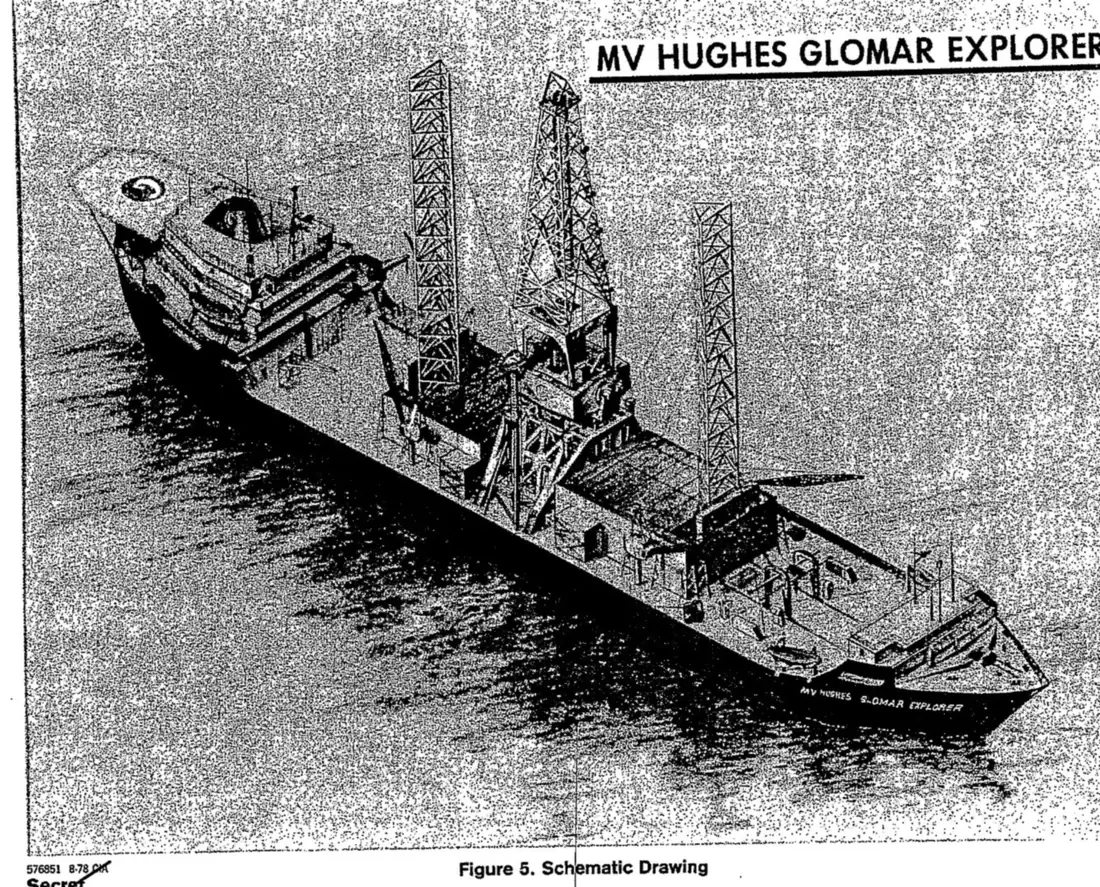
In 1974 the CIA disguised a spy ship as a Howard Hughes mining venture and sent it to pull a sunken Soviet nuclear submarine off the floor of the Pacific, three miles down, while Soviet ships watched.
Byte 1
March 1968
A submarine disappears
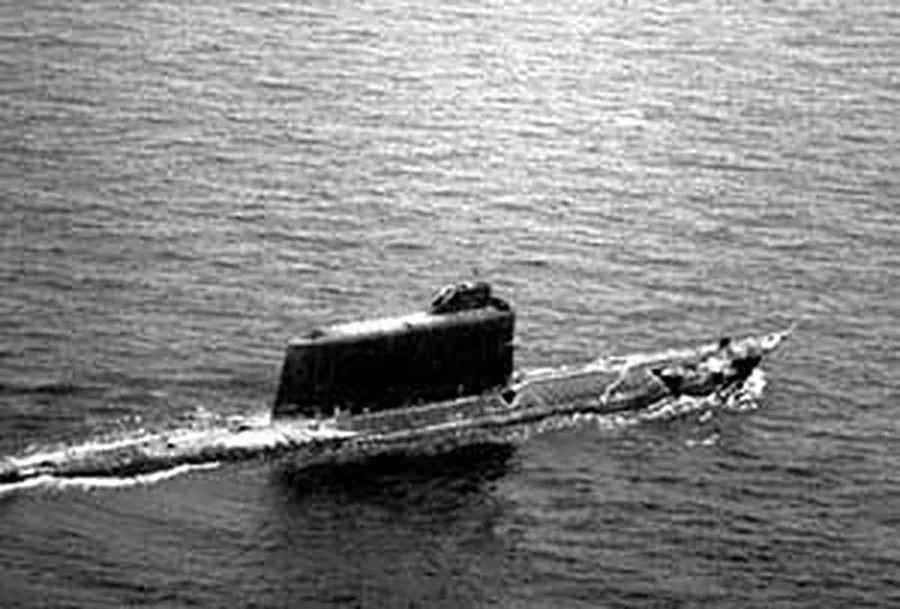
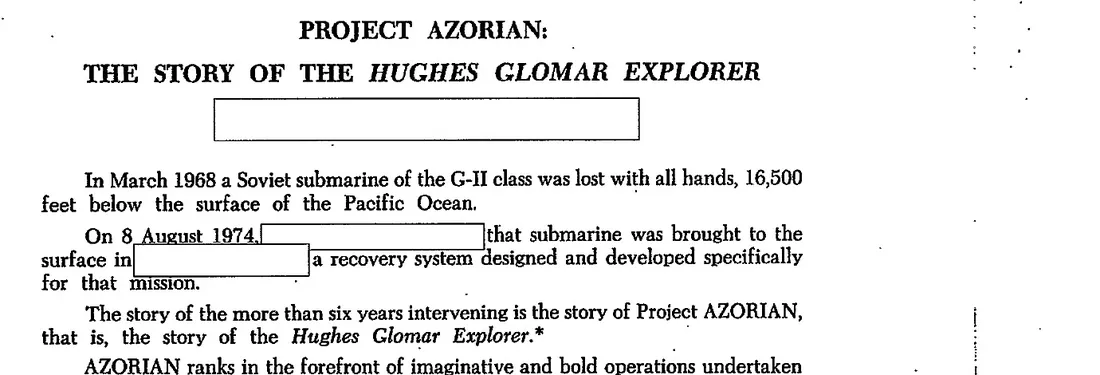
The Soviet submarine K-129 left its base at Petropavlovsk around March 1, 1968, carrying 98 men and three nuclear missiles. About a week later it sank somewhere in the middle of the Pacific. Nobody aboard got off a distress call.
The Soviet Navy searched for two months and found nothing. What caused the sinking is still unknown.
The Americans had a better idea of where to look. Navy underwater microphones had recorded the sound of the disaster. That summer the spy submarine USS Halibut towed cameras over the area and photographed the wreck lying on the bottom, about 1,560 miles northwest of Hawaii.
Byte 2
1969 to 1974
Three miles of pipe
CIA engineers proposed something nobody had ever done. A ship would lower a giant steel claw on a string of pipe and haul the submarine straight up. The CIA's estimate of the weight was about 2,000 to 2,200 tons.
Lower the claw yourself. Watch what you pass on the way down.
The claw is at the surface, hanging in the center well of the ship.
Byte 3
1972 to 1973
Enter Howard Hughes
A secret this big needed a cover story. Howard Hughes was a billionaire famous for hiding from the public, and his companies already did secret work for the government. A senior Hughes official asked him to lend his name, and he agreed.
The world was told Hughes was building a ship to scoop metal nodules off the deep ocean floor. Mining experts believed it. Some companies started planning ocean mining ventures of their own.
The claw itself was built out of sight inside a giant covered barge called HMB-1. Off Catalina Island the barge sank itself, and the ship parked on top and pulled the claw up through doors in the bottom of its own hull.
The long way to California
The ship was too wide for the Panama Canal, so it sailed around the bottom of South America.
- Chester, PennsylvaniaTo fit under the Delaware Memorial Bridge, the crew cut 28 feet off the top of the derrick, then a floating crane put it back.
- Strait of MagellanTwo Chilean pilots came aboard to steer through the passage at the tip of South America.
- Valparaiso, ChileThe ship arrived the day after a military coup. Tanks filled the streets while technicians waited to get aboard.
- Long Beach, CaliforniaThe ship tied up at Pier E to get ready for the real job.
Byte 4
July 18, 1974
What kind of vessel are you?
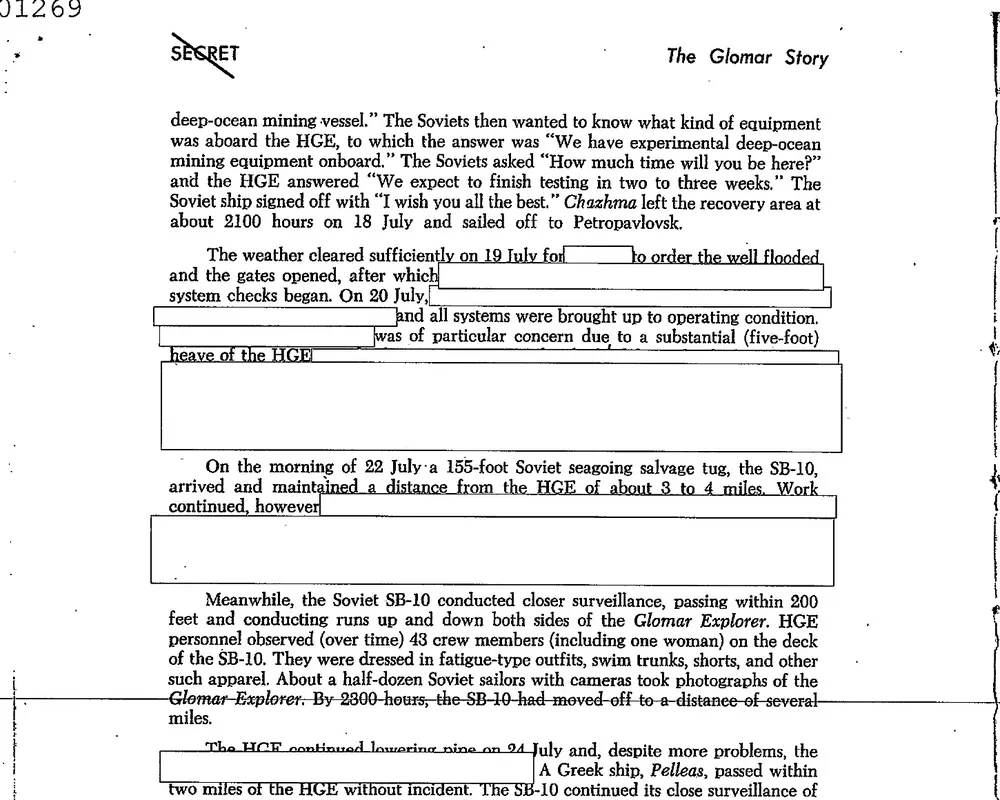
The Glomar Explorer reached the wreck site on the Fourth of July. Two weeks later the Soviet missile tracking ship Chazhma came over the horizon. Its helicopter made low passes over the deck taking pictures. Then the Soviets got on the radio.
You are on the Glomar's radio. Every answer has to match the cover story the whole world has already read about. Pick your reply, then see what the crew actually said.
Your reply:
Chazhma left that night. Four days later a 155 foot Soviet salvage tug called SB-10 arrived and stayed for weeks. The Americans counted 43 people on its deck, including one woman, many in swim trunks, snapping photos. Once it came within 75 yards. The crew stacked crates on the helicopter deck so no Soviet helicopter could land.
Byte 5
August 1 to 9, 1974
The claw breaks
The claw closed on the submarine and lifted it off the bottom on August 1. Partway up, some of its steel grabbing arms failed. Most of the hull broke away and fell back three miles to the seafloor.
On August 8 what was left reached the ship. Tap each part of K-129 to see what happened to it.
Choose a part of the submarine.
Radiation monitors aboard picked up plutonium leaking from the recovered nuclear torpedoes. Exactly what came up is still classified. Accounts disagree on whether any code machines were inside, and the CIA has never said.
Byte 6
September 4, 1974
Six sailors
Inside the recovered section were the bodies of six Soviet sailors. On September 4, 1974, the Americans buried them at sea in a steel chamber about 90 miles southwest of Hawaii. The coffins were covered with the Soviet naval flag. A chaplain read prayers, and the Soviet national anthem played.
The CIA filmed the ceremony. For 18 years the families were told nothing. In October 1992, after the Soviet Union collapsed, CIA Director Robert Gates flew to Moscow and handed the film to Russian President Boris Yeltsin.
One dot for each man aboard K-129. Six were ever recovered.
Byte 7
June 1974 to March 1975
The burglary that blew the cover
- Burglars break into Summa Corporation headquarters in Los Angeles, a Hughes company, and haul away files. The CIA later feared one was a memo to Hughes describing the submarine plan.
- The Los Angeles Times prints a confused version of the story connecting Hughes and his mining ship to the CIA.
- CIA Director William Colby personally asks newspaper editors to hold the story. Several of the biggest papers in the country agree.
- Columnist Jack Anderson breaks it on national radio and TV. The next day The New York Times runs Seymour Hersh's story on its front page.
With the cover blown, the White House canceled a second mission that would have gone back for the rest of the submarine.
Byte 8
March 1975 to today
Neither confirm nor deny
Rolling Stone reporter Harriet Ann Phillippi filed a Freedom of Information Act request for CIA records about the ship. A CIA lawyer wrote an answer built so that even a no could not tip off the Soviets.
A federal appeals court upheld the answer in 1976. In 1977 the Carter administration admitted the project existed. Government agencies still give the same kind of answer today, and it is still called a Glomar response.
"We can neither confirm nor deny that this is our first tweet."
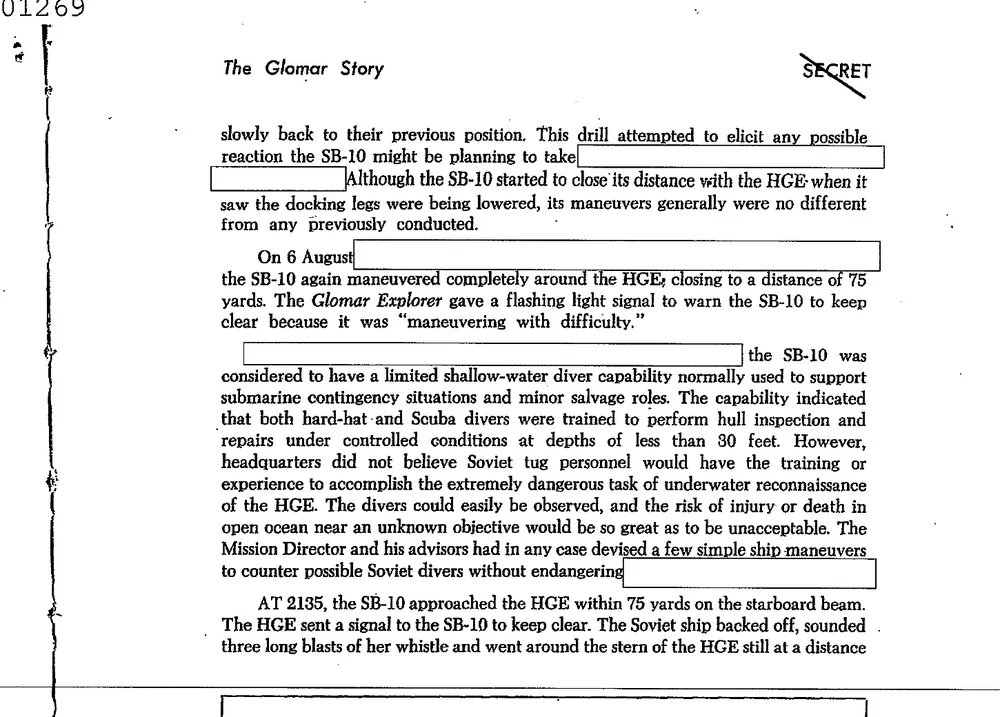
Sources. Central Intelligence Agency, "Project Azorian: The Story of the Hughes Glomar Explorer," declassified 2010, via the National Security Archive. Foreign Relations of the United States, 1969 to 1976, Volume XXXV, Document 196. Phillippi v. Central Intelligence Agency, 546 F.2d 1009 (D.C. Cir. 1976). Norman Polmar and Michael White, Project Azorian: The CIA and the Raising of the K-129 (Naval Institute Press, 2010). Videos are embedded from YouTube and not rehosted.