The Magic Paint
Sabin von Sochocky was a doctor who came to the United States from Austria in 1906. By 1913 he had a paint that glowed on its own, a pinch of radium mixed into zinc sulfide, a powder that flashes whenever radiation hits it.
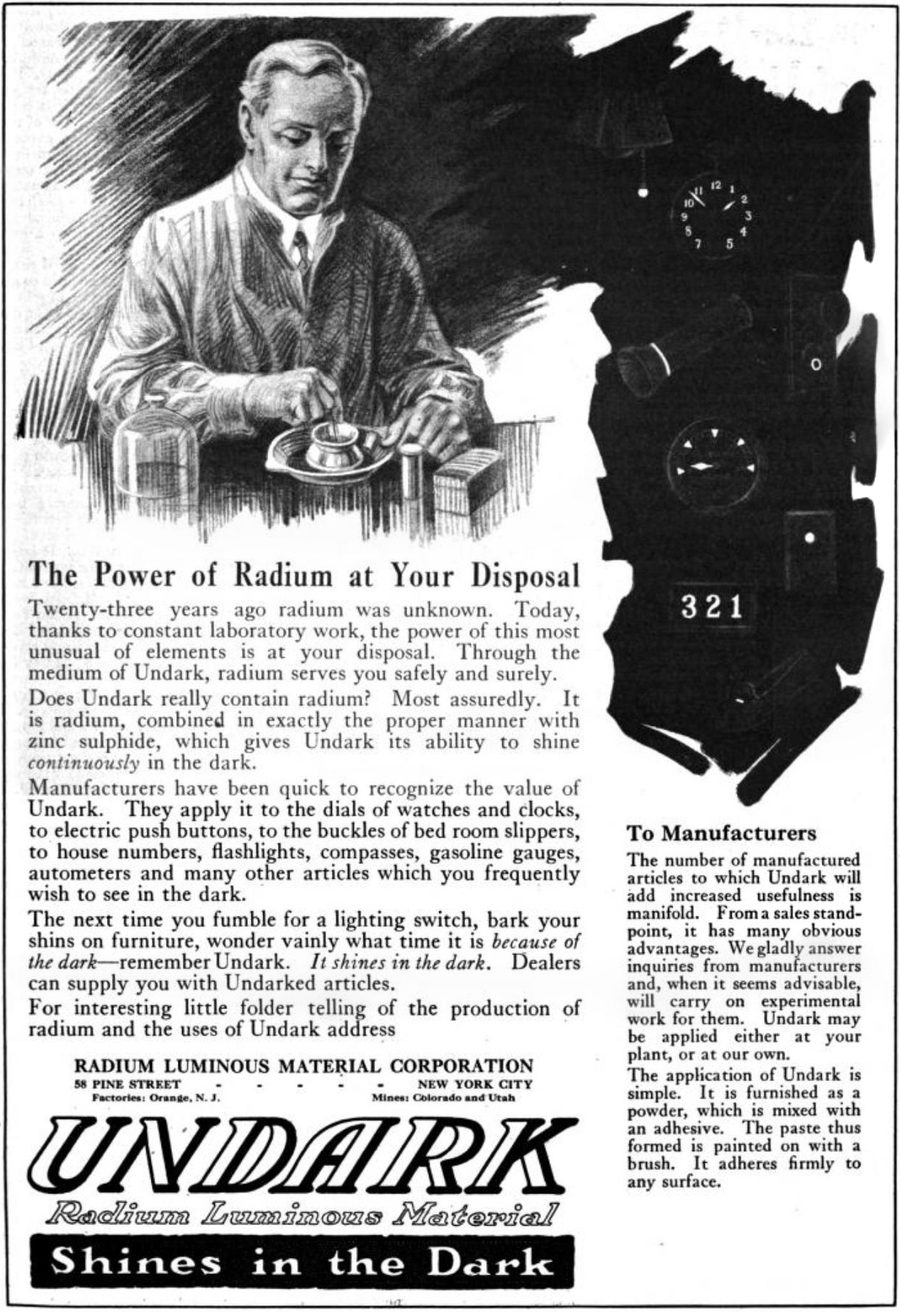
In 1917 his company moved into a bigger plant in Orange, New Jersey. The country had just entered the First World War, and soldiers needed watches they could read at night. By 1920 Scientific American counted more than 1,000,000 glowing watches and clocks.
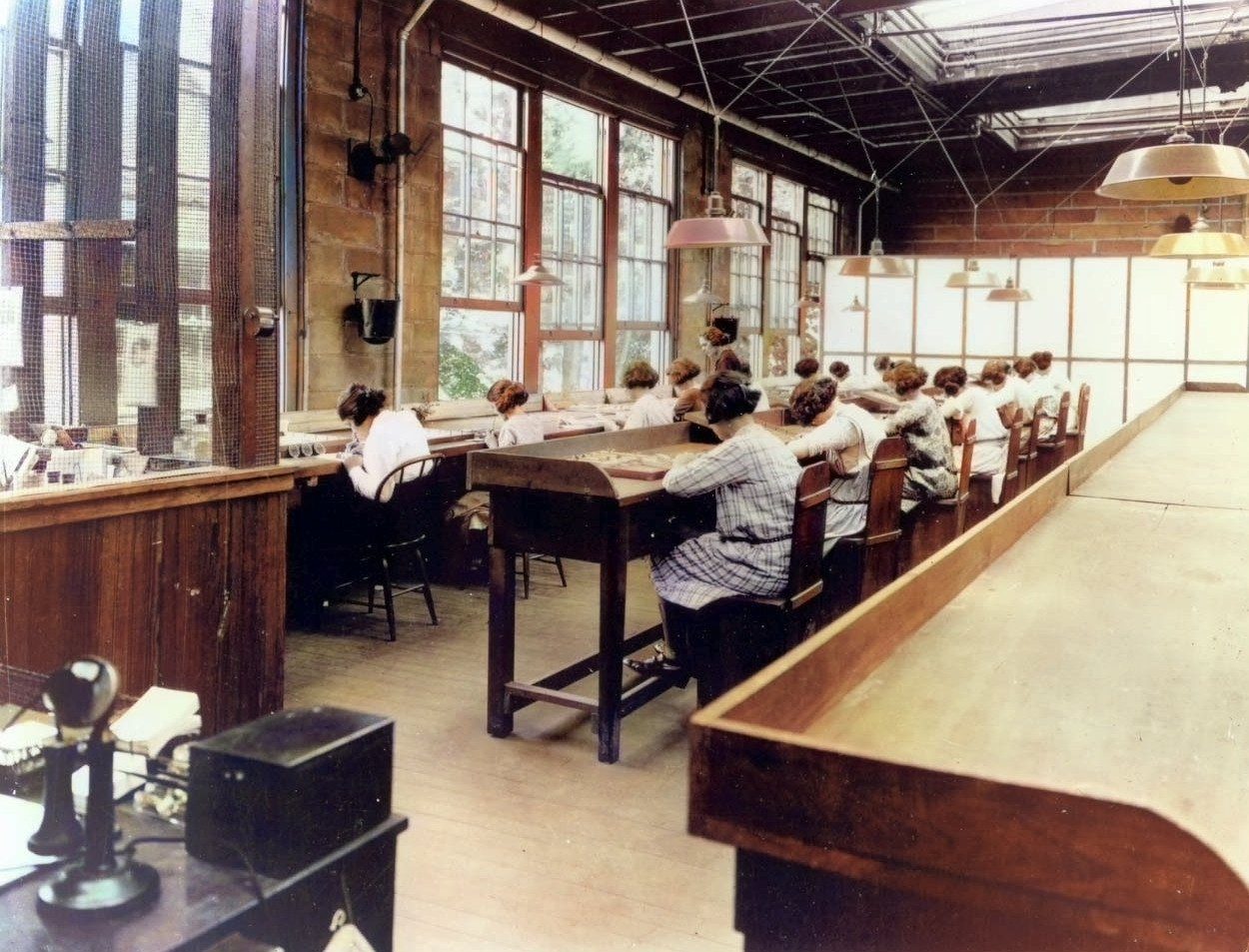
The painting was done by young women. Katherine Schaub started on February 1, 1917, when she was 14. Grace Fryer started that year at 18. They were paid by the dial, so speed was money.
The camel hair brushes spread after a few strokes, and a fat brush blotted the tiny numbers. The fastest fix was to draw the tip between your lips. The painters called the routine lip, dip, paint.
“Miss Fryer estimates that she put the radium paint brush to her lips to wet it about 300 times a day between 1917 and 1920 when she and 70 other women were employed.”
United Press interview, May 15, 1928Paint the outlined numeral, one at a time. Twelve make a dial. Every stroke dulls the brush, and a dull brush blots the dial into the scrap box.
45 seconds on the clock. Keys: P paints, L lips, R rags.
The rag takes about as long as a real wipe and rinse. The report at the end uses measurements from 1925.
Something in the Jaw
Mollie Maggia had painted dials since 1917. Early in 1922 a dentist pulled a sore tooth, and the hole never healed. More teeth came out, then pieces of her jawbone. She died on September 12, 1922. She was 24, and the story that followed her to the grave was that she had died of syphilis.
“We have a chronic, progressive rotting away of the bone.”
Castle, Drinker and Drinker, Journal of Industrial Hygiene, 1925More painters were getting sick the same way. In March 1924 the company president, Arthur Roeder, hired a Harvard team led by the husband and wife doctors Cecil and Katherine Drinker. The company's first guess was dirty brushes. The Drinkers cultured them and grew nothing but ordinary mouth germs.
So they looked at the paint. They took the painters into a darkroom and flashed a light. Zinc sulfide gives light back slowly, so any paint dust would glow for a few seconds afterward.

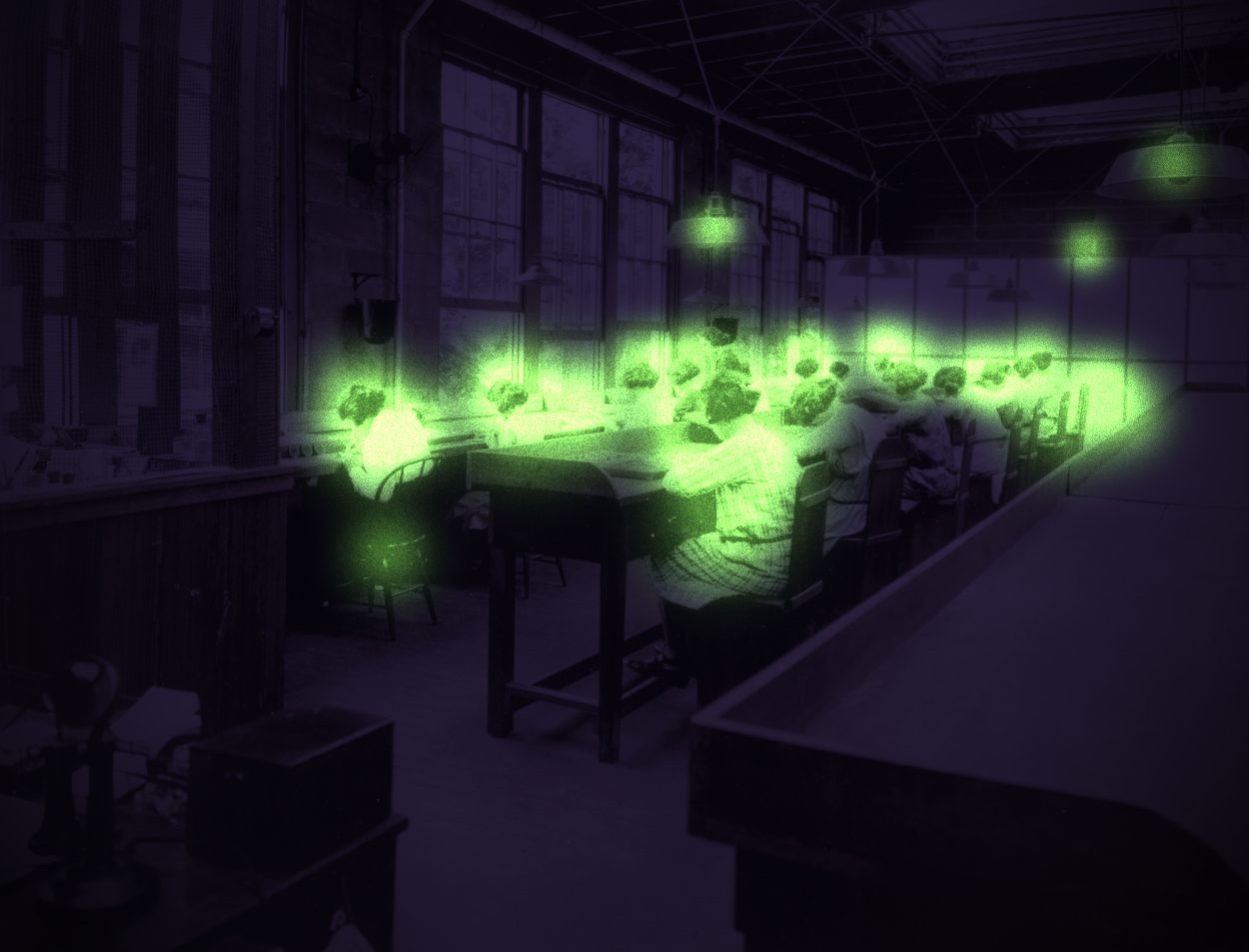
Turn off the lights first. Then flash.
- Hair
- Faces
- Hands
- Arms
- Necks
- Dresses
- Underclothes
- Corsets
- Tables
- Chandeliers
- Wall beams
- Chairs nobody sat in
- Office girls
- Machine shop dust, one floor down
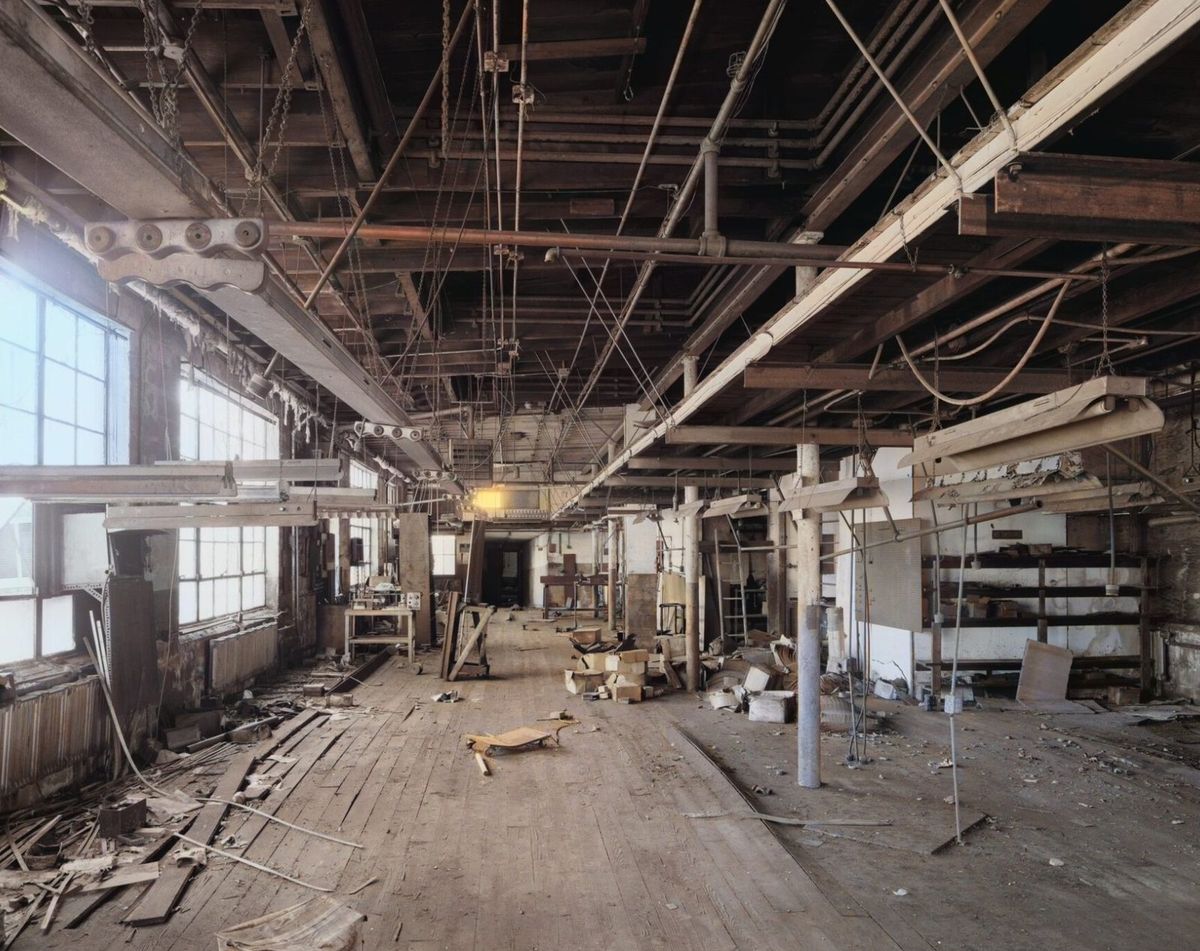
The glow spots are placed from the Drinkers' written list. The photograph is the Orange studio about two years before their visit.
“The hair, faces, hands, arms, necks, the dresses, the underclothes, even the corsets, of the dial painters were luminous. One of the girls showed luminous spots on her legs and thighs. The back of another was luminous almost to her waist.”
Castle, Drinker and Drinker, 1925The man who weighed out the powder said it blew away if he breathed on it. The woman who had the job before him noticed that when she blew her nose, it glowed in her handkerchief.
Glow proves dust, not radiation. For that the Drinkers placed sealed dental X ray film around the building. Film in a sealed packet only clouds if radiation passes through the wrapper. The radiologist George Pfahler had set the rule. If a sealed film fogs within two weeks, the people near it are getting too much.
Every film starts clear. Slide the days forward.
The layout is a sketch. The fogging times are the Drinkers' own.
They also drew blood from 22 employees. Not one sample, the report said, was “entirely normal.” On June 3, 1924, the Drinkers told Roeder what they believed. Radium had caused the dying jaws.
The Report That Changed on the Way
Roeder did not accept the answer. He blamed infections the women had picked up somewhere else. Then the report reached the New Jersey Department of Labor saying something different. In the version the state received, every girl was in perfect condition.
Alice Hamilton, the country's leading expert on factory poisons, heard about it and wrote to Katherine Drinker.
“Do you suppose Roeder could do such a thing as to issue a forged report in your name?”
Alice Hamilton to Katherine Drinker, 1925The company had asked the Drinkers to hold off publishing because of the lawsuits. Roeder threatened to sue if they went ahead. They published anyway, in the August 1925 Journal of Industrial Hygiene, and the real conclusion went into print.
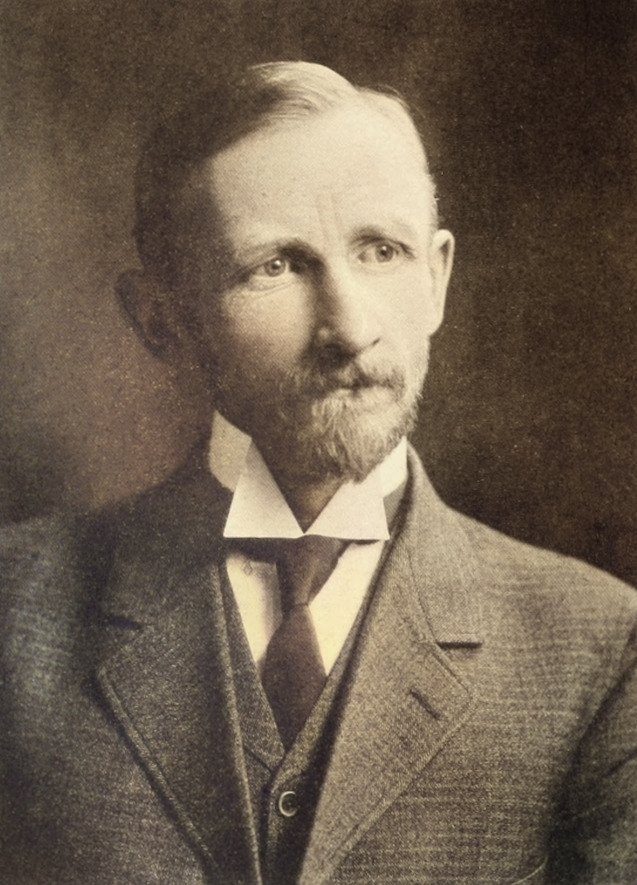
Outsiders were counting too. Frederick Hoffman, a Prudential Insurance statistician brought in by the Consumers' League, told the American Medical Association in May 1925 about 5 dead painters and 12 living ones with the same rotting jaws. He named it radium necrosis.
Harrison Martland, the Essex County medical examiner, picked up gamma rays coming out of living painters and found radon, the gas radium gives off, in their breath. He laid bone from a dead painter on dental film, and the bone took its own picture.
The company hired its own expert, Frederick Flinn of Columbia University. His 1926 paper found no industrial hazard. Two years and several deaths later, he changed his mind in print.
Unmask the company
Every one of these lines was said or written about the painters. Pull off each mask and see what the record shows underneath.
0 of 5 unmasked
Doomed to Die
In May 1927 Grace Fryer found a lawyer who would take the case, Raymond Berry of Newark. Katherine Schaub and Edna Hussman joined her, with Mollie Maggia's sisters Quinta McDonald and Albina Larice. Each sued the United States Radium Corporation for $250,000.
The company's answer was the calendar. New Jersey gave workers two years to sue. The women had painted from 1917 to 1920 and were not diagnosed until 1927, so the company argued their time ran out before they knew what was wrong.
In October 1927 Mollie Maggia's body was dug up to settle how she had died. Doctors found no sign of syphilis. Her bones were radioactive.
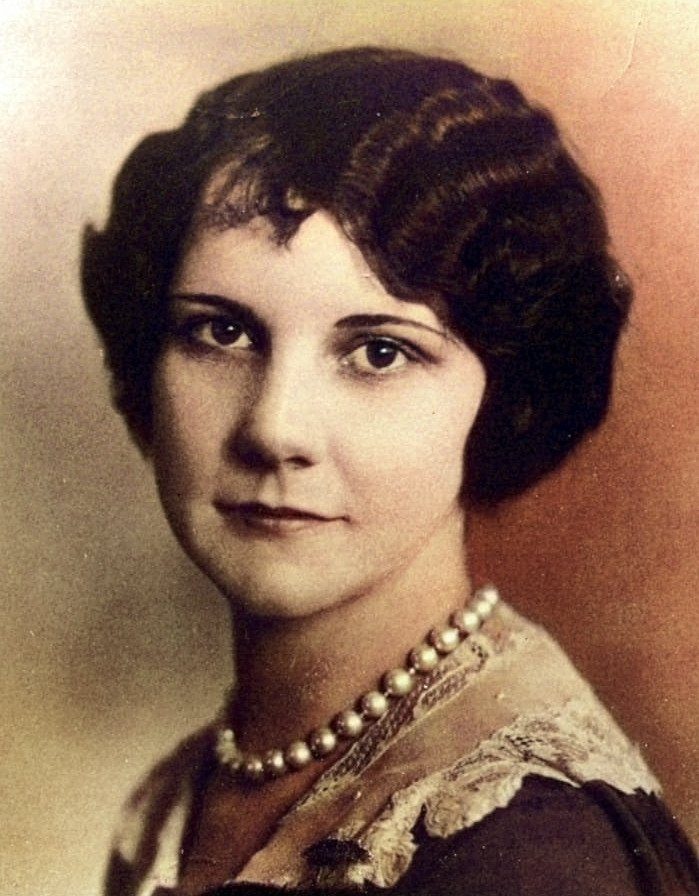
“I have had 19 operations,” Miss Fryer said, “but my doctors tell me there is no hope.”
New Britain Herald · May 15, 1928Each woman will receive $10,000 in cash and an annuity of $600.
Milwaukee Leader · June 5, 1928Panel by panel: the stall
- July 19, 1927
Berry asks the court to throw out the two year deadline.
- January 12, 1928
The first hearing. Two of the women cannot get out of bed. None of them can raise an arm to take the oath.
- April 2
Postponed. Defense witnesses cannot appear.
- Late April
The women finish their evidence. The company asks for more time.
- May 1928
Doctors say the women may have a year left. The company refuses a faster hearing.
- June 4, 1928
Settled out of court. $10,000 each, $600 a year for life, and every medical bill paid.
Two weeks later Roeder wrote that settling admitted nothing, because “there is very little question but that we had a perfect defense.”
In November 1928 Sabin von Sochocky, the man who brought radium paint to America, died of radium poisoning. He had once figured the radium in his own body would take 3,520 years to leave it. Grace Fryer died on October 27, 1933. She was 34.
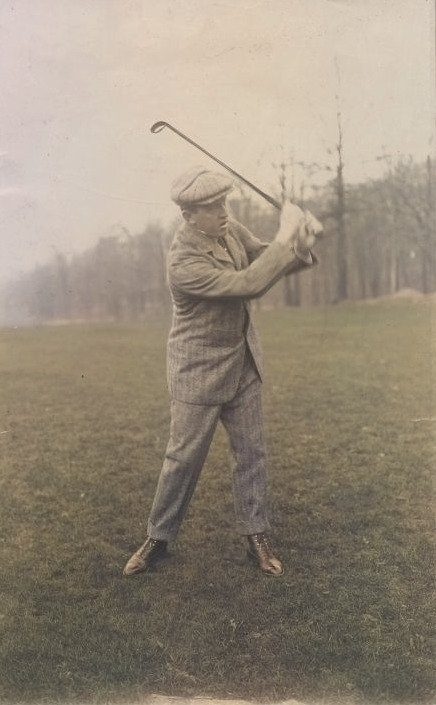
Rich people paid to swallow radium. Eben Byers, a Pittsburgh steel man and the 1906 national amateur golf champion, hurt his arm in 1927, and a doctor suggested Radithor, bottled radium water from East Orange, New Jersey. Byers drank about three bottles a day for two years.
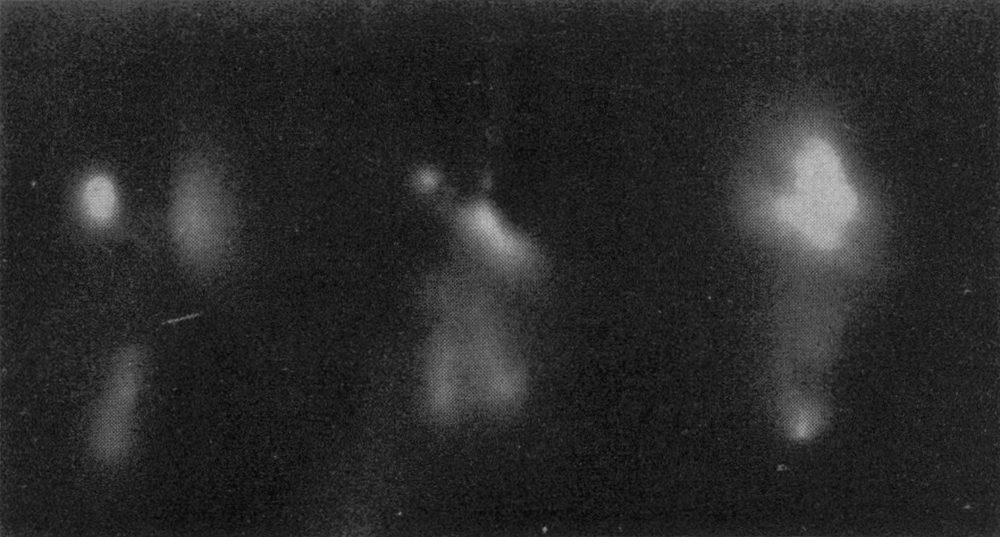
He died on March 31, 1932, at 51, after surgeons had removed most of his jaw. Laid on film for ten days, his teeth took their own picture.
The Society of the Living Dead
Radium Dial opened a studio in an old high school in Ottawa, Illinois, in 1922. In 1925 a company officer told a federal investigator it turned out about 4,300 dials a day, and that it was practically impossible to stop the workers from tipping their brushes in their mouths.
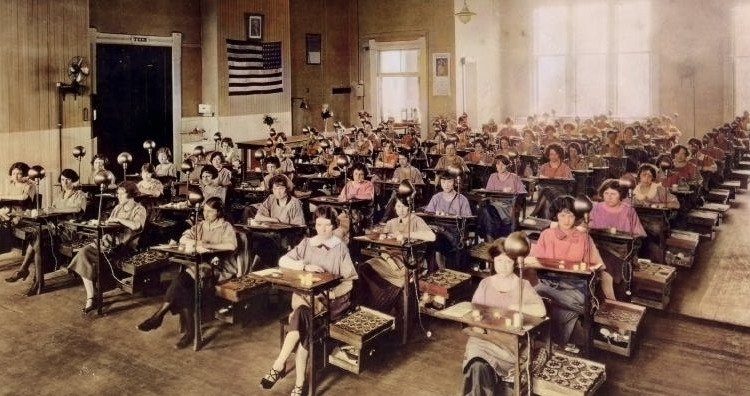
In 1928 the New Jersey headlines reached Illinois, and a notice went up in the plant. According to the women's lawyer, it said Ottawa used a different type of radium that was not dangerous.
Catherine Wolfe painted there from 1922 to 1931 for $15 a week. By 1931 she walked with a limp, and her supervisors let her go.
“Your limping will cause talk. We're sorry, you'll have to go.”
As Catherine Donohue testified, February 1938She married Tom Donohue in 1932 and had two children as her health failed. In 1937 a Chicago lawyer, Leonard Grossman, took her case and other Ottawa painters' cases without pay. The newspapers called the group the Society of the Living Dead.
“In my opinion, her death is almost certain within a matter of months,” Dr. Dalitsch testified in her absence.
Evening Star, Associated Press · February 11, 1938She was the 10th to die. Four doctors certified that she died of radium poisoning.
Washington Daily News, United Press · July 27, 1938The hearing opened on February 10, 1938. When a dentist testified that she would be dead within months, Catherine Donohue collapsed. She weighed 71 pounds. The arbitrator moved the rest of the hearing to the couch in her living room.
She won. The Illinois Industrial Commission ordered Radium Dial to pay her $5,661. The company, which had already moved to New York, appealed and fought even the bond it had to post to keep appealing. Catherine Donohue died on July 27, 1938, at 35. The company's last appeals failed in 1939.
What the Bones Taught
By 1931 Martland was seeing bone cancers appear years after the jaws had rotted. The dial painters, he wrote, were “proof that radiation can produce malignancy.” It was the first hard evidence that radiation stored inside the body causes cancer.
The physicist Robley Evans built counters that could measure radium inside living people. In 1941, with the military about to order glowing dials by the thousands, a federal committee reviewed 27 people Evans had measured. Seven held half a microcurie or less and had no symptoms. The twenty who were sick held 1.2 to 23. The committee set the limit for a worker's body at 0.1.
For radium, one microcurie is about one millionth of a gram.
The red band on the meter is everything above the 1941 limit. The clicks are scaled so the loudest one stays bearable. Each time the click rate triples, the radium went up about ten times.
The simplest lesson was to keep the brush out of your mouth. After 1925 the lip pointing stopped. Decades later Argonne National Laboratory measured how much radium each generation of painters had absorbed.
How much radium the painters absorbed
Average radium taken into the body, in microcuries, for women grouped by the years they were hired. Measured cases only.
The first three bars are women hired before the brush rule. Guess the fourth, then reveal.
Every person whose radium was measured by the end of 1990, most of them dial workers, in no particular order.
The exact position of each red dot inside the top group is not published. They are scattered through it here.
As of 1994, Argonne had not found a single radium cancer in anyone who started dial work after 1925. When the atomic bomb project began making plutonium, its first safety limit was built from the radium standard. That story is in Never Use the Word.
Finish the Comic
The last panel
Every horror comic ends with a narrator box. Write this one in 80 to 150 words, speaking to the reader, with at least two real facts from these pages.
When you finish, copy everything and paste it into the Classroom assignment. Your work saves in this browser as you type.