Sarajevo to London · June 28 to August 4, 1914
Thirty Seven Days
On a Sunday morning in Sarajevo, a 19 year old student fired two shots into an open car. Thirty seven days later, Britain declared war on Germany and most of Europe was fighting. The clearest way to see how that happened is on a map.
Map 1 · Europe in June 1914
Two sides already drawn
Germany and Austria Hungary signed an alliance in 1879, and Italy joined them in 1882 to make the Triple Alliance. France and Russia answered with their own alliance in 1894. Britain settled old quarrels with France in 1904 and with Russia in 1907, and those three became the Triple Entente. But these promises were different. Britain’s friendly agreements did not automatically require war, and Italy stayed neutral in 1914. Pick a country to examine its position.
Pick a country
Click a country on the map or use the buttons below the map. Lines show its promises.
Read the country guide
Britain
Its agreements with France (1904) and Russia (1907) settled colonial disputes. They were not a single mutual-defense treaty. Britain had also guaranteed Belgian neutrality under the 1839 Treaty of London. Its government chose war on August 4.
France
France’s military alliance with Russia counterbalanced Germany. Its Entente with Britain was a friendly agreement, with military talks, rather than an identical treaty. Germany declared war on France on August 3.
Germany
Germany was allied with Austria-Hungary and Italy. Its July 5–6 backing encouraged Austria-Hungary to confront Serbia. It declared war on Russia on August 1 and France on August 3.
Austria-Hungary
The Habsburg empire was allied with Germany and Italy. It feared Serbian influence and separatism among its South Slav peoples. It declared war on Serbia on July 28.
Russia
Russia was allied with France and had an agreement with Britain. It backed Serbia as a Balkan partner, without a formal Russo-Serbian alliance. Its general mobilization intensified the crisis.
Italy
Italy belonged to the Triple Alliance, but argued that this defensive treaty did not require it to support Austria-Hungary’s offensive war. It remained neutral in 1914 and entered against Austria-Hungary in May 1915.
Serbia
An independent Balkan state backed by Russia. Austria-Hungary blamed it for the Sarajevo assassination. Support by conspirators and Serbian officers is not the same as proof that its civilian government ordered the murder.
Belgium
A neutral state whose independence and neutrality were guaranteed by the 1839 treaty. Germany invaded it on August 4. Belgium resisted, and Britain entered the war that evening.
Ottoman Empire
Outside the two prewar groupings shown here. It signed a secret alliance with Germany on August 2, stayed out of the initial August fighting, and entered the war later in 1914.
Luxembourg
German troops occupied neutral Luxembourg on August 2.
Switzerland
Remained neutral throughout the war.
Spain
Remained neutral throughout the war.
Montenegro
Supported Serbia and entered the war against Austria-Hungary in August 1914.
Albania
Formally neutral but politically unstable; foreign armies later occupied much of it.
Portugal
An old British ally; entered the war against Germany in 1916.
Netherlands
Remained neutral throughout the war.
Norway
Remained neutral throughout the war.
Romania
Had a secret connection with the Triple Alliance, but remained neutral in 1914 and joined the Entente in 1916.
Sweden
Remained neutral throughout the war.
Denmark
Remained neutral throughout the war.
Greece
Remained neutral in 1914 amid internal division; entered on the Allied side in 1917.
Bulgaria
Remained neutral in 1914 and joined the Central Powers in 1915.
Map drill
Click Serbia
Map 2 · The world in 1914
Small countries, giant empires
The same powers that faced off in Europe ruled much of the rest of the planet. By 1914 Europeans controlled about 90 percent of Africa, and Ethiopia and Liberia were the continent’s two widely recognized independent states. Rivalry over colonies brought Germany and France close to war over Morocco in 1905 and again in 1911. Pick an empire to highlight its territories. This simplified map groups colonies, protectorates and self-governing dominions together. They did not all have the same government or rights.
Read the empire guide
British
Britain’s empire included India, large African territories, Canada, Australia and New Zealand. Some were self-governing dominions; others were ruled very differently. War involved the empire, and millions of colonial subjects supplied labor, resources or military service.
French
France ruled large territories in North and West Africa, Madagascar and Indochina. France drew troops and resources from its empire during the war.
German
Germany held colonies in Africa and the Pacific, including German East Africa and German South West Africa. It had fewer overseas possessions than Britain and France.
Russian
Russia’s empire stretched across northern Eurasia and Central Asia. Much of its expansion was over connected land rather than overseas colonies.
Italian
Italy held Eritrea and Italian Somaliland and had seized Libya from the Ottoman Empire in 1911–12. Its empire was still expanding.
Austro-Hungarian
The Habsburg empire ruled many national groups in central and southeastern Europe. It was a land empire, not a major overseas colonial power.
Ottoman
The Ottoman Empire still controlled Anatolia and large parts of the Arab Middle East, while losing much of its former European territory.
Pick an empire above. Borders are simplified from a 1914 historical map.
Colonies compared with the home country
Each bar compares the estimated area of overseas possessions with the home country (1×). These rounded estimates come from the map’s simplified polygons. Area is not population, wealth or military strength.
"We do not want to put anyone in the shade, but we too demand our place in the sun."Bernhard von Bülow, German foreign secretary, speaking to the Reichstag on December 6, 1897
Germany unified in 1871, while Britain and France already held overseas empires. German leaders sought more colonies and a larger navy. Colonial conquest served the ambitions of imperial powers and cost colonized peoples land, resources and freedom.
Sarajevo · Sunday, June 28, 1914
A wrong turn on Franz Joseph Street
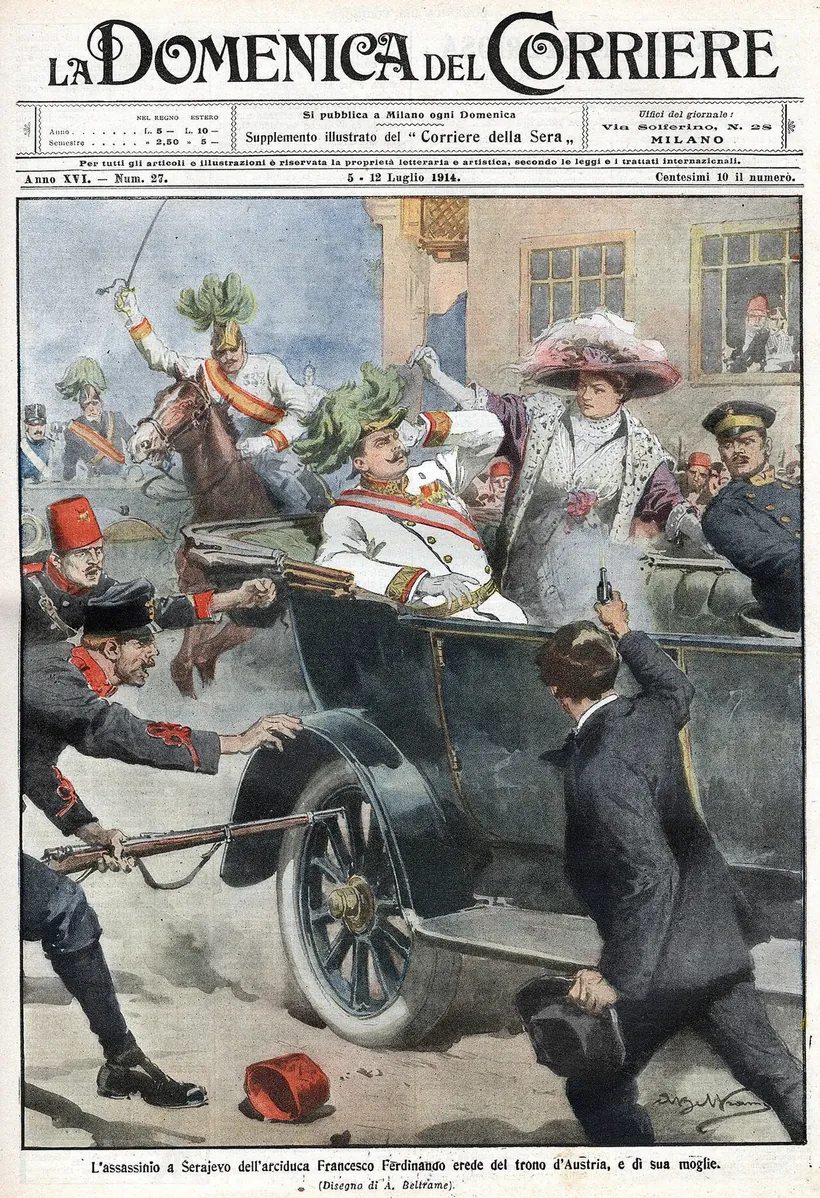
Archduke Franz Ferdinand, next in line to rule Austria Hungary, visited Sarajevo with his wife Sophie to watch army exercises. Austria-Hungary had occupied and administered Bosnia since 1878, then formally annexed it in 1908, and many Bosnian Serbs wanted it joined to Serbia. June 28 was Vidovdan, a Serbian national holiday marking the Battle of Kosovo in 1389.
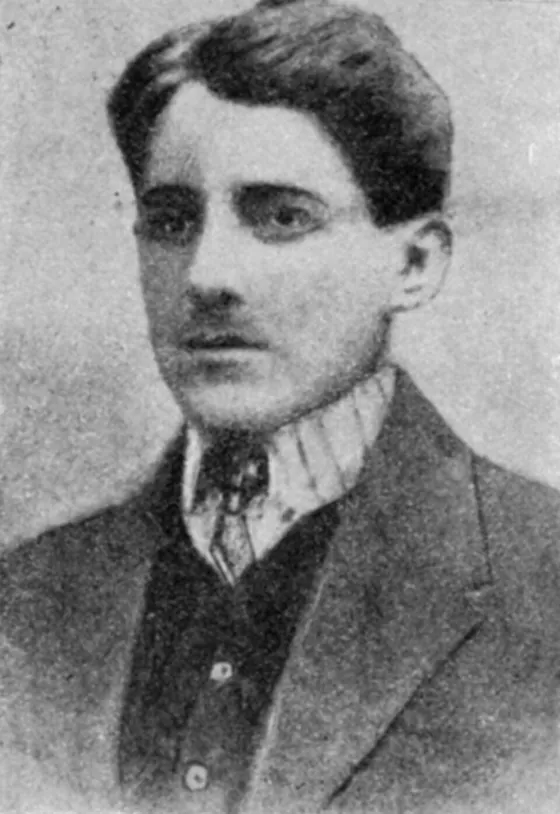
A group of young nationalist conspirators waited along the riverside road. Serbian military officers connected to the Black Hand helped supply weapons. That does not establish that Serbia’s civilian government ordered the assassination. At about 10:10 Nedeljko Čabrinović threw a bomb that bounced off the archduke's car and wounded officers in the car behind. After a reception at City Hall, the driver turned onto Franz Joseph Street by mistake and stopped to back up. Gavrilo Princip was standing on that corner. He fired twice, and both the archduke and Sophie were dead before noon.
Count Franz von Harrach, riding on the car's running board, later reported the archduke's last words to his wife.
"Sopherl! Don't die! Stay alive for our children!"Franz Ferdinand, as recorded by Count Harrach
Map 3 · The July Crisis
Step through the thirty seven days
Austria Hungary blamed Serbia. What happened next moved along the lines you saw on Map 1. Use the buttons or the slider to move between ten key events and watch the map change.
Day 0
June 28
Shots in Sarajevo
Read the complete crisis timeline
- June 28 · Shots in Sarajevo. Gavrilo Princip kills Franz Ferdinand and Sophie. A political crisis begins. No great power has declared war yet.
- July 5–6 · Germany gives its backing. Germany promises Austria-Hungary support, often called the “blank check.” Vienna can confront Serbia with a powerful ally behind it.
- July 23 · An ultimatum to Serbia. Austria-Hungary delivers a list of demands and gives Serbia 48 hours to answer. Some demands would allow Austro-Hungarian officials to operate inside Serbia.
- July 25 · Serbia answers; ties break. Serbia accepts many demands but qualifies or rejects others, especially foreign participation in its judicial process. Austria-Hungary breaks diplomatic relations. Military preparations accelerate.
- July 28 · Austria-Hungary declares war. Austria-Hungary declares war on Serbia. The following day its forces bombard Belgrade. The crisis has become a war between two states.
- July 30 · Russia orders general mobilization. Russia orders its armed forces to prepare for war. It wants to support Serbia and protect its position in the Balkans. German leaders regard general mobilization as a direct threat.
- August 1 · Germany declares war on Russia. After demanding that Russia halt its military preparations, Germany declares war. France also orders general mobilization. Germany’s planners fear a war on two fronts.
- August 2 · Luxembourg is occupied. German troops occupy neutral Luxembourg as the western deployment begins. Germany demands passage through Belgium. Italy declares neutrality.
- August 3 · Germany declares war on France. Germany declares war on France. Belgium refuses the demand for free passage. German military planning now helps push the crisis westward.
- August 4 · Belgium is invaded; Britain enters. Germany invades Belgium. After an ultimatum expires, Britain declares war on Germany that evening. Five of Europe’s six great powers are now involved; Italy remains neutral.
Map 4 · The Western Front, 1914
Six weeks to Paris
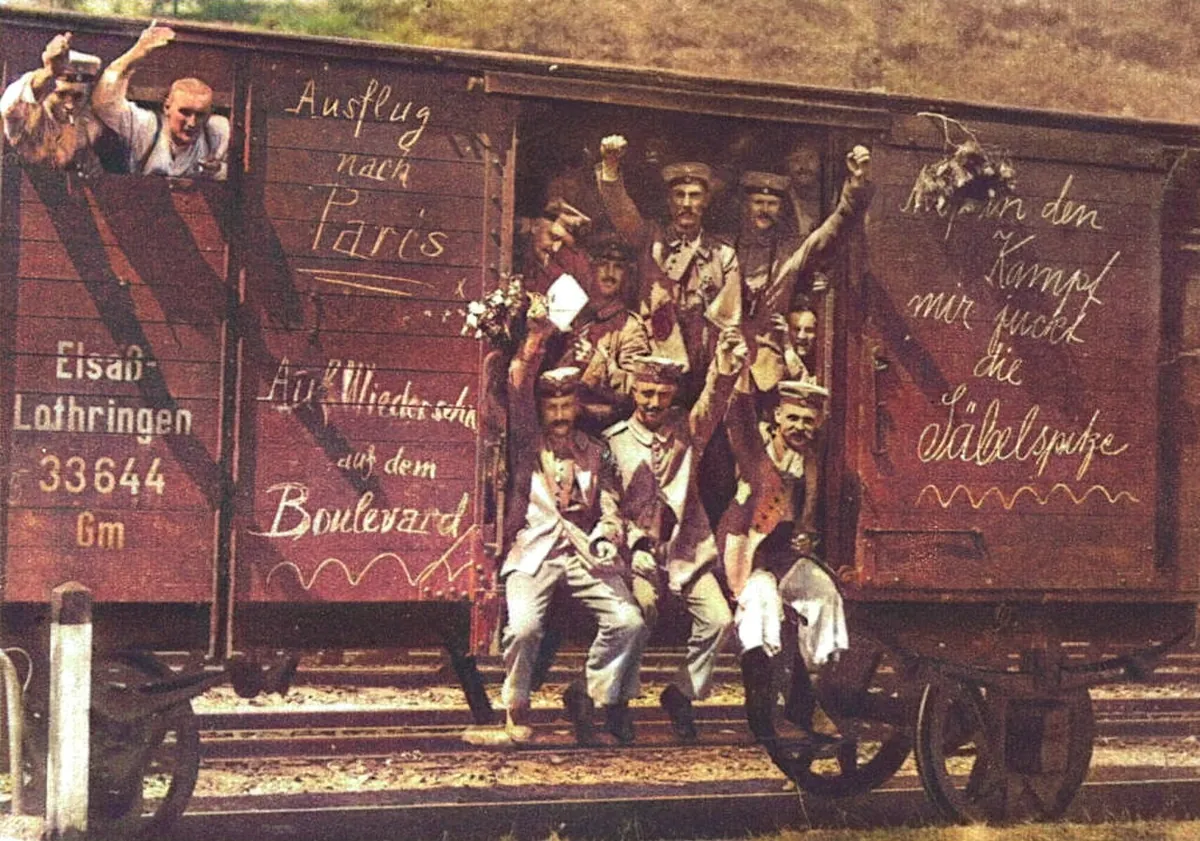
Germany sat between France and Russia. Its answer drew on a plan developed by Alfred von Schlieffen in 1905 and later modified by Helmuth von Moltke. The intended right wing would pass through neutral Belgium and sweep around Paris to defeat France in about six weeks. The routes below are a teaching schematic, not exact troop positions. Then the troops would ride trains east to face Russia, which German planners expected to need about six weeks to get ready.
Read all three Western Front views
The planned sweep
The right wing was intended to pass through Belgium and swing around Paris. Germany hoped to defeat France quickly, then shift forces east by rail. The map simplifies the plan and does not show every army.
The campaign changes direction
Belgian resistance, marching and supply problems, French action, the British army and Russian pressure complicated the advance. German forces turned east of Paris. French and British forces counterattacked at the Marne in September, and Germany withdrew.
The quick victory fails
After the Marne, both sides tried to outflank each other northward. By late 1914, trench lines stretched from the North Sea to Switzerland. The dotted line is a schematic of the front; the war continued for nearly four more years.
Workshop · the long-term pressures
Remember MAIN
The assassination explains why this crisis began when it did. MAIN helps explain why the crisis spread. Read each cause, then test the difference. More than one cause can affect the same event; choose the clearest match in each example below.
Militarism
Building up armed forces and treating military readiness as a way to solve political problems.
Britain and Germany competed to build powerful warships. Mobilization meant calling up reserves and moving troops and supplies. In July 1914, leaders feared that waiting would leave them behind.
Mobilizing was not the same as declaring war. It still made opponents fear an attack.
Alliances
Agreements and strategic partnerships that connected one country’s security to another’s.
Germany backed Austria-Hungary. France had a military alliance with Russia. Britain’s agreements with France and Russia were different, and its cabinet still had to decide whether to fight.
Italy belonged to the Triple Alliance but stayed neutral in 1914. Treaty terms and political choices mattered.
Imperialism
Extending control over other peoples and territories for power, resources or strategic advantage.
European empires competed for colonies and influence. The Moroccan crises of 1905 and 1911 deepened tension between Germany and France. Overseas empires also drew people far beyond Europe into the war.
A large empire did not automatically mean a large home country. Compare the map and area bars.
Nationalism
Strong loyalty to a nation, sometimes including a demand for independence, expansion or national unity.
Some South Slavs wanted independence from Austria-Hungary or union with Serbia. Austrian leaders feared that nationalist movements could break apart their multiethnic empire.
A nation is a people who see themselves as sharing an identity. A state is a political government and territory. Their borders do not always match.
Put the cause to work
Choose M, A, I or N for each example, then check your reasoning. You can correct an answer and check again.
The trigger: Princip’s assassination of Franz Ferdinand and Sophie on June 28. The pressures: MAIN. A spark and the conditions around it are different parts of an explanation.
Finish · about 5 minutes
Explain how the war spread
Use details from the maps and timeline. Two or three sentences for each answer is enough. Your answers and MAIN choices use the shared work controls below.
Sources and map notes
The maps simplify borders and military movements for teaching. Alliance colors describe alignment, not a promise to fight in every situation. Crisis colors show involvement, not occupied land. The complete text guides below also work if a map or video is unavailable.
- Imperial War Museums: the outbreak of war
- UK Foreign Office: the July Crisis in diplomatic documents
- World of the Habsburgs: the Sarajevo assassination
- Read the U.S. diplomat’s June 28 report
- NZ History: the plan and the actual German advance
Maps adapted from André Ourednik and contributors, Historical Basemaps (GPL-3.0). Editable map source, license and full image credits. The map data is a work in progress. Area comparisons are approximate and combine different forms of imperial control. Period images retain their own stated rights. The troop-train photo is colorized; the newspaper scene is an illustration made after the attack.