Officials used deadlines, police, forced marches, and paperwork to drive Chinese residents out.

EXPULSION. PAPERWORK. RESISTANCE.
THEY
SAID
NO.
The law reached the street.
It reached the ship.
It reached the courtroom.
Chinese Americans met it in every place.
THE ANSWER: Chinese Americans organized mass resistance and fought exclusion in court. Some of what they won now protects everyone in the United States.
START EPISODE ↓USH9 · LECTURE 16BABOUT 25 MINUTES
01NOVEMBER 3, 1885
HOW A CITY FORCED PEOPLE OUT
Tacoma turns exclusion into an organized procedure other cities can copy.
Tacoma's mayor gave the city's Chinese residents until November 1 to leave.
On November 3 a crowd of several hundred, including the police and the fire chief, went house to house and told people to pack.
They were marched eight miles through rain to a rail station outside town.
Twenty seven men were later indicted. None were prosecuted.
EXPULSIONS & VIOLENCE / SELECTED RECORDS01
The log
Jean Pfaelzer’s research documents at least 200 expulsions of Chinese communities in California alone between 1849 and 1906.
What this proves +
Rock Springs was a massacre. Tacoma was a procedure, run by elected officials, with a published deadline and an orderly march. It was copied across the West because it worked and because nobody involved was punished. Killing was not the common method. Paperwork and a deadline were.
Go deeper +
Jacob Weisbach, a German immigrant who had become mayor of Tacoma, called a mass meeting at the Alpha Opera House on February 21, 1885. About nine hundred people attended.
SOURCE TEXT
If the people are in earnest, if they are Free Americans in fact, they will not yield up their homes and business to the filthy horde.
Mayor Jacob Weisbach, Tacoma, February 21, 1885
On September 28 he presided over an Anti Chinese Congress in Seattle that set a regional deadline of November 1. By the time the deadline arrived, roughly seven hundred of the estimated one thousand Chinese residents in Pierce County had already gone.
On November 3 a crowd that started around two or three hundred and grew toward five hundred moved through the remaining Chinese homes and businesses. It included prominent merchants, city police, and the fire chief. Between one hundred fifty and two hundred people were ordered out, and at half past one in the afternoon they were marched eight miles in heavy rain to the Lake View rail station, where they were made to buy tickets to Portland or ride in boxcars. Two men died of exposure waiting for transportation.
Twenty seven men, Weisbach among them, were indicted on federal conspiracy charges. The indictments were dismissed on technical grounds. New indictments were brought and dismissed the same way. Nobody stood trial.
Newspapers across the West began calling it the Tacoma Method. Seattle attempted the same thing in February 1886 and the territorial governor declared martial law to stop it.
02OCTOBER 7, 1888
THE GOVERNMENT CANCELS HIS RETURN
Chae Chan Ping crosses the Pacific with a valid certificate—and arrives after Congress voids it.
Chae Chan Ping had lived in San Francisco since 1875.
He left for China in June 1887 holding a return certificate the United States government had issued him.
On October 1, 1888, while he was at sea, Congress voided every certificate like it.
He reached San Francisco six days later and was not allowed off the ship.
HONG KONG → SAN FRANCISCO02
The crossing
Move the ship. You control the crossing; you cannot change its dates.
AT SEAOCT 1OCT 7
OCTOBER 1, 1888
SCOTT ACT
SCOTT ACT
Timeline illustration; positions do not represent measured distance.
Begin the crossing. The law will change even if you stop moving.
U.S.
1887
ISSUED BY THE UNITED STATES1887
Certificate
of return
CHAE CHAN PING
San Francisco resident since 1875
VOID AND OFNO EFFECTReconstructed teaching document
He was not permitted to land. About 20,000 other Chinese laborers holding the same certificate were outside the country when it was cancelled.
Chae Chan Ping v. United States · May 13, 1889
The Supreme Court ruled against him unanimously, recognizing broad federal power to exclude foreigners.
What this proves +
The government issued a document, then cancelled the document, then refused to honor it, and the Supreme Court held unanimously that it was entitled to do all three. The case became a foundation of the broad congressional authority known as plenary power.
Go deeper +
Chae Chan Ping was a laborer who had lived in San Francisco for twelve years. Under the 1884 amendments to the exclusion act, a Chinese laborer who wished to visit China could obtain a certificate entitling him to return. He obtained one and sailed on the steamer Belgic on June 2, 1887.
The Scott Act was signed on October 1, 1888. It declared all such certificates void and of no effect. Roughly twenty thousand Chinese laborers who were outside the United States holding valid return certificates found that the papers in their pockets had become worthless while they were away. Chae Chan Ping's steamer docked in San Francisco on October 7. He was detained on board and refused permission to land.
His case reached the Supreme Court, which decided it on May 13, 1889 under the name Chae Chan Ping v. United States, and it is still commonly called the Chinese Exclusion Case. The Court ruled against him unanimously. Justice Stephen Field wrote that the power to exclude foreigners belongs to the government as an attribute of sovereignty, that Congress may exercise it whenever it judges the public interest requires, and that the decision is conclusive upon the courts.
That holding has a name. It is the plenary power doctrine, and it gave Congress exceptionally broad authority over immigration, with courts generally deferring to exclusion decisions. It did not eliminate every form of judicial review. It was announced in a case about one man and a cancelled piece of paper, and it became a lasting influence on American immigration law.
AI-authored scene · illustrative reconstruction
03MAY 5, 1892
THE GEARY ACT DEMANDS PROOF
Chinese laborers must document their right to remain under unequal rules.
Congress renewed exclusion for another ten years and added something new.
Chinese laborers already in the United States had one year to obtain a certificate of residence and produce it when challenged.
Without the required proof, they faced arrest and deportation. Section 4 also prescribed up to a year at hard labor.
CERTIFICATE OF RESIDENCE / RECONSTRUCTED FILE03
The proof
Assemble the first three records. Then examine the requirement you cannot supply yourself.
This teaching file combines the 1892 law and the 1893 photograph requirement. The white-witness test shown below applied in court after a laborer missed registration for an unavoidable reason.
01
Name, age, and occupation
Sample identity record attached.
02
Local residence
Sample residence record attached.
03
Photograph
Photograph record attached. Required from November 1893.
04
Proof of residence at the time of passage
AT LEAST ONE CREDIBLE WHITE WITNESSFixed legal condition · there is no field for your own testimony to replace it.
SOURCE TEXTAct of May 5, 1892, Section 3
Any Chinese person or person of Chinese descent arrested under the provisions of this act ... shall be adjudged to be unlawfully within the United States unless such person shall establish, by affirmative proof, to the satisfaction of such justice, judge, or commissioner, his lawful right to remain.
SOURCE TEXTAct of May 5, 1892, Section 4
Shall be imprisoned at hard labor for a period of not exceeding one year and thereafter removed from the United States.
In 1896, Wong Wing required a criminal trial before punitive imprisonment at hard labor.
What this proves +
The Geary Act made a document into a condition of remaining in the country. Its burden of proof fell on Chinese residents. For a laborer seeking a court exception after missing registration for an unavoidable reason, Section 6 required a credible white witness to establish prior residence.
Go deeper +
Representative Thomas J. Geary of California introduced the bill on February 18, 1892. President Benjamin Harrison signed it on May 5.
The act extended exclusion for ten more years and required Chinese laborers entitled to remain in the United States to apply for certificates of residence within a year. Other Chinese residents could obtain certificates voluntarily. Section 7 specified identifying information; a photograph requirement was added in November 1893.
Section 3 placed the burden of proof on the person arrested under the law. Section 4 prescribed up to a year of imprisonment at hard labor followed by removal for those adjudged not entitled to remain. In 1896, Wong Wing v. United States held that punitive imprisonment required the constitutional protections of a criminal trial.
Section 6 ordered deportation for a laborer found without a certificate after the deadline unless a judge accepted accident, sickness, or another unavoidable reason for not obtaining it. Prior residence then had to be established by at least one credible white witness. The racial test shown in this file belongs to that court exception, not to every ordinary certificate application.
Roughly one hundred ten thousand people were affected by the registration campaign.
04MAY 10, 1886
YICK WO WINS EQUAL PROTECTION
A Chinese laundryman proves that a fair-looking law can still be enforced unfairly.
Six days after the bomb at Haymarket, the Supreme Court ruled unanimously for a laundryman in San Francisco.
Lee Yick had run a laundry for twenty two years. The city systematically denied Chinese applicants permits while approving nearly all other applicants.
The Court held that a law fair on its face, applied with an unequal hand, still violates the Constitution.
YICK WO v. HOPKINS · 118 U.S. 356“An evil eye
“An evil eye
and an unequal hand.”
UNANIMOUS
Read the original opinion ↗Equal protection applies to persons.
Lee Yick did not have to be a citizen to win.
What this proves +
The record of this period runs in two directions at once. Everything so far has been done to Chinese immigrants. From here the hour follows what they did, and what they did was sue. Chinese residents brought thousands of cases in American courts during exclusion, and some of what they won protects everyone in the country now.
Go deeper +
Lee Yick arrived in San Francisco in 1861 and ran a laundry in a wooden building for twenty two years. In 1880 the city passed Order Number 156, which required a permit from the Board of Supervisors to operate a laundry in a wooden building. Laundries in brick or stone buildings needed no permit.
The ordinance said nothing about race. Roughly three hundred twenty laundries in the city were in wooden buildings, and more than two hundred of them were Chinese owned. The city systematically refused Chinese applicants while approving nearly all applicants who were not Chinese.
Lee Yick kept operating, was arrested, refused to pay the fine, and took the case up. The Supreme Court decided it on May 10, 1886, and ruled for him without a dissent. Justice Stanley Matthews wrote the opinion.
SOURCE TEXT
Though the law itself be fair on its face and impartial in appearance, yet, if it is applied and administered by public authority with an evil eye and an unequal hand, so as practically to make unjust and illegal discriminations between persons in similar circumstances, the denial of equal justice is still within the prohibition of the Constitution.
Yick Wo v. Hopkins, 118 U.S. 356, decided May 10, 1886
The Court also held that the Fourteenth Amendment's guarantee of equal protection applies to all persons within the territorial jurisdiction of the United States, not only to citizens. Lee Yick was not a citizen and could not become one. He won anyway.
05MAY 1893
ONE HUNDRED THOUSAND REFUSE
Chinese communities organize mass resistance to federal registration.
The Chinese Six Companies told their communities not to register under the Geary Act, and to pay for lawyers instead.
The great majority did not register.
Then the Supreme Court upheld the law, five to three.
THE INSTRUCTION FROM THE SIX COMPANIES
Do not register.
Pay for lawyers.
5—3THE COURT UPHELD THE LAW
MAY 15, 1893
MAY 15, 1893
What this proves +
This was one of the largest organized acts of civil disobedience in nineteenth century America, and almost nobody has heard of it. It was funded, coordinated, and carried out by people who were barred from citizenship, and it was a genuine gamble that failed in court.
Go deeper +
The Chinese Consolidated Benevolent Association, known as the Six Companies, was the umbrella organization of Chinese district associations in San Francisco. When the Geary Act passed in May 1892, the Six Companies issued instructions across the country. Do not register. Contribute to a legal fund instead. The plan was to force a test case with the entire population as the plaintiff, and to have the law struck down before the registration year expired.
The great majority complied with the boycott rather than the statute. Of roughly one hundred ten thousand people subject to the act, only a small fraction had registered when the year ran out in May 1893. Those without the required certificates now faced arrest and deportation under the act.
The test case was Fong Yue Ting v. United States. The Supreme Court decided it on May 15, 1893, ten days after the registration deadline. The Court upheld the Geary Act by five votes to three. Justice Horace Gray wrote that the power to expel foreigners rests on the same footing as the power to exclude them, and upheld the deportation provisions against the constitutional challenge.
Justice Stephen Field dissented, and so did Justice David Brewer and Chief Justice Melville Fuller. Field, who four years earlier had written the opinion against Chae Chan Ping, drew a line at expelling people already lawfully resident without a trial.
The government did not have the money or the officers to deport a hundred thousand people, and the mass removal never happened. Congress passed an amendment in November 1893 extending the registration period by six months. This time, with the constitutional argument gone, people registered.
06AUGUST 1895
WONG KIM ARK WINS CITIZENSHIP
A San Francisco cook secures birthright citizenship under the Fourteenth Amendment.
Wong Kim Ark was born in San Francisco to parents who were barred by law from ever becoming citizens.
He came home from a visit to China and customs refused to let him land.
He was held on ships in the harbor for five months.
Then he won, six to two, affirming citizenship at birth for U.S.-born children of resident immigrant parents under the Fourteenth Amendment.
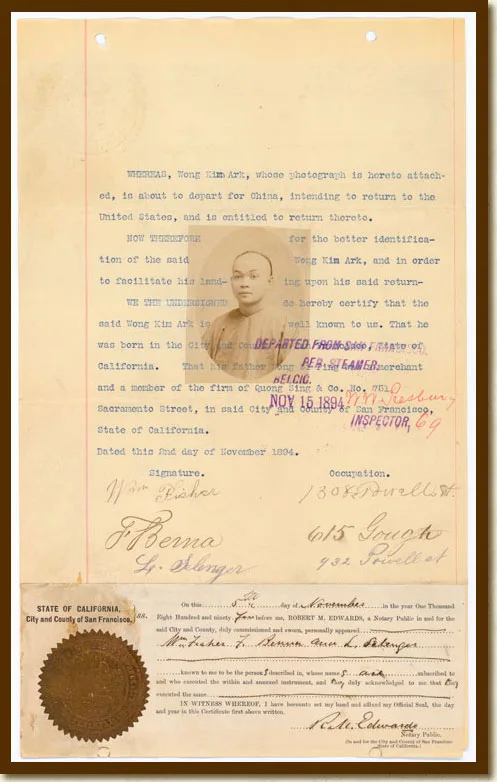
His face, attached to his own departure statement. November 5, 1894. National Archives, San Francisco; Records of the Immigration and Naturalization Service, identifier 2641490.
Read the original record ↗UNITED STATES v. WONG KIM ARK
751
SACRAMENTO STREET
SAN FRANCISCO
SACRAMENTO STREET
SAN FRANCISCO
6—2
Citizen at birth.
March 28, 1898.
The ruling concerned a U.S.-born child of Chinese parents domiciled here. The Fourteenth Amendment includes the condition “subject to the jurisdiction thereof.”
Read the original opinion ↗What this proves +
The exclusion laws produced the case that settled birthright citizenship for the whole country. A cook kept on a boat for five months won a landmark interpretation of the Fourteenth Amendment’s citizenship guarantee.
Go deeper +
Wong Kim Ark was born at 751 Sacramento Street in San Francisco around 1873, to Chinese parents who ran a merchant business there and who could not naturalize under the 1882 act. He worked as a cook. He visited China and returned in 1890 and was readmitted as a native born citizen without trouble.
He went again and returned in August 1895 aboard the steamer Coptic. This time the collector of customs at San Francisco refused to let him land, on the theory that a child born in the United States to Chinese subjects was himself a Chinese subject and therefore excluded. He was held aboard ships in the harbor for five months while the case went forward.
The Supreme Court decided United States v. Wong Kim Ark on March 28, 1898, and ruled in his favor six votes to two. The Fourteenth Amendment says that all persons born or naturalized in the United States, and subject to the jurisdiction thereof, are citizens. The Court held that this means what it says, read against the common law rule the country had inherited, and that a child born on American soil to parents who are themselves permanently barred from citizenship is nonetheless a citizen at birth.
Chief Justice Melville Fuller dissented, joined by Justice John Marshall Harlan.
07ANGEL ISLAND, 1910 TO 1940
EXCLUSION LASTS SIXTY-ONE YEARS
The system survives wars, inventions, and generations before repeal in 1943.
An estimated 100,000 Chinese people were detained at Angel Island.
Detentions often ran from weeks to months. One documented detention lasted 756 days.
More than two hundred poems have been recovered from the barracks walls, cut into the wood by people waiting.
SOURCE TEXT · ANGEL ISLAND BARRACKS WALL · IN TRANSLATION
“Twice I have passed through the blue ocean,
experienced the wind and dust of journey.
Confinement in the wooden building
has pained me doubly.”
Author unknown · English translation
1882 TO 1943 / ANNUAL RECORD07
Sixty-one years
Move down the column. Watch what changes. Read what does not.
YEAR / IN THE UNITED STATESCHINESE LABORERS
Read every year as a table
| Year | In the United States | Chinese laborers |
|---|
DECEMBER 17, 1943 · THE MAGNUSON ACT
Sixty-one years.
The annual quota was
105
PEOPLE.
What this proves +
The law was not a single event. It became a condition that lasted for a lifetime. Follow the years beside inventions, wars, and national milestones: the country changes while the same exclusion line keeps repeating.
Go deeper +
The immigration station on Angel Island opened on January 21, 1910 and operated until 1940. The Angel Island Immigration Station Foundation estimates that about 100,000 Chinese people were detained there, and unlike arrivals at Ellis Island, who were usually processed in hours, Chinese arrivals were detained in locked barracks while a Board of Special Inquiry examined them. Inspectors asked questions designed so that only a person from the claimed family and village could answer. How many steps to the door of your house. Which direction does your village face. Who lived in the third house on the row. Answers were checked against relatives interviewed separately, and a contradiction could mean removal.
People waited weeks and months. Some waited longer. They wrote on the walls, and then carved what they had written into the wood, and the station painted over it and they carved again. More than two hundred of those poems have been recovered.
SOURCE TEXT
Twice I have passed through the blue ocean, experienced the wind and dust of journey.Confinement in the wooden building has pained me doubly.
Carved into the barracks wall at Angel Island, author unknown
A fire destroyed the administration building in 1940 and the station closed.
Exclusion ended on December 17, 1943, in the middle of a war in which China was an American ally. The Magnuson Act repealed the exclusion laws and made Chinese immigrants eligible for naturalization. It set the number of Chinese people who could enter the United States each year at one hundred five.
✓EPISODE TWO / THE ANSWERS
WHAT YOU NOW KNOW.
Congress voided Chae Chan Ping’s return certificate while he was at sea.
The Geary Act forced Chinese laborers to prove their right to remain under racially unequal rules.
The Chinese Six Companies coordinated one of the largest acts of civil disobedience in nineteenth-century America.
Yick Wo strengthened equal protection; Wong Kim Ark affirmed birthright citizenship.
Exclusion lasted until 1943. Repeal initially allowed an annual quota of only 105.
THREE STORIES TO REPAIR
Return to Episode One →“Chinese immigrants were passive victims.”
They organized, refused registration by the tens of thousands, and repeatedly challenged the government in court.
“The people responsible for anti-Chinese violence were punished.”
Across the selected cases, convictions were overturned, indictments dismissed, or defendants acquitted.
“Exclusion lasted about ten years.”
It began in 1882 and continued through renewals and added restrictions until 1943.
Open the source register ↗
Primary records
- Chinese Exclusion Act · May 6, 1882 · 22 Stat. 58
- Page Act · March 3, 1875 · 18 Stat. 477
- Scott Act · October 1, 1888
- Geary Act · May 5, 1892 · 27 Stat. 25, Sections 3, 4, 6 and 7; McCreary amendment · November 3, 1893.
- Magnuson Act · December 17, 1943
- Yick Wo v. Hopkins · 118 U.S. 356 (1886)
- Chae Chan Ping v. United States · 130 U.S. 581 (1889)
- Fong Yue Ting v. United States · 149 U.S. 698 (1893)
- United States v. Wong Kim Ark · 169 U.S. 649 (1898)
- Wong Wing v. United States · 163 U.S. 228 (1896)
- Sweetwater County grand jury statement · 1885
- Samuel Gompers and Herman Gutstadt, Meat vs. Rice, AFL, 1902; quoting James G. Blaine, 1879.
- Charles Crocker’s account of the 1867 strike; Jacob Weisbach’s Tacoma speech, February 21, 1885.
- Angel Island barracks wall poetry, 1910–1940, in translation.
Research & counting
- U.S. Census · decennial counts, 1860–1940. Sex counts are rounded estimates.
- Library of Congress · This Month in Business History, the 1867 railroad strike.
- National Archives · Chinese American records guide
- National Park Service · San Francisco Maritime, Page Act history.
- Angel Island Immigration Station Foundation · By the Numbers. Updated detention estimates and documented 756-day detention.
- The Tacoma Method project · expulsion histories.
- Jean Pfaelzer, Driven Out: The Forgotten War Against Chinese Americans (2007).
How to read this two-part story
The railroad, mining camp, and steamship scenes are AI-authored illustrations. They are not archival photographs. Document interfaces are teaching reconstructions. The statute scan is an authentic National Archives document.
Primary records, court opinions, and institutional histories support the narrative. The comparative growth line is arithmetic, not a historical prediction or a causal estimate. The outcome column compares five selected records.
Historical racist statements appear as attributed evidence. No invented portraits or decorative Chinese writing are used.