Test the explanation
Compare preparation, opportunity and chance. Test explanations against five unexpected NFL routes, then defend a bounded argument.
Complete Assignment B only. A and B are alternative assignments, not two required parts.
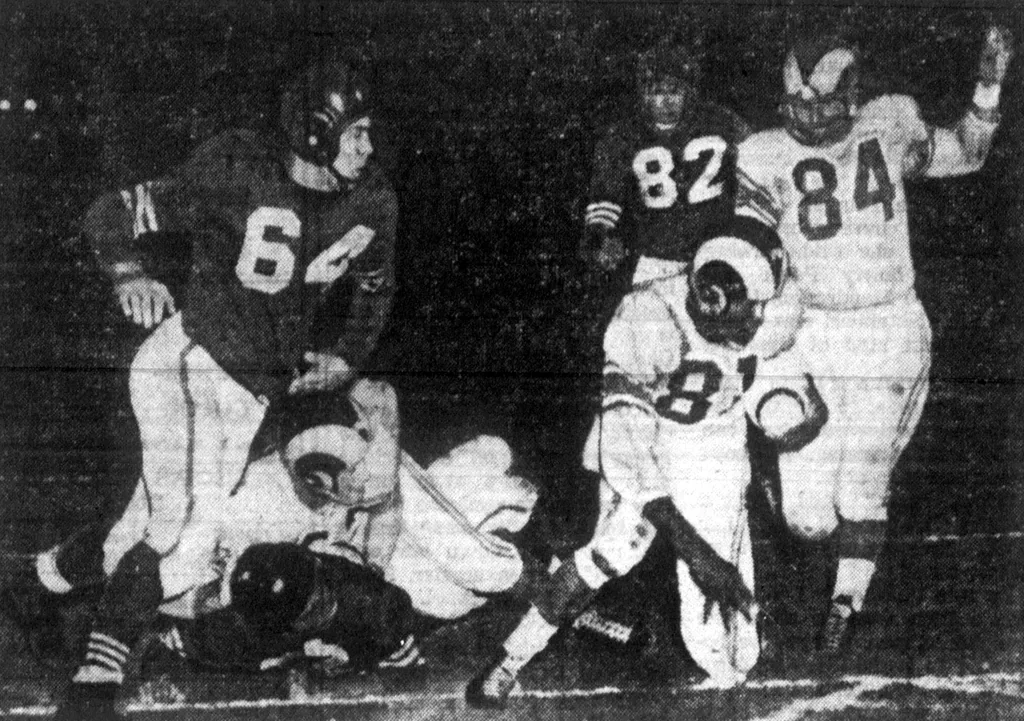
Night Train Lane, number 81.
This photograph records a September 3, 1953 Rams–49ers preseason play, not Lane's 1952 tryout.
Los Angeles Daily News, U.S. public domain; territorial restrictions may apply. Photograph and license record.

- 01Read your five cases.
- 02Explore the odds and image evidence.
- 03Check five claims and one other sport.
- 04Write three responses and Turn In.
Who opened the door?
Talent does not arrive neatly labeled. These five cases ask how someone reached a roster when the usual route did not work—or did not exist for them. Look for what the person could control and what depended on somebody else.
Night Train Lane
Night Train Lane, number 81.
This photograph records a September 3, 1953 Rams–49ers preseason play, not Lane's 1952 tryout.
Los Angeles Daily News, U.S. public domain; territorial restrictions may apply. Photograph and license record.
Dick Lane played one season of junior college football in Nebraska, then spent four years in the Army. At Fort Ord in California he caught 18 touchdown passes for the base team in 1951.
Out of the Army in 1952, he worked at an aircraft plant in Los Angeles, lifting heavy sheets of metal out of a bin and feeding them into a press. His bus to work passed the office of the Los Angeles Rams, the defending NFL champions. One day he got off, walked in with a scrapbook of old newspaper clippings, and asked for a tryout.
The Rams tried him at receiver and then moved him to defense. In 12 games that fall he intercepted 14 passes. Teams now play 17 games, and nobody has passed him. He finished his career with the Detroit Lions from 1960 to 1965 and went into the Hall of Fame in 1974.
"Lane came out here to make the ball club. Well, last night he got himself a job."
Rams coach Joe Stydahar, after Lane's first scrimmage, August 1952
- StartArmy veteran at an aircraft plant
- DoorA scrapbook and a walk-in
- Result14 interceptions as a rookie
Rocky Bleier
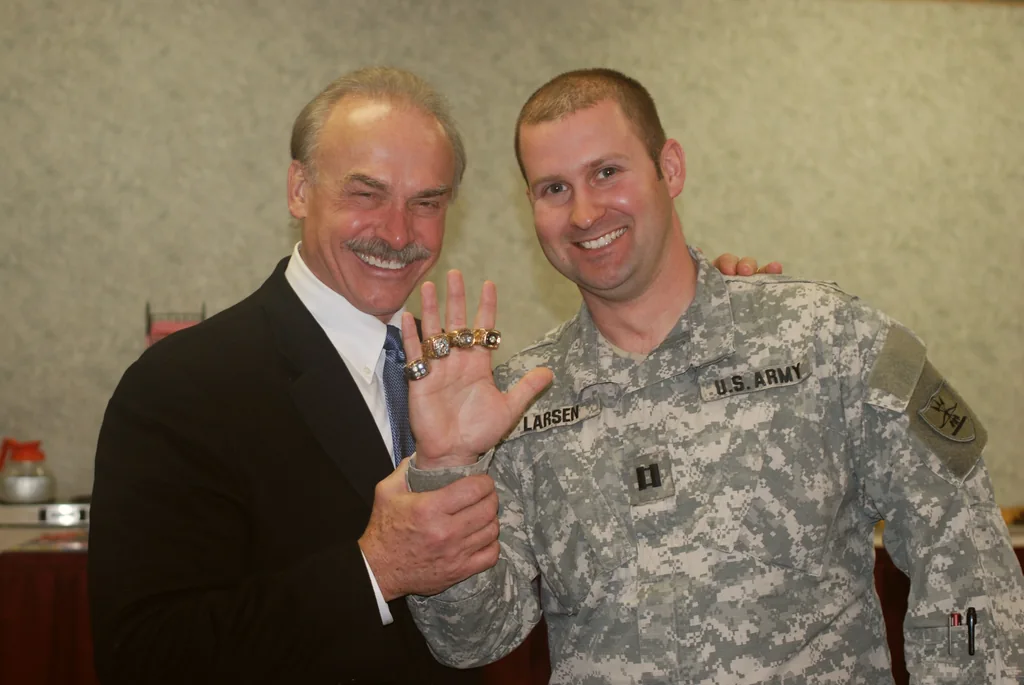
Four rings. One long comeback.
Rocky Bleier (left) with Doug Larsen at a 2009 National Guard conference. The rings are visible in an authentic photograph.
Photo: Bill Prokopyk / U.S. Army, U.S. public domain. Photograph and license record.

The Steelers took Rocky Bleier with the 417th pick in the 1968 draft. He had been team captain at Notre Dame. After his rookie season the Army drafted him, and in May 1969 he shipped out to Vietnam with the 196th Light Infantry Brigade.
On August 20, 1969, his unit came under attack near Hiep Duc. A bullet went through his thigh, and a grenade blast tore into his right leg and foot. Doctors removed more than 100 pieces of shrapnel. In a hospital in Tokyo they told him he would not play football again. He received the Bronze Star and the Purple Heart.
While he recovered, a postcard arrived from Steelers owner Art Rooney. Bleier reported to camp in 1970 at about 180 pounds and could not walk without pain. The team kept him on injured reserve. By 1974 he was a starting running back. He won Super Bowls IX, X, XIII and XIV, and he caught a touchdown pass from Terry Bradshaw in Super Bowl XIII.
- StartNFL rookie, then wounded soldier
- DoorA team willing to wait
- ResultFour Super Bowl rings
Kurt Warner
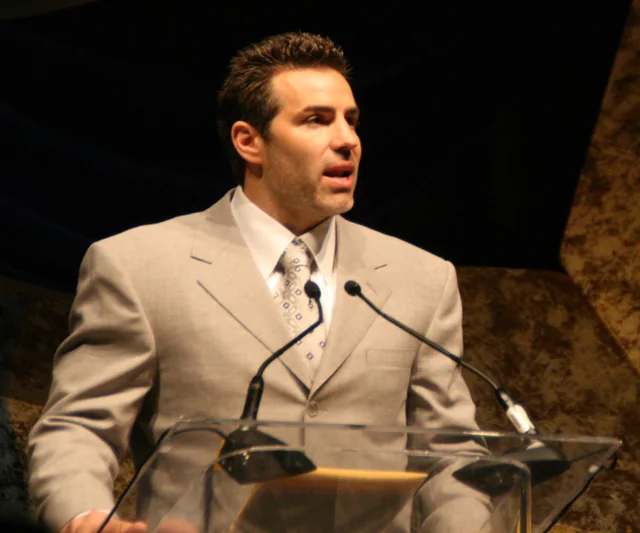
Kurt Warner, after the long route.
Warner worked stocking grocery shelves in 1994. This is a later portrait, not a photograph from that job.
Photo: John Trainor, CC BY 2.0. Photograph and license record.

Kurt Warner sat on the bench at Northern Iowa until his senior year. No team drafted him in 1994. The Green Bay Packers brought him to training camp and cut him.
He went back to Cedar Falls, Iowa, and stocked shelves on the night shift at a Hy-Vee grocery store for $5.50 an hour. In 1995 he signed with the Iowa Barnstormers of the Arena Football League and played there through 1997. The St. Louis Rams signed him in 1998 and sent him to play for the Amsterdam Admirals in NFL Europe.
In the 1999 preseason, Rams starter Trent Green tore his ACL. Warner took over and threw 41 touchdown passes. He won the NFL MVP award. In Super Bowl XXXIV he threw for 414 yards, a Super Bowl record at the time, and won that game's MVP too. He went into the Hall of Fame in 2017. Hollywood told his story in American Underdog in 2021.
- StartCut quarterback stocking shelves
- DoorArena football and NFL Europe
- ResultNFL and Super Bowl MVP
Stephen Neal
Stephen Neal never played college football. At Cal State Bakersfield he was a heavyweight wrestler. He went 156 and 10 and won two NCAA titles. In the 1999 NCAA final he beat Brock Lesnar, who later became a WWE champion. That same year Neal won the world freestyle championship.
He had not played football since high school in San Diego when the New England Patriots signed him in July 2001 after a special workout. He said the helmet felt like it weighed 20 pounds. The Patriots cut him in August. He spent that fall on the Philadelphia Eagles practice squad, and in December the Patriots signed him back.
He learned to play guard and stayed in New England through 2010. He started 81 of his 86 games and won Super Bowls XXXVI, XXXVIII and XXXIX.
- StartWorld champion wrestler
- DoorA private football workout
- ResultThree Super Bowl rings
Brandon Aubrey
Brandon Aubrey won a national championship playing soccer at Notre Dame. Toronto FC took him in the first round of the 2017 MLS draft, but he never played a game for them. After a lower league club released him in 2018, he went to work as a software engineer at GM Financial.
He had never kicked a football in a game. One day he and his wife Jenn bought a kicking tee and went to a high school field. He lined up a 60 yard field goal and made it. He found a kicking coach, Bryan Egan, and kept training while he worked. He kicked for the Birmingham Stallions of the USFL, and the Dallas Cowboys signed him in 2023.
He made the first 35 field goals of his NFL career, a league record. In 2024 he made 14 field goals of 50 yards or longer, the most ever in one season. In September 2025 he hit a 64 yarder against the Giants to force overtime, then kicked the winner.
"We were like, okay. We have something here."
Jenn Aubrey on his first 60 yard kick, NBC DFW
- StartSoccer player, then software engineer
- DoorPractice and the USFL
- ResultFirst 35 NFL field goals made
Keep the odds in view.
NCAA 2018–2019 comparisons, rounded: about 73 of 1,000 high school players reach NCAA football, and about one senior in 1,000 is drafted. These compare cohort totals; they do not follow one group of 1,000 individuals. NFL success is not guaranteed by persistence.
| Player | NFL draft | Route year |
|---|---|---|
| Night Train Lane | Not drafted | 1952 |
| Rocky Bleier | 417 · 1968 | 1969 |
| Kurt Warner | Not drafted | 1994 |
| Stephen Neal | Not drafted | 2001 |
| Brandon Aubrey | Not drafted | 2023 |
The route year marks the story’s turning point, not necessarily a draft, debut or photograph date. The five people are selected exceptions, not a representative sample of everyone who tried.
Distinguish an example from a general rule. A successful outlier can disprove “the draft always gets it right,” but five selected successes cannot tell us the success rate of everyone who was overlooked.
Look beyond the surface.
Keep three different claims separate.
- Observed: what is visible in a particular source photograph.
- Documented: what a dated written account establishes beyond that frame.
- Interpreted: what an overpainting or reconstruction supplies to make the story vivid.
Compare Lane’s original press photograph with Warner’s later portrait. A matching uniform number can help identify a person when the original caption supports it. Neither photograph records Warner’s grocery shift or Lane’s initial tryout.
Can a later photograph prove an earlier career event?
No. The original Lane photograph records a 1953 play, while the written account documents the 1952 office visit. Warner’s 1994 grocery work is documented by written sources; his 2007 portrait cannot depict that shift.
Build a bounded argument.
Acknowledge what your evidence cannot establish. Distinguish “this helped him” from “this always works.” Consider a rival explanation, then explain why your claim survives it—or revise the claim.
Does the evidence support it?
Supported means the claim is established by your readings. Contradicted means the record conflicts with it. Needs context means a compressed statement omits steps or limits that matter. Make a call, check the evidence and revise if needed. These calls prepare your writing; they are not a separate Turn In.
0 of 5 evidence calls checked.
1. The draft always identified which of these players would become successful.
Read the evidence check
Contradicted. Lane, Warner, Neal and Aubrey were not drafted into the NFL. Their cases are counterexamples to the word always.
2. Lane’s rookie season provides evidence of immediate NFL success.
Read the evidence check
Supported. He intercepted 14 passes in 12 games in 1952. That dated performance supports the limited claim about his rookie season.
3. Warner went from a grocery store to Super Bowl MVP.
Read the evidence check
Needs context. The compressed arc omits Arena Football, NFL Europe, a Rams backup season and Trent Green’s injury. Chronology alone does not explain causation.
4. Neal’s wrestling titles meant he had no football skills left to learn.
Read the evidence check
Contradicted. He had to learn guard play, was cut, spent time on Philadelphia’s practice squad and returned to New England. Athletic transfer did not erase the learning.
5. Aubrey was an athlete before he became an NFL kicker.
Read the evidence check
Supported. His Notre Dame soccer championship and later professional soccer career establish that. His 2018 photograph records soccer, not an NFL kicking appearance.
Dave Ayres: the emergency goalie
Dave Ayres was 42 and worked maintenance and drove the Zamboni for the Toronto Marlies, the Maple Leafs' minor league team. He was also the emergency backup goalie for NHL games in Toronto, available to either team. Fifteen years earlier he had a kidney transplant.
On February 22, 2020, both Carolina Hurricanes goalies, James Reimer and Petr Mrazek, got hurt against the Leafs. Ayres pulled on a Carolina jersey with number 90 and went in during the second period. The first two shots went in. He stopped the next eight. Carolina won 6 to 3. He was the first emergency goalie ever to win an NHL game and the oldest goalie to win his regular season debut.
Connection: Like the NFL cases, Ayres needed both readiness and an opportunity he could not schedule. The emergency created the door; it did not make the saves for him.
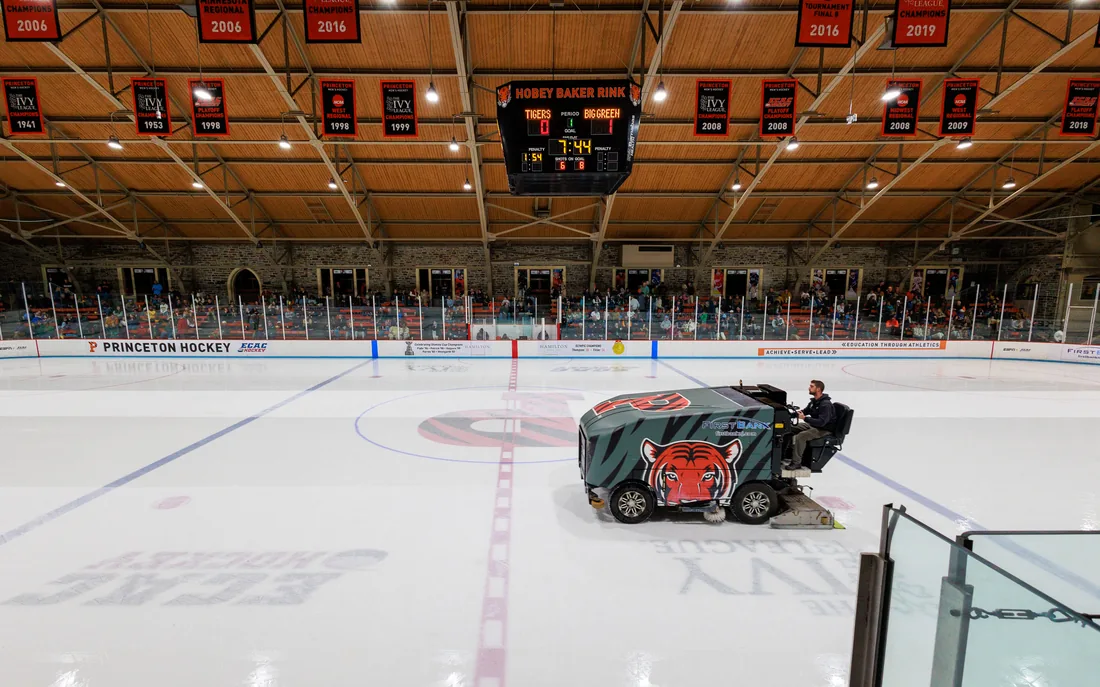
CC BY 4.0, Kenneth C. Zirkel. Original photographic color or monochrome retained; resized as WebP. Source · License record.

Three responses. About 300 words.
Complete all three. Each targets 90–110 words. Use the readings and image labels as evidence. You do not need to complete the other assignment.
Assignment B saves and turns in separately. Use your usual Hall Pass PIN. Work already started in the earlier full edition remains in the preserved original assignment.