S1 · CIA, Natural Spies (2024) ↗
The agency’s retrospective: 1964–1967, working equipment, limited tests and its rejection of the taxi story. It is also the institution defending its own conduct.

hidden history · 1964–1967 · 15–20 minutes
One microphone. One transmitter. One agent with absolutely no interest in the assignment.
open the case ↓Modern generated illustration · not archival evidence
Imagine two people talking on a bench. A stranger walking up with a microphone changes the conversation. A cat wandering over might not. During the Cold War, when the United States and Soviet Union competed for military and political advantage, the CIA investigated exactly that possibility. Its 2024 history dates the cat experiment to 1964. The ridiculous part of the story is real: the agency tried turning a living cat into a mobile listening device. S1
According to the CIA, a microphone went into an ear, a transmitter under the skin, and an antenna into the fur. The animal was part of the experiment; it could not be treated like an ordinary piece of equipment. The agency says the equipment worked. A useful operation required something more difficult: the cat had to approach the right conversation, remain unnoticed and stay there. Imagine a delivery app that works perfectly except the driver chooses every destination. S1
try the evidence
Illustrative mission exercise, not a reconstruction of a specific test. Try all three positions. Each fixes one problem and exposes another.
simplified interpretation
The microphone needs the right location. The cat does not owe you that location.Choose a control to examine the evidence.
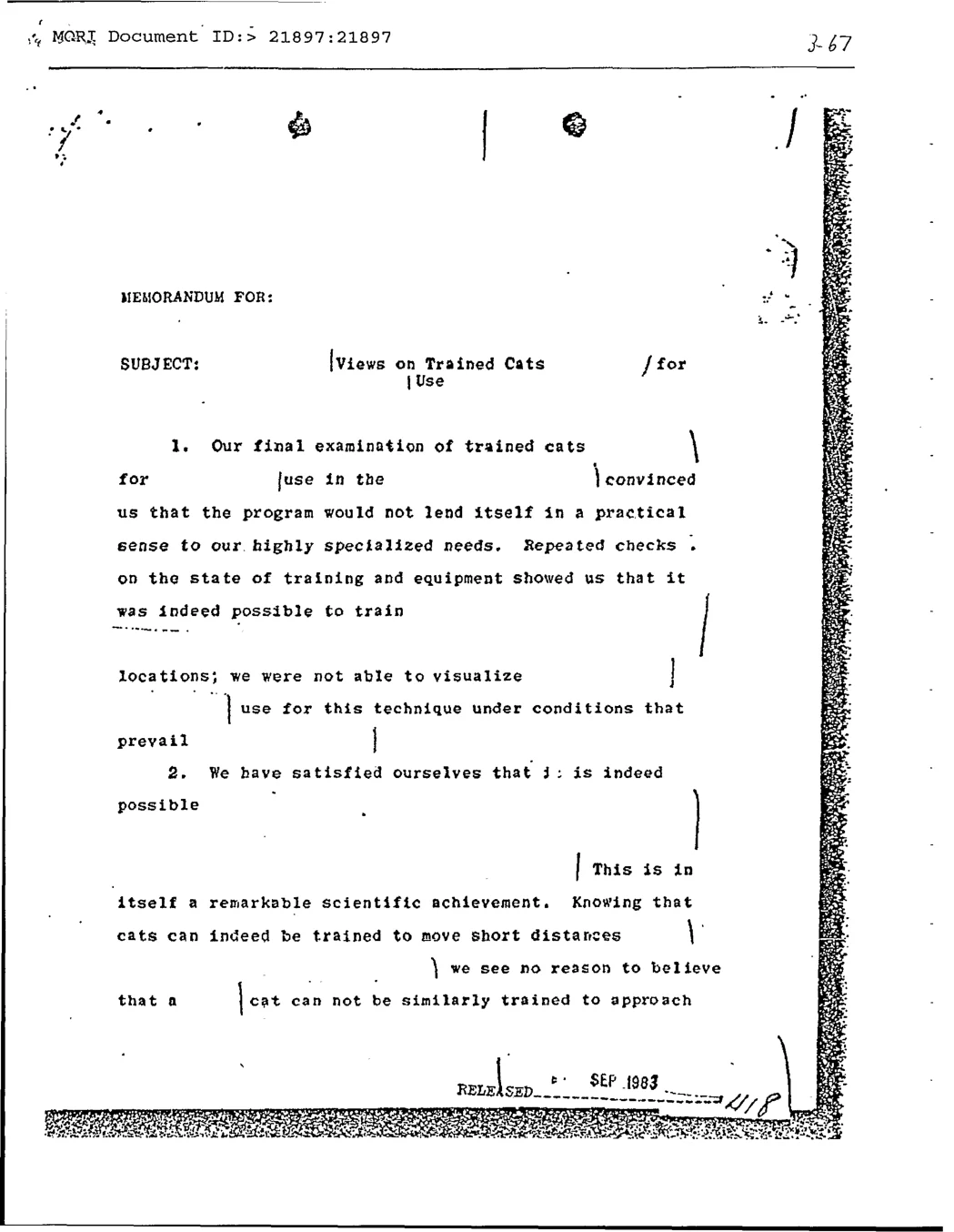
The agency says limited field tests exposed a control problem: the animal went where it wanted. That is different from proving cats cannot learn anything. The surviving 1967 memo acknowledges training achievements but rejects the technique as practical for the agency’s specialized needs. Laboratory success and a reliable mission are different tests. Use the listening-position exercise, then think about who actually controls the route. S1, S2
Close to the project’s end. Establishes the agency’s practicality judgment. Names and operational details are redacted.
A later institutional account. Supplies the agency’s version of the equipment and disputed taxi story. Does not become an independent witness just because it is official.
You may have heard that a taxi killed the cat on its first mission. Later accounts disagree. Smithsonian reported both that story and a former CIA technical official’s rejection of it in 2013. In 2024 the CIA explicitly called it a myth and said the cat was unharmed. That later statement matters, but it is still an agency account. The careful conclusion is that the taxi story is disputed and should not be presented as a documented ending. S1, S3
case in 28 seconds
Silent captioned recap. Original generated illustration, not archival footage. The written story and sources carry the full explanation.
A redaction is missing information. It does not authorize us to fill the blank with the wildest explanation. Document 27 gives us a contemporary judgment that the technique was impractical in a foreign operational setting. It does not settle every later anecdote about the animal. Compare the two source cards: one was written as the project ended; the other was published decades later for the public. Each can answer a different question. S2
The program ended in 1967; the CIA says the cat was never used operationally. We can establish an unusual research project and a practical failure without pretending to know every detail. Calling the project real does not make every story attached to it real. Your strongest ending keeps the secret experiment, the unreliable delivery system and the disputed taxi anecdote in separate sentences. S1
your verdict
A working microphone is not a controllable spy.
Answer in your own words. Source IDs refer to the records below. Use the shared work controls to load, back up or turn in your work.
check the record
Historical research checked October 27, 2026. A source may establish one claim while leaving another unresolved.
The agency’s retrospective: 1964–1967, working equipment, limited tests and its rejection of the taxi story. It is also the institution defending its own conduct.
Document 27 is a contemporary, heavily redacted CIA memo. Use its conclusion about practicality; the archive’s accompanying taxi anecdote is a separate later account.
Interviews report conflicting recollections of the program and the cat’s fate. Useful for comparing testimony, rather than treating one entertaining version as settled.
Cover and recap visuals: modern illustrations created for this lesson with ImageGen. They establish atmosphere and are not primary sources. The silent recaps use those illustrations and the cited historical summary. Any classroom scenario, paraphrase or model is labeled.
Corrections: bring a conflicting source to your teacher. Identify the claim, the source ID and the evidence that changes it.