S1 · NSA National Cryptologic Museum, Great Seal (2021) ↗
Explains the 1945 gift, 1952 discovery, passive resonator and external radio illumination. The displayed museum item is a replica.
hidden history · 1945–1960 · 15–20 minutes
The embassy accepted the present. The hidden microphone waited for someone outside to switch it on.
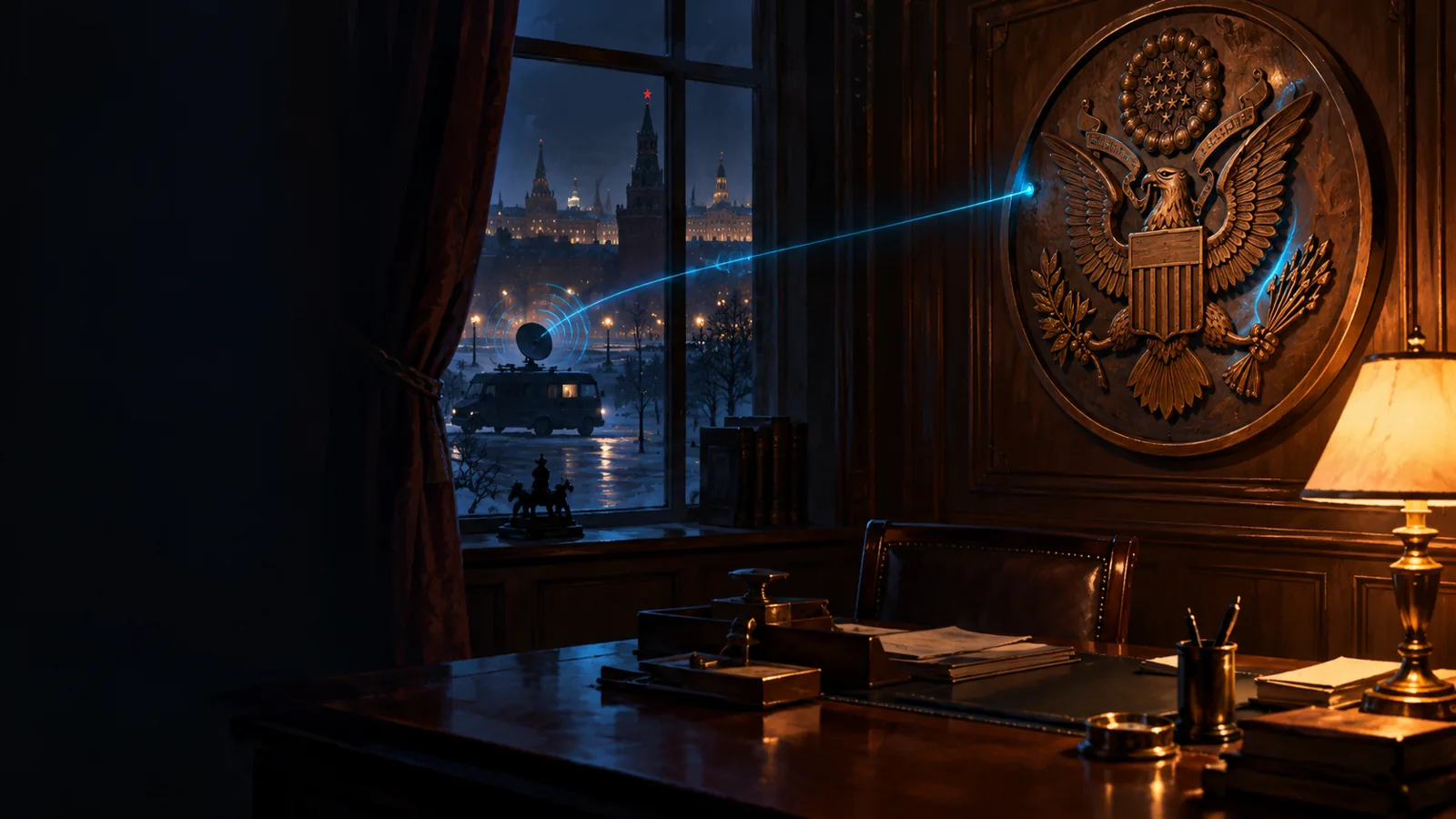
open the case ↓Modern generated illustration · not archival evidence
In August 1945 Soviet schoolchildren presented a carved wooden Great Seal of the United States to the American ambassador. The carving hung in the ambassador’s Moscow residential office. A national emblem in a diplomatic office seemed appropriate. That social setting helped place a covert device near private conversations. The gift was not merely camouflage; it supplied a reason for the object to remain in a valuable location. S1
Inside was a listening device later nicknamed “The Thing.” Unlike an ordinary self-powered radio transmitter, it had no internal battery. It used energy from a radio beam directed at it from outside. That made a search for familiar wiring or an always-broadcasting signal less useful. A failed search can tell you something about the search method as well as the room. S1, S2
try the evidence
Conceptual model. Sound is represented visually; no microphone is used and no audio is recorded. The beam must be on before the model returns a signal.
simplified interpretation
Beam OFF. Room speech alone produces no usable returning signal in this conceptual model.Choose a control to examine the evidence.
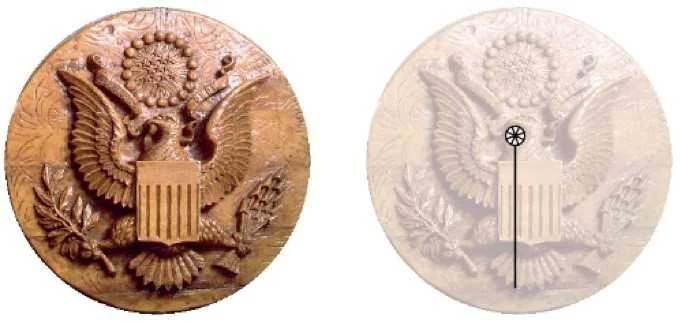
The mechanism was a passive cavity resonator. In plain language, speech in the room vibrated a thin membrane. When the external beam illuminated the device, those vibrations altered the reflected radio signal. Receivers outside could recover the speech. Our beam switch below shows the dependency: no external illumination, no useful reflected audio in this simplified model. It is a conceptual explanation; the real mechanism was more complex. S1, S3
The device was discovered in 1952 during the period when George Kennan was ambassador. Its intermittent activation made detection difficult. Toggle the beam and run both scans. A quiet result while the beam is off does not demonstrate that the plaque is harmless. Equally, one real bug does not mean every gift is bugged. Both conclusions require evidence that fits the claim. S2
No active return under those conditions. It does not establish that no passive device is present.
A returning signal under illumination. Now there is a different observation to investigate.
In May 1960, after the Soviet Union shot down an American U-2 reconnaissance plane, the United States displayed the Great Seal deception at the United Nations. The exhibit helped demonstrate that espionage ran in both directions. Revealing somebody else’s spying did not make the American flight disappear. The public display was evidence and an argument delivered at a politically useful moment. S2
case in 28 seconds
Silent captioned recap. Original generated illustration, not archival footage. The written story and sources carry the full explanation.
NSA museum video · the Great Seal ↗
Optional later video supplement. Opens the original publisher; school networks may block playback.
The hidden device and its operating principle are documented. The CIA’s retrospective says exactly what information was compromised is difficult to determine. Avoid turning years of possible access into a claim that every conversation was recorded continuously. Also read museum captions: the NSA and International Spy Museum identify their displayed versions as replicas or reproductions. A replica can explain a mechanism while remaining a different object from the original. S1, S2, S3
your verdict
A silent scan is evidence about a condition, not proof of an empty room.
Answer in your own words. Source IDs refer to the records below. Use the shared work controls to load, back up or turn in your work.
check the record
Historical research checked October 27, 2026. A source may establish one claim while leaving another unresolved.
Explains the 1945 gift, 1952 discovery, passive resonator and external radio illumination. The displayed museum item is a replica.
Explains the lack of an internal power source, discovery and 1960 public display. Notes uncertainty about exactly what information was compromised.
Explains sound-driven modulation of the reflected beam and clearly identifies its displayed objects as later reproductions.
Cover and recap visuals: modern illustrations created for this lesson with ImageGen. They establish atmosphere and are not primary sources. The silent recaps use those illustrations and the cited historical summary. Any classroom scenario, paraphrase or model is labeled.
Corrections: bring a conflicting source to your teacher. Identify the claim, the source ID and the evidence that changes it.