S1 · U.S. Army, Ghost Army deception tactics (2021) ↗
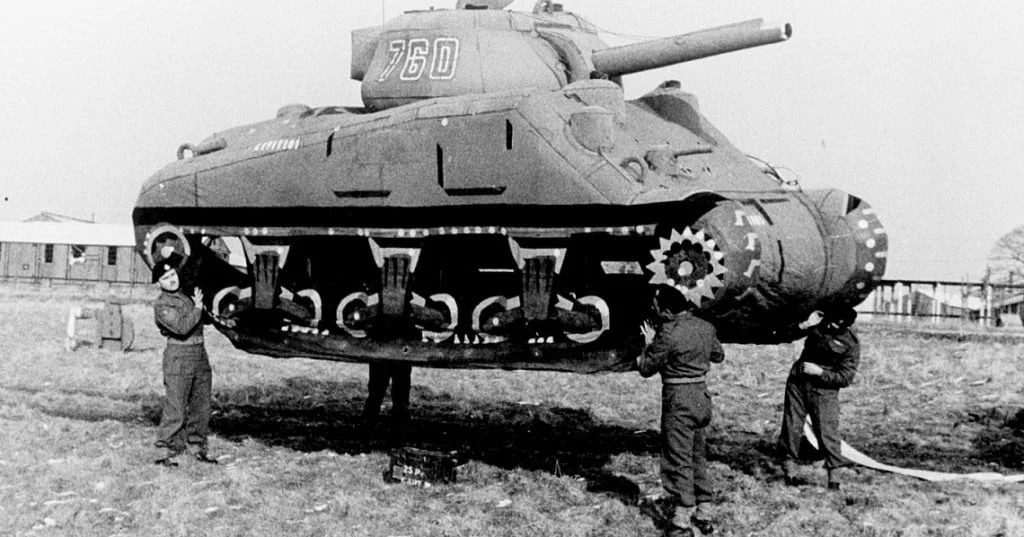
Describes the 1,100-person 23rd Headquarters Special Troops and its visual, sonic, radio and impersonation methods. Includes a National Archives photograph of a dummy tank.
hidden history · 1944–1945 · 15–20 minutes
Rubber tanks. Recorded engines. Fake radio traffic. Real soldiers close enough to the front to be in danger.
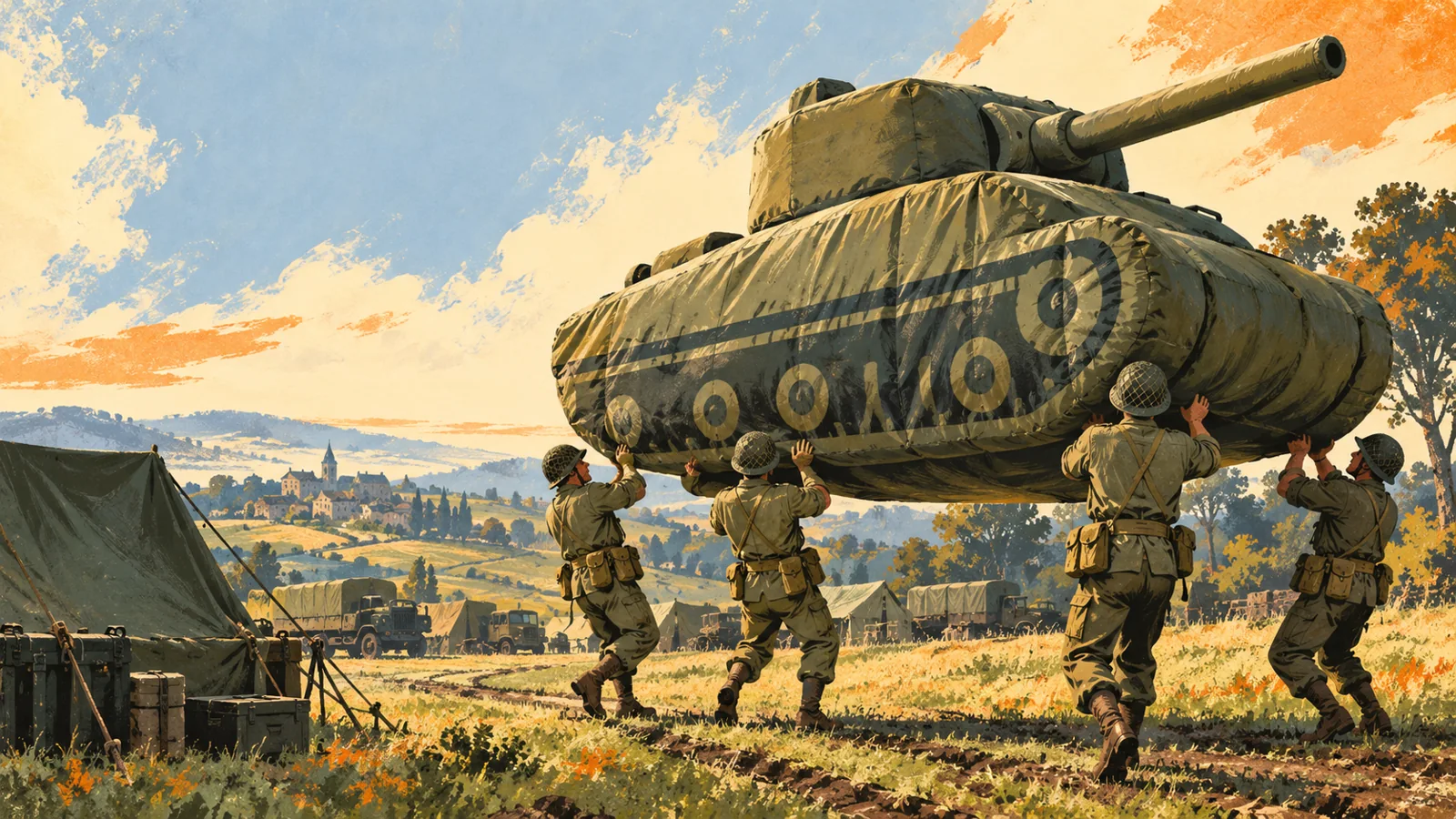
open the case ↓Modern generated illustration · not archival evidence
In 1944 the U.S. Army activated the 23rd Headquarters Special Troops for battlefield deception. Roughly 1,100 men helped create the appearance of much larger forces. Their job was not simply to hide American activity. Sometimes it was to attract attention to a place where the real attack was not happening. The name “Ghost Army” describes a manufactured impression, not supernatural soldiers. S1, S2
Inflatable dummy tanks and other equipment could suggest a force when viewed from a distance. Up close, the illusion could collapse: a tank that several people can lift is not a working armored vehicle. Distance changes what an observer can resolve. That is why a photograph can be accurate about what the camera saw while supporting a mistaken conclusion about what stood there. The trick exploited the observer’s limited viewpoint. S1
try the evidence
Simplified interpretation exercise. These combinations are not historical enemy assessments or measured confidence scores.
simplified interpretation
A distant observer has an incomplete view. Add a cue or inspect from closer.Choose a control to examine the evidence.
A silent camp full of motionless tanks might invite suspicion. Specialized sonic units used recorded military sounds and powerful playback equipment to suggest vehicles, construction and troop movement. Sound supplied a second kind of cue. It mattered that the cues fit the visual story, rather than merely making impressive noise. Try adding the channels and notice how your explanation changes when several signals agree. S2
Radio operators could imitate traffic associated with real units. Soldiers also used impersonation and other visible details to reinforce the story. An enemy analyst might see a camp, hear movement and intercept messages that seem to corroborate one another. But several channels can share one source: the same deception team. Multiple signals are not automatically independent evidence. That is the reasoning problem our board makes visible. S1
A photograph, a recording and radio traffic can appear to support the same conclusion.
If a single team designed all three, they are parts of one deception. Ask how each item was produced.
The 23rd worked near the front and could attract actual enemy attention. The Army museum records three members killed and dozens wounded during its wartime service. Those men were not safe merely because their tanks were inflatable. The 3133rd Signal Service Company carried out a separate sonic-deception mission in Italy; it should not be casually folded into every story about the 23rd. Precise unit names help keep the history straight. S3
case in 28 seconds
Silent captioned recap. Original generated illustration, not archival footage. The written story and sources carry the full explanation.
Official Army video · Ghost Army artists ↗
Optional later video supplement. Opens the original publisher; school networks may block playback.
Postwar secrecy delayed broad recognition. The soldiers’ props, recordings and photographs now help document the deception. That creates a useful puzzle: the photograph of a fake tank is not necessarily a fake photograph. It may be genuine evidence that somebody constructed a decoy. Before dismissing or accepting an image, identify which claim you are asking it to prove. “A tank shape existed” and “an armored division was stationed there” demand different evidence. S1, S2
your verdict
Three convincing signals can still come from one deception.
Answer in your own words. Source IDs refer to the records below. Use the shared work controls to load, back up or turn in your work.
check the record
Historical research checked October 27, 2026. A source may establish one claim while leaving another unresolved.
Describes the 1,100-person 23rd Headquarters Special Troops and its visual, sonic, radio and impersonation methods. Includes a National Archives photograph of a dummy tank.
Explains recording and playback, January 1944 activation, specialized components and postwar secrecy.
Distinguishes the 23rd from the separate 3133rd unit, describes operational risk and museum artifacts. Casualty claims refer to the 23rd.
A short official video supplement. Third-party playback can be unavailable on school networks; the complete story remains in the lesson.
Cover and recap visuals: modern illustrations created for this lesson with ImageGen. They establish atmosphere and are not primary sources. The silent recaps use those illustrations and the cited historical summary. Any classroom scenario, paraphrase or model is labeled.
Corrections: bring a conflicting source to your teacher. Identify the claim, the source ID and the evidence that changes it.