S1 · Smithsonian, the surviving nose cone ↗
Museum object 1981.0997.02, gift of B. F. Skinner. A surviving experimental apparatus establishes development, not combat deployment.
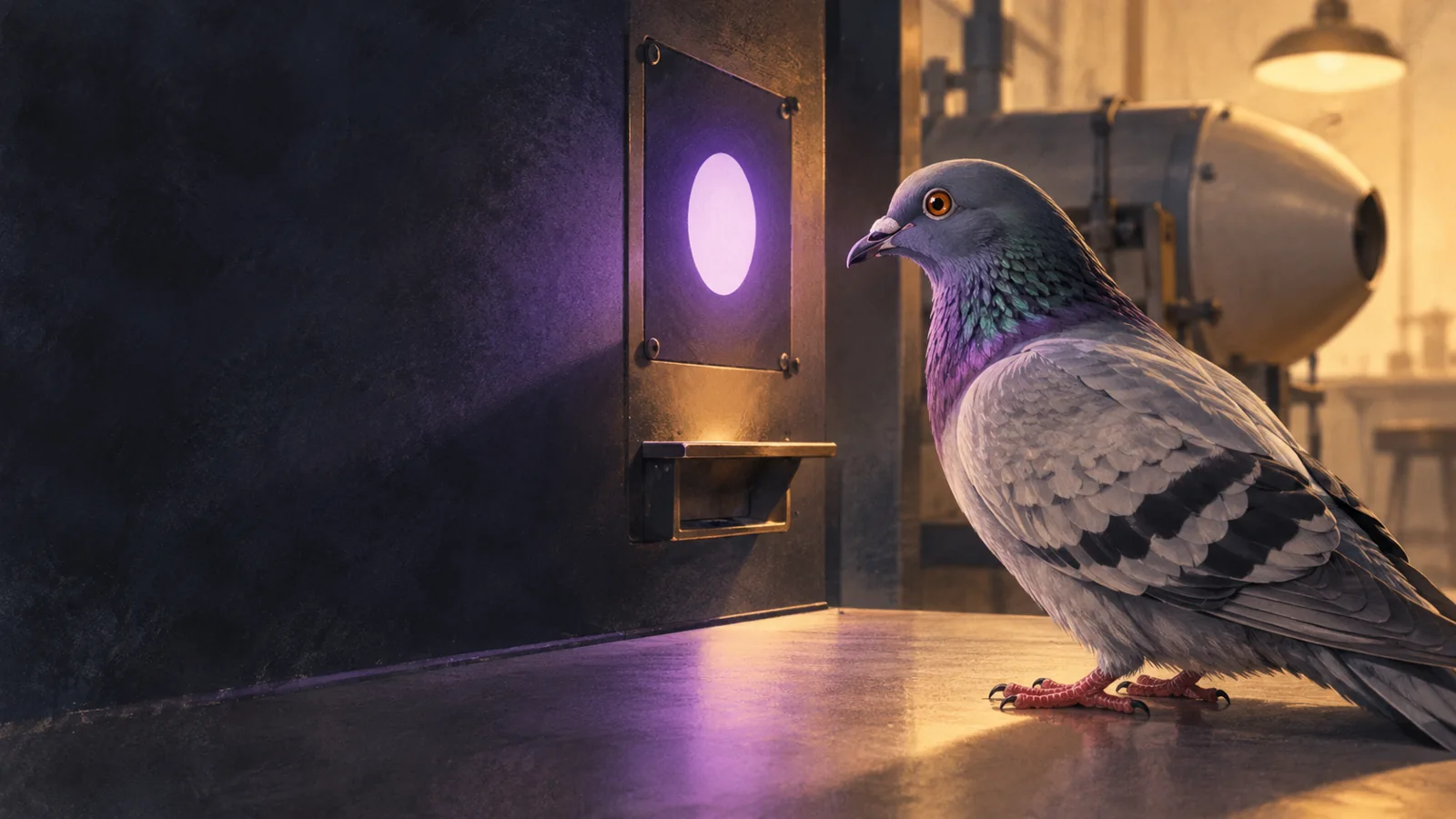
hidden history · 1940s–1950s · 15–20 minutes
Before dependable electronic guidance, a psychologist proposed putting the pilot inside the nose cone. The pilot was a pigeon.
open the case ↓Modern generated illustration · not archival evidence
During World War II, researchers were trying to improve how weapons reached moving targets. Psychologist B. F. Skinner proposed an unusual guidance system: trained pigeons inside a nose cone. His work used a basic learning principle. A behavior followed by a reward may become more likely. The bird did not need to understand war, geography or a flight plan. It needed to perform a trained response to a visible image. S1, S2
The experimental system presented a target image to a pigeon. Training encouraged pecks at the target, and those responses could be used in a guidance concept. A surviving Smithsonian nose cone has compartments for three birds. This is not a story about pigeons carrying messages or homing to a loft. Those are different uses of the same species. Here the proposed contribution was visual tracking inside an experimental apparatus. S1
try the evidence
Invented conceptual exercise. The feedback is explanatory; it does not measure how quickly a real pigeon learns.
simplified interpretation
The bird is responding to a display, not reading a human mission plan.Choose a control to examine the evidence.
Use the invented training board. Choosing the target produces a reward; choosing the background does not. This is a conceptual demonstration, not an animal-learning experiment or a historical performance record. The point is that a reliable-looking behavior can be shaped without the subject understanding the whole system. You can distinguish “the bird pecked the image” from “the bird understood the mission.”
General Mills provided technical support, and the project received wartime government attention. The work was more substantial than an amusing sketch on a napkin. Later, the Navy revived the idea under the name Orcon, short for organic control. But a funded program and a convincing demonstration still leave questions about reliability, integration and the alternatives available to a military service. S3
A bird can learn to respond to a target image. That can be observed directly.
A fielded weapon requires the complete system to work reliably in conditions a laboratory demonstration may not reproduce.
The Skinner Foundation preserves a silent film showing target training. Look for the response the film actually records. A bird pecking at a display establishes that behavior under those conditions. It does not show a missile reaching an enemy ship. A film can be authentic while an exciting caption asks it to prove more than it contains. Open the original film link beside the recap and make that distinction yourself. S2
case in 28 seconds
Silent captioned recap. Original generated illustration, not archival footage. The written story and sources carry the full explanation.
Historical training film · B. F. Skinner Foundation ↗
Optional later video supplement. Opens the original publisher; school networks may block playback.
The birds were never used in combat, and the later program ended as electronic guidance became a more practical option. The remaining apparatus helps document a serious, strange engineering approach. It does not establish that pigeon-guided weapons fought a secret war. A useful ending gives the research its due while keeping the laboratory, the proposed system and operational service separate. S1, S3
your verdict
A bird can learn the task without understanding the mission.
Answer in your own words. Source IDs refer to the records below. Use the shared work controls to load, back up or turn in your work.
check the record
Historical research checked October 27, 2026. A source may establish one claim while leaving another unresolved.
Museum object 1981.0997.02, gift of B. F. Skinner. A surviving experimental apparatus establishes development, not combat deployment.
Includes a silent historical film of training and a link to Skinner’s own retrospective. Film of a trained response is not film of a weapon flying in combat.
Retrospective history of the project, General Mills support and the later Orcon program. Distinguish demonstrations from operational service.
Visuals: modern illustrations created for this lesson with ImageGen. They establish atmosphere and are not primary sources. The silent recaps use those illustrations and the cited historical summary. Any classroom scenario, paraphrase or model is labeled.
Corrections: bring a conflicting source to your teacher. Identify the claim, the source ID and the evidence that changes it.