S1 · U.S. Army historian, Bats Over Tokyo (2008) ↗
Traces the 1942 proposal, development problems, a 1943 accidental fire and the program’s cancellation. A retrospective, not a combat report.
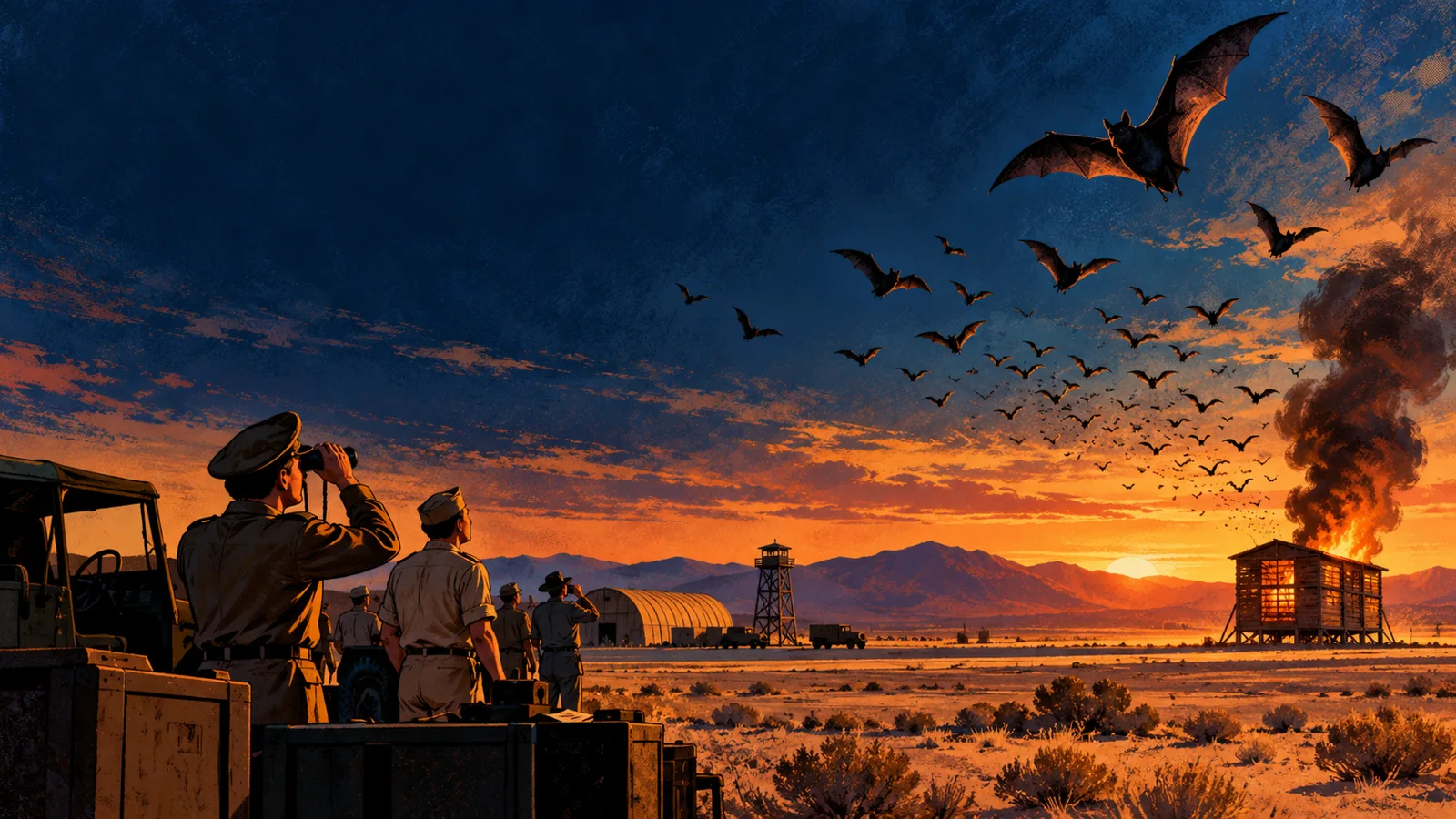
hidden history · 1942–1944 · 15–20 minutes
The plan: burn enemy buildings. The test: burn the buildings on your own side.
open the case ↓Modern generated illustration · not archival evidence
In January 1942, shortly after Pearl Harbor, a Pennsylvania dentist proposed using bats to carry small incendiaries into Japanese buildings. An incendiary starts a fire. The idea depended on an ordinary animal habit: bats find dark places to rest. Military researchers took the proposal seriously. A plan can sound absurd and still receive actual government attention; that is why we check records before deciding whether it happened. S1
The planners wanted many scattered fires in the wooden structures of Japanese cities. That means this is a story about attacks on inhabited places, not merely a funny animal invention. The proposed delivery system combined aircraft, containers and living animals. Every transition had to work. The Air Force’s history confirms testing, while also stating that the weapon was never used operationally. Testing a plan is not the same as deploying it against an enemy. S3
try the evidence
Simplified reasoning board. Select a stage to see why one successful component would not establish the whole mission.
simplified interpretation
Five assumptions connect the idea to the intended outcome. Select any stage.Choose a control to examine the evidence.
Researchers had to keep bats inactive during transport and have them wake at the right point after release. Some failed to wake in time; others did not go where the researchers wanted. The basic problem was control across an entire sequence. Our five-stage board below is a simplified way of reasoning about that problem. It is a conceptual checklist, without invented success rates. It asks which assumption breaks the mission. S1
A 1943 test incident in New Mexico turned the plan against American facilities. Armed bats escaped or woke prematurely and roosted in buildings at an auxiliary airfield, starting fires. The National Park Service recounts the incident in its Carlsbad history. Later retellings vary on the extent of the damage; we do not need an inflated destruction claim to recognize the failure. The intended behavior—seeking shelter—also made the animals dangerous at the test site. S2
Under test conditions, the animals and incendiaries could start unintended building fires.
Therefore they could deliver a predictable, controllable, effective attack in combat. That requires separate evidence.
A building fire demonstrated that the combination could ignite structures. It did not show that the military could choose the structures, control the timing, protect its own personnel or use the method reliably in an actual attack. That distinction is an inference from the test, not a quotation from a commander. Make the same distinction when you see a viral demonstration of a new invention: ask what was tested and what was merely promised.
case in 28 seconds
Silent captioned recap. Original generated illustration, not archival footage. The written story and sources carry the full explanation.
Responsibility passed between military services, but the program ended in 1944. It never became the combat weapon its advocates imagined. That ending does not prove the project was fake, and the earlier fire does not prove it was combat-ready. An accurate account can hold both facts at once. It can also ask whether using animals and targeting urban buildings deserved scrutiny before a test began. S1, S3
your verdict
Starting a fire and controlling a mission are different achievements.
Answer in your own words. Source IDs refer to the records below. Use the shared work controls to load, back up or turn in your work.
check the record
Historical research checked October 27, 2026. A source may establish one claim while leaving another unresolved.
Traces the 1942 proposal, development problems, a 1943 accidental fire and the program’s cancellation. A retrospective, not a combat report.
Describes the Carlsbad test incident and why animal behavior complicated delivery. The broad scale of the damage is described differently in later retellings.
Confirms actual air-drop testing and that the weapon was never used operationally. The historical record separates an actual test from an operational weapon.
Visuals: modern illustrations created for this lesson with ImageGen. They establish atmosphere and are not primary sources. The silent recaps use those illustrations and the cited historical summary. Any classroom scenario, paraphrase or model is labeled.
Corrections: bring a conflicting source to your teacher. Identify the claim, the source ID and the evidence that changes it.