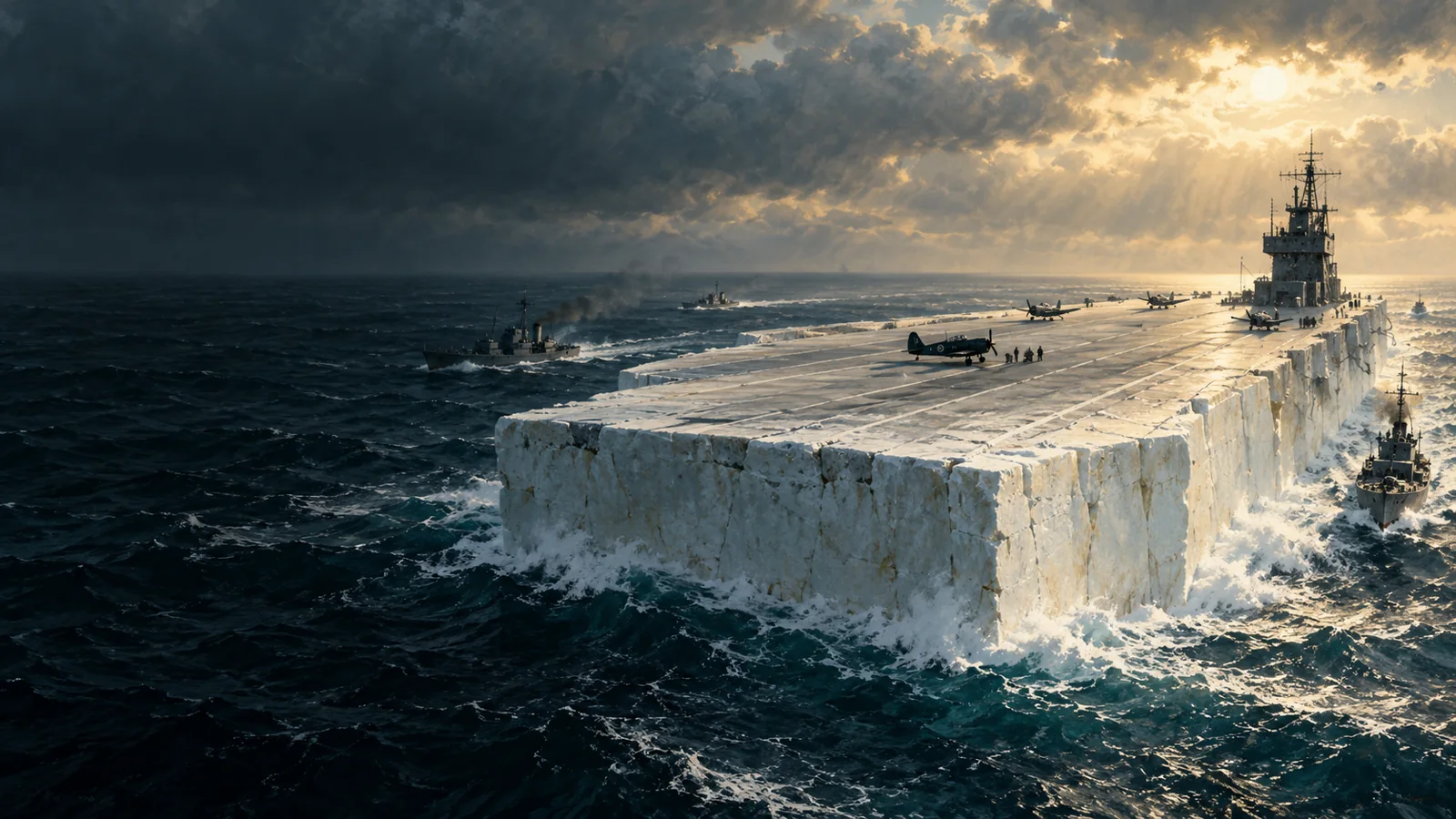
The ocean was full of submarines. The middle of the Atlantic was beyond many aircraft. One proposed answer was a runway made from frozen water and wood pulp.
Modern generated illustration · not archival evidence
byte 01
A runway where there was no runway
During World War II, German submarines attacked the ships carrying supplies across the Atlantic. Convoys could receive air protection near land, but many aircraft could not cover the middle of the ocean. Planners considered an extraordinary answer: build a floating airfield so large that aircraft could use it far from shore. The proposed structure would be made largely from frozen material. The problem was serious even if the proposed answer sounds like a joke. S1, S3
byte 02
The ice had an extra ingredient
Ordinary ice is brittle. Researchers investigated a tougher mixture of ice and wood pulp called pykrete. Reinforcement changed its behavior and made an enormous frozen structure more interesting to engineers. But the mixture was still a material that needed suitable conditions. A block surviving a demonstration would not by itself establish that an entire ship could be built, maintained, moved and operated. That gap between a material and a system is the center of this case. S1
try the evidence
Build the requirements, not just the hull.
Qualitative planning board, not a strength or heat-flow simulation. Each step adds a different requirement; it gives no measured historical performance.
simplified interpretation
MATERIAL + SUPPORT SYSTEM + USEFUL MISSION. Select a requirement to inspect what it leaves unanswered.
MATERIAL reinforced ice
SUPPORT cold and structure
MISSION cost and alternatives
Choose a control to examine the evidence.
byte 03
The Canadian lake was real
In 1943, a secret refrigerated test model took shape on Patricia Lake near Jasper, Alberta. The local museum describes an insulated wooden frame and an ice hull kept cold by equipment on board. This was more than a drawing, and less than a giant carrier serving in the Atlantic. Work on the model offered evidence about a specific experiment. It did not silently turn the full proposal into an operational fleet. S2
byte 04
Now pay for the cold
The conceptual requirements board above lets you add reinforced ice, cooling equipment and a full mission. No invented strength percentages or melting times are supplied. The actual project required insulation, refrigeration, steel, labor and money. A seemingly abundant raw material could still demand a complicated support system. Ask the whole engineering question: what must remain true for this object to keep doing its job? The answer includes far more than whether it initially floats. S1, S3
Two pictures, two different claims
The model on the lake
Evidence that a refrigerated test structure was constructed. Its scale and purpose matter.
The full-size carrier illustration
An image of what planners hoped to build. It documents the concept, not a ship that entered service.
byte 05
The problem changed while the solution grew
Wartime alternatives improved. Longer-range aircraft, escort ships, better radar and additional bases changed the original need for a huge frozen airfield. A proposal can become less useful even while researchers learn something valuable. The question was not simply “could anyone make this float?” It was also “would this be ready soon enough, at a useful cost, compared with other ways to protect shipping?” The giant carrier was never built for service. S1, S3
case in 28 seconds
The short version
Silent captioned recap. Original generated illustration, not archival footage. The written story and sources carry the full explanation.
Read the complete video transcript
Wartime planners needed air cover in the middle of the Atlantic.
Project Habbakuk investigated an enormous carrier made with reinforced ice.
A refrigerated model was built in Canada, but the full ship required much more.
Costs, engineering and better alternatives stopped the giant carrier.
byte 06
What sank was not a giant warship
The Patricia Lake test structure eventually lost its refrigeration and melted, leaving remains beneath the water. Those remains help document a real experiment. They are not the wreck of a secret, full-size carrier that fought an unrecorded battle. The strongest account is already remarkable: wartime governments investigated a frozen aircraft carrier, tested part of the idea and did not take the enormous final step. An abandoned proposal can be real history without a hidden operational ending. S2
your verdict
What can you defend?
A real test model does not put a giant carrier into service.
Answer in your own words. Source IDs refer to the records below. Use the shared work controls to load, back up or turn in your work.
check the record
Sources & limits
Historical research checked October 28, 2026. A source may establish one claim while leaving another unresolved.
The participating research institution explains the air-coverage problem, reinforced ice, the prototype and the material, refrigeration and strategic obstacles. Its full-size carrier image is labeled a fantasy illustration.
Local museum account of the 1943 refrigerated test model and its surviving site. A test structure on a Canadian lake is different from an operational Atlantic carrier.
Describes the mid-Atlantic air gap, experimental construction and the engineering and changing wartime requirements. Retellings differ on some demonstration anecdotes; this lesson does not depend on them.
Visuals: modern illustrations created for this lesson with ImageGen. They establish atmosphere and are not primary sources. The silent recaps use those illustrations and the cited historical summary. Any classroom scenario, paraphrase or model is labeled.
Corrections: bring a conflicting source to your teacher. Identify the claim, the source ID and the evidence that changes it.