S1 · NASA, New View of the City Under the Ice (2024) ↗
New radar imagery of the known Camp Century site. It shows a Cold War base, not a newly discovered ancient civilization.
hidden history · 1959–2024 · 15–20 minutes
The base had rooms, tunnels and a nuclear power plant. The bigger plan depended on one bad assumption: that the ice would behave like land.
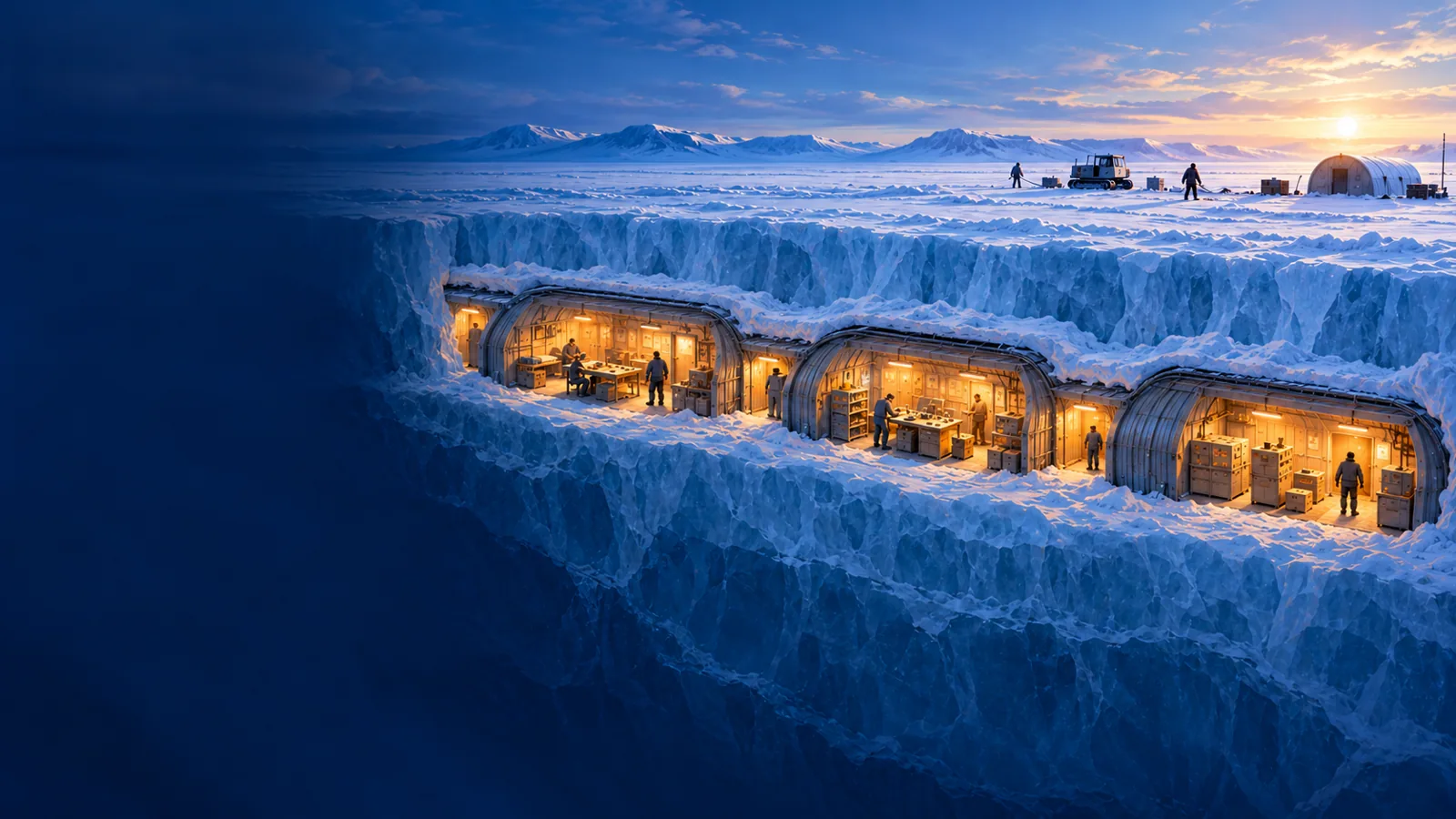
open the case ↓Modern generated illustration · not archival evidence
In 1959 the U.S. Army Corps of Engineers built Camp Century within the Greenland Ice Sheet. Workers cut trenches near the surface, covered them and installed a small community of rooms and corridors. A portable nuclear power plant supplied electricity. Greenland was strategically important during the Cold War because the Arctic lay between North America and the Soviet Union. The camp was real, with real people living under the snow. S1, S2
Camp Century also helped test the feasibility of a much larger military concept: Project Iceworm. Planners considered a network beneath the ice that could support as many as 600 ballistic missiles. The scale of that proposal is not the scale of the camp that was built. The larger missile network was never realized. Do not turn a plan for 600 missiles into a claim that 600 missiles were secretly installed there. S2
try the evidence
Conceptual comparison, not an engineering simulation. The visual change illustrates deformation without assigning a real rate or date.
simplified interpretation
A room can be real while the proposed network remains unbuilt.Choose a control to examine the evidence.
Ice can look still while slowly deforming and moving. Rooms and tunnels that require stable shapes face a continuing maintenance problem in such a setting. Test the assumption on the conceptual board. It does not calculate Greenland’s actual flow rates or reproduce engineering measurements. It makes one dependency visible: a rigid facility needs its surroundings to remain compatible with its structure.
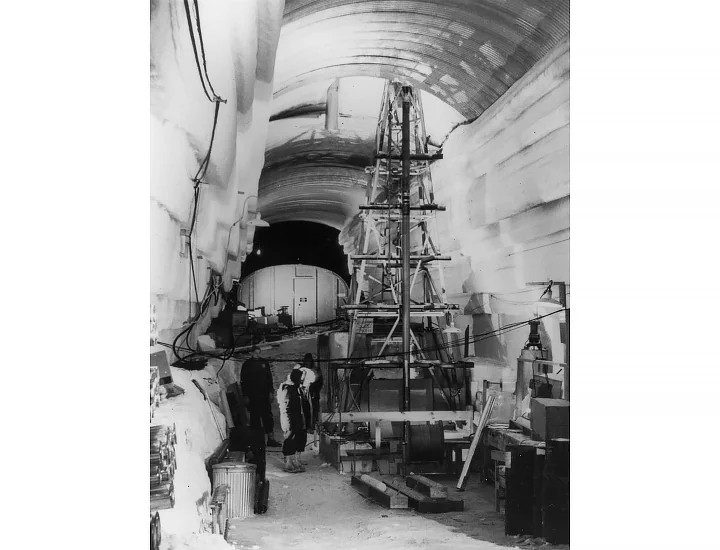
The Army made a film showing Camp Century’s construction and life beneath the ice. A promotional film has a purpose, but that does not make every frame false. Ask what it directly shows: workers, structures and equipment. Ask separately what it emphasizes or leaves out. A functioning camp in a selected scene would not establish that a vast, long-lived missile system was practical. S3
Camp Century: a real experimental base, corridors, living spaces, equipment and a power plant.
Iceworm: a much larger network intended to support hundreds of missiles. That network was not built.
Camp Century was abandoned during the 1960s, while its scientific legacy continued through samples and research. In 2024 NASA radar produced a striking new view of structures now buried farther beneath the ice. “A new image of a known base” is a different claim from “a lost civilization discovered.” The age and origin of the site matter more than the dramatic appearance of a radar picture. S1, S2
case in 28 seconds
Silent captioned recap. Original generated illustration, not archival footage. The written story and sources carry the full explanation.
Historical Army film · Camp Century ↗
Optional later video supplement. Opens the original publisher; school networks may block playback.
The abandoned site has also raised questions about waste and changing ice conditions. Scientific studies have used different observations, models and climate scenarios; those should not be compressed into a guaranteed date when the camp will emerge. For this case, the central historical distinction is secure: Camp Century existed, but the proposed Iceworm missile network did not. Evidence for the base cannot do the work of evidence for the entire plan. S2, S4
your verdict
A real base is not proof that its much larger proposed network existed.
Answer in your own words. Source IDs refer to the records below. Use the shared work controls to load, back up or turn in your work.
check the record
Historical research checked October 27, 2026. A source may establish one claim while leaving another unresolved.
New radar imagery of the known Camp Century site. It shows a Cold War base, not a newly discovered ancient civilization.
Primary research distinguishes Camp Century from the unrealized Iceworm concept. Its future waste-exposure discussion uses climate scenarios; it is not a certain countdown.
The Army’s historical promotional film documents construction and daily life. It is useful evidence of the base and of how the Army presented its work.
Later scientific assessment of site conditions. Present-day monitoring and future projections are separate from the 1960s engineering failure.
Visuals: modern illustrations created for this lesson with ImageGen. They establish atmosphere and are not primary sources. The silent recaps use those illustrations and the cited historical summary. Any classroom scenario, paraphrase or model is labeled.
Corrections: bring a conflicting source to your teacher. Identify the claim, the source ID and the evidence that changes it.