S1 · Royal Navy Museums, HMS Seraph and Mincemeat ↗
Describes the submarine delivery off Spain on April 30, 1943 and the false Greece/Sardinia invasion story.
hidden history · 1943 · 15–20 minutes
Britain gave a dead man an invented identity. His paperwork had to survive an enemy’s curiosity.
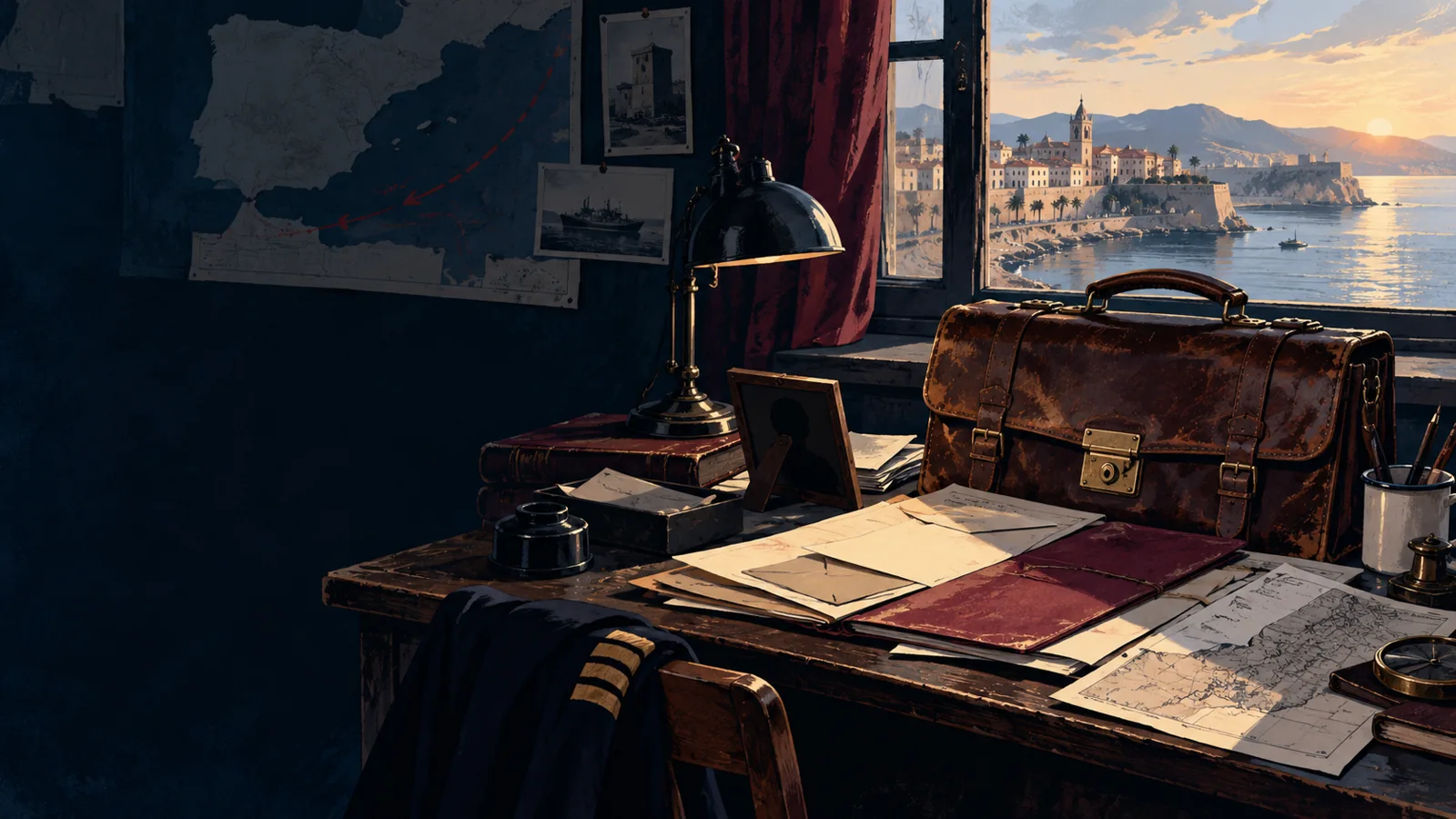
open the case ↓Modern generated illustration · not archival evidence
In 1943 the Allies were preparing to invade Sicily, the large island off southern Italy. Britain wanted German leaders to expect the main attack somewhere else. Rather than send an obvious false message directly, intelligence officers arranged for the enemy to discover apparently private evidence. A found secret can feel more believable than an announcement because the finder believes it was never intended for them. S1, S2
British officers built a Royal Marine identity called Major William Martin around the body of a real man. Personal papers and a supposed romantic life helped make the identity look lived-in. The National Archives preserves the photograph used as “Pam,” the supposed girlfriend. The ordinary-looking details were part of the deception, not unrelated decoration. Our pocket exercise asks what each sort of item might establish and what it could never prove. S2, S3
try the evidence
Simplified evidence exercise using types of planted material. The item descriptions below are explanatory paraphrases, not facsimile transcriptions.
simplified interpretation
What makes an invented identity feel lived-in? Choose a type of planted evidence.Choose a control to examine the evidence.
HMS Seraph delivered the body off Spain on April 30, 1943. The planted documents suggested Allied attacks on Greece and Sardinia, distracting from Sicily. Spain was officially neutral, but the planners expected German intelligence to obtain the papers through contacts there. This was an attempted chain of human decisions: discovery, examination, copying, forwarding and belief. The British could prepare the evidence without directly controlling every person who handled it. S1
A romance did not prove a military plan. It made the carrier seem like a person whose official documents might be genuine. That is a powerful difference. A believable identity can lend credibility to a claim that still needs independent checking. Think of a convincing social-media profile: old pictures and personal details may tell you who appears to be speaking, while doing little to verify the link they just shared. S3
Can strengthen the impression that an identity has an ordinary private life.
A credible identity does not independently authenticate every document carried by that person.
German leaders accepted the deception, and forces were directed toward threatened areas outside Sicily. The Allies landed in Sicily in July. Museum histories treat Mincemeat as a successful deception. It would be a further leap to say one briefcase alone won the invasion or to invent a precise number of lives it saved. A campaign still depended on soldiers, logistics, other intelligence and many decisions. S1, S2
case in 28 seconds
Silent captioned recap. Original generated illustration, not archival footage. The written story and sources carry the full explanation.
Official military video · Operation Mincemeat ↗
Optional later video supplement. Opens the original publisher; school networks may block playback.
The invented officer became famous as “the man who never was.” The real man was Glyndwr Michael, a Welshman whose identity was publicly recognized much later; his name was added to the Huelva grave in 1997. The operation’s cleverness should not erase the person whose body made it possible. We can study the successful deception while asking what dignity, consent and remembrance mean in a wartime secret. S2
your verdict
Authentic-looking identity details can carry false information.
Answer in your own words. Source IDs refer to the records below. Use the shared work controls to load, back up or turn in your work.
check the record
Historical research checked October 27, 2026. A source may establish one claim while leaving another unresolved.
Describes the submarine delivery off Spain on April 30, 1943 and the false Greece/Sardinia invasion story.
Describes the false identity, evidence, German reaction, Sicily and the later recognition of Glyndwr Michael. Operation success does not supply an exact number of lives saved.
Archival item WO 106/5921: the planted photograph used to make the papers seem authentic. Its catalog date is approximate; it is evidence of the identity construction.
Optional retrospective video. The lesson distinguishes the successful deception from a claim that it alone determined a campaign.
Visuals: modern illustrations created for this lesson with ImageGen. They establish atmosphere and are not primary sources. The silent recaps use those illustrations and the cited historical summary. Any classroom scenario, paraphrase or model is labeled.
Corrections: bring a conflicting source to your teacher. Identify the claim, the source ID and the evidence that changes it.