S1 · Library of Congress, Belief, Legend and the Great Moon Hoax (2014) ↗
Connects the August 1835 series to real astronomical interest, borrowed scientific authority and the contemporary news style. Not every reader accepted the story.
hidden history · 1835 · 15–20 minutes
In 1835, a newspaper delivered lunar animals and winged people. The borrowed authority was easier to find than the evidence.
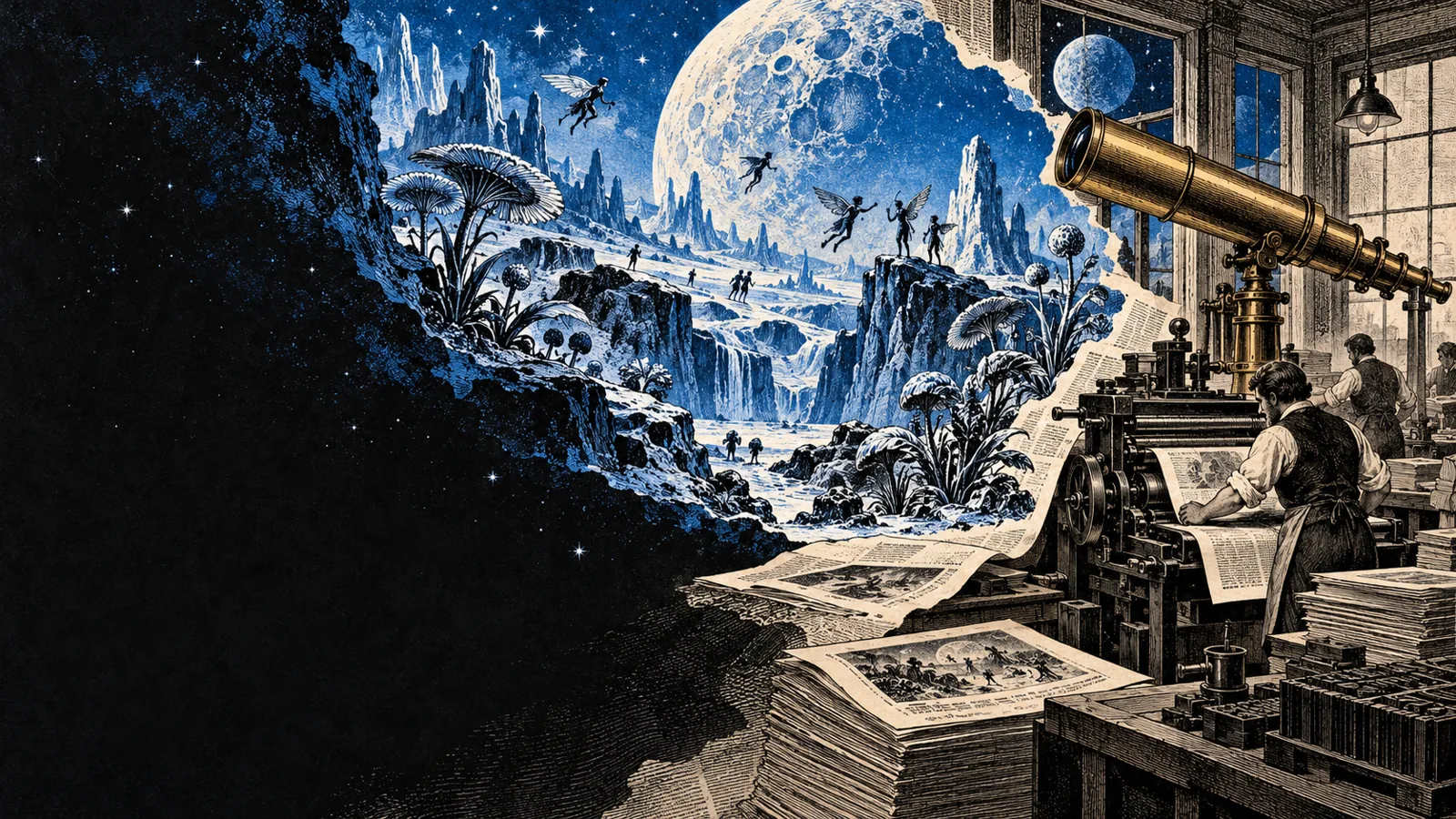
open the case ↓Modern generated illustration · not archival evidence
In August 1835, New York’s Sun ran a six-part series announcing astonishing discoveries on the Moon. The articles borrowed the authority of the real astronomer John Herschel, who was observing the southern sky from the Cape of Good Hope. Readers were already interested in astronomy and new instruments. The invention arrived inside a world containing enough real science to make the next claim feel possible. S1, S2
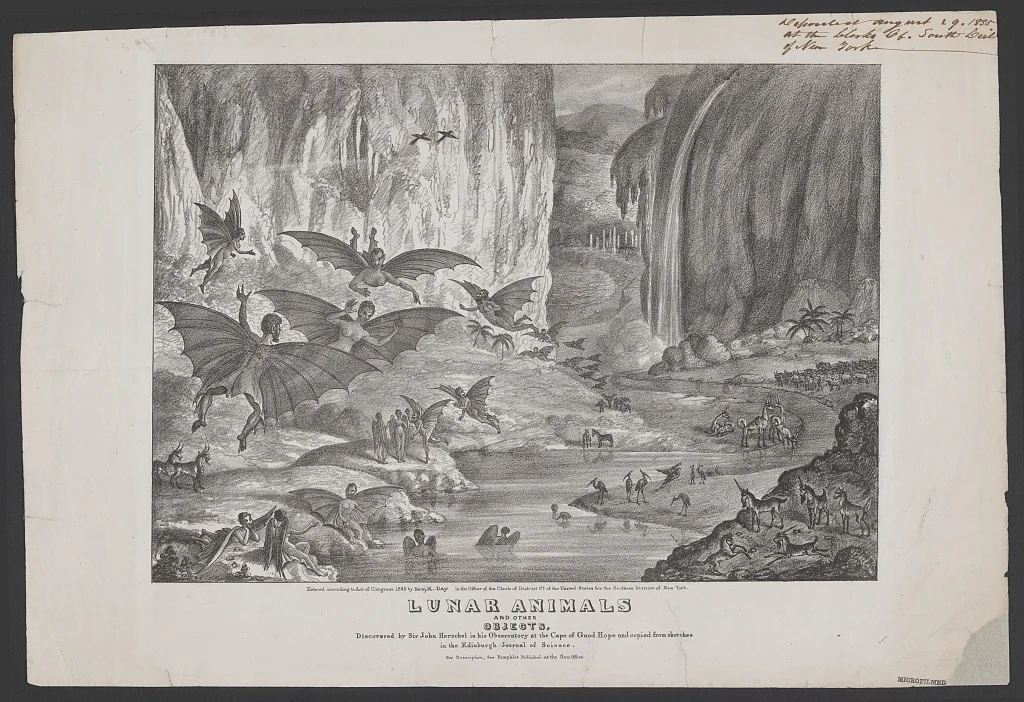
The series described lunar landscapes, unusual animals and winged humanlike creatures. These were fabricated discoveries, not observations confirmed by Herschel. The supposed reporting used scientific language and a claimed connection to the Edinburgh Journal of Science. Our illustration deliberately shows fantasy: it depicts what the story asked readers to imagine, not what the Moon looked like. The difference belongs in the caption, not hidden in a distant source list. S1, S2
try the evidence
Invented paraphrase, not a quotation from the Sun. Switch the prestigious labels off; then compare the evidence that remains.
simplified interpretation
A famous astronomer, a remarkable telescope and a claimed scientific journal make an extraordinary report feel credible. Where is the independently checkable observation?Choose a control to examine the evidence.
The mechanism is familiar: attach a real expert’s name to a report, invoke an impressive instrument, cite a publication, then add precise-sounding details. None of those moves substitutes for a traceable observation. Try removing the borrowed authority below. The evidence for the lunar creatures does not change when the prestigious labels disappear. What changes is how the sentence feels to a reader. That is an original demonstration of the story’s logic, not an experiment on 1835 readers.
Five publications can all descend from the same initial assertion.
Independent evidence has its own path to what happened. It can corroborate rather than merely echo.
Imagine five newspapers repeating one report. You may have five pages, but only one chain of information. Independent confirmation would require another observer using a separate route to the evidence. Our reprint counter makes the difference concrete. A rumor can become more visible without becoming better supported. That applies whether the copying happens through a printing press, a repost or a screenshot.
case in 28 seconds
Silent captioned recap. Original generated illustration, not archival footage. The written story and sources carry the full explanation.
BBC Reel video · the Great Moon Hoax ↗
Optional later video supplement. Opens the original publisher; school networks may block playback.
A surviving illustration or newspaper can be an authentic historical object and still depict a false claim. Its value changes with the question. It is poor evidence that bat people lived on the Moon. It is excellent evidence for what a publisher circulated, how a fantastic discovery was pictured and what readers were asked to believe. A primary source is close to the event; that does not make every assertion inside it accurate. S1, S2
The supposed reporter, “Dr. Andrew Grant,” was fictitious; journalist Richard Adams Locke created the persona. The hoax spread, but “everyone believed it” is a stronger claim than the sources support. Readers differed, and satire, entertainment and belief can overlap. The enduring lesson is not that people in 1835 were foolish. It is that a false story can borrow real expertise and the normal appearance of news. Your job is to follow its claimed source until you reach an actual observation—or discover that the chain ends. S1
your verdict
A famous name and five copies still do not make an observation.
Answer in your own words. Source IDs refer to the records below. Use the shared work controls to load, back up or turn in your work.
check the record
Historical research checked October 27, 2026. A source may establish one claim while leaving another unresolved.
Connects the August 1835 series to real astronomical interest, borrowed scientific authority and the contemporary news style. Not every reader accepted the story.
Describes the six-part Sun series and its fictional discoveries. The page URL contains 1825, but the article and event are 1835.
Optional later video overview, distinct from the 1835 newspaper evidence. The complete accessible explanation remains on this page.
Cover and recap visuals: modern illustrations created for this lesson with ImageGen. They establish atmosphere and are not primary sources. The silent recaps use those illustrations and the cited historical summary. Any classroom scenario, paraphrase or model is labeled.
Corrections: bring a conflicting source to your teacher. Identify the claim, the source ID and the evidence that changes it.