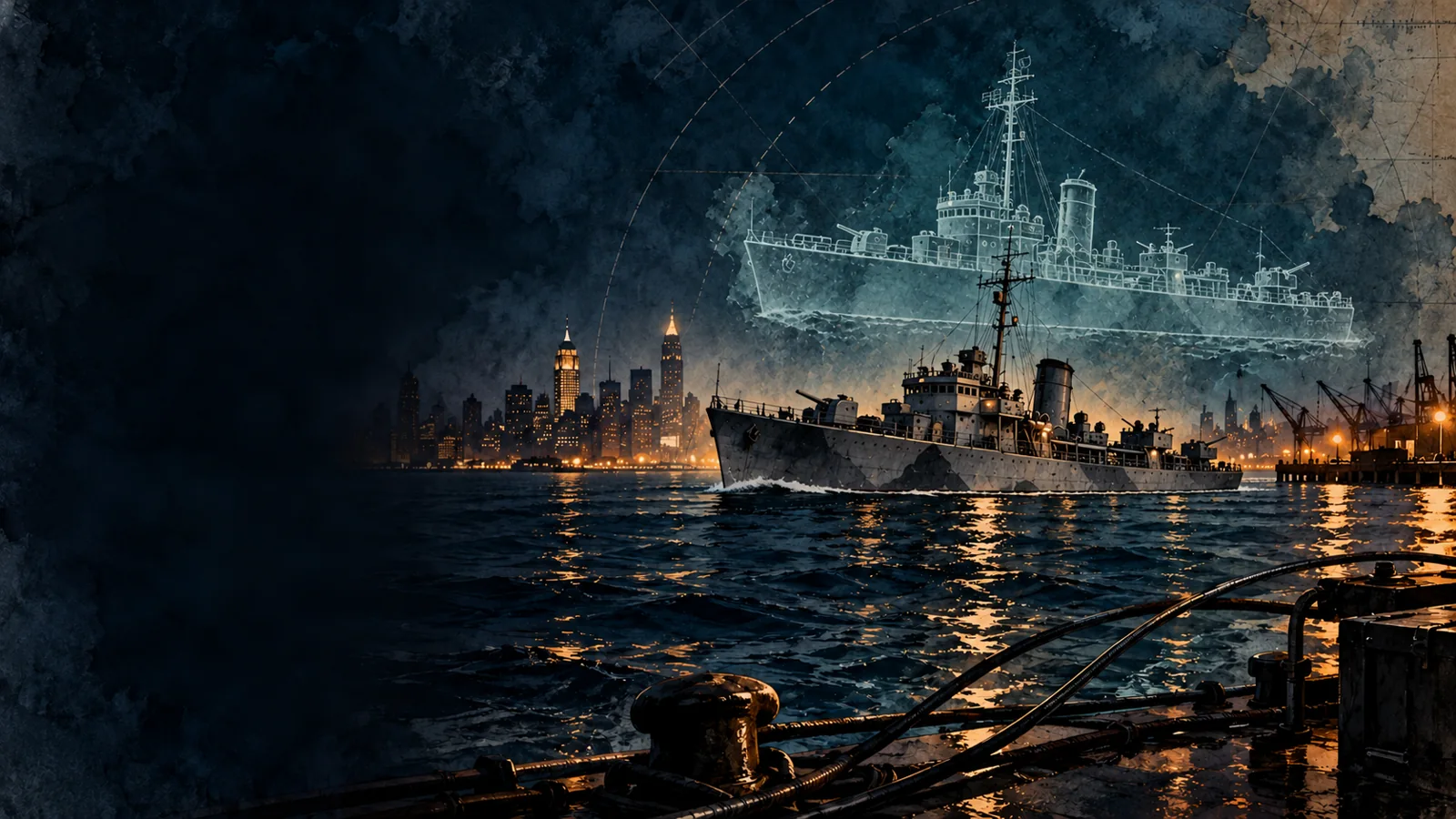
A destroyer escort. A letter written years later. One slippery word: invisible. The Philadelphia Experiment gets stranger as the story gets farther from the records.
Modern generated illustration · not archival evidence
byte 01
Start with the claim, not the fog
The Philadelphia Experiment legend says the Navy made a warship invisible and teleported it between Philadelphia and Norfolk in 1943. Later retellings make that claim dramatic. Start by writing down what would have to be established: the named ship, its location, the equipment, witnesses and the extraordinary result. A real Navy and a real warship would establish the setting. They would not establish the disappearance. The Navy’s archival searches report no supporting documents for the alleged event. S1
byte 02
The ship had a normal job
USS Eldridge was a Cannon-class destroyer escort commissioned in August 1943. Its documented work included escorting Atlantic convoys. The Navy’s later summary of its war diary places it around Bermuda during training, then back in New York from October 18 to November 1. That location record is a specific way to test versions set in Philadelphia during that interval. We are reading a published summary of the diary here, rather than pretending to have reproduced the original pages. S1, S4
try the evidence
Invisible to what?
Conceptual detector comparison. It distinguishes types of observation without estimating mine risk or real equipment performance.
simplified interpretation
The ship stays here. The detector determines what question you are asking.
MAGNETIC signature can be reduced
EYESIGHT ship remains visible
RADAR ship remains a target
Choose a control to examine the evidence.
byte 03
Invisible needs an object
Degaussing was a real way to reduce a steel ship’s magnetic signature, helping protect it from magnetic mines. That does not remove the ship from human sight or radar. Use the detector board above: the same hull can matter differently to different sensing systems. This is a qualitative explanation, not a model of the equipment’s actual effectiveness. Before accepting “the ship became invisible,” ask what kind of detection the speaker means. S3
byte 04
The letter arrived years later
The Office of Naval Research traces the story to correspondence received after Morris K. Jessup’s 1955 book about UFOs. A writer calling himself Carlos Miquel Allende described a supposed wartime experiment. This is a claim made years after the alleged event, not a ship’s contemporary experiment report. The age, access and independence of a source matter even when its details are vivid. A person reporting an extraordinary experience still leaves the task of checking it. S2
Custody and confirmation
A government office has a copy
Shows possession or interest. It does not establish that the office tested and confirmed every statement.
A verified experiment record
Would need identifiable origin, method, observations and corroboration. A copy of an extraordinary story supplies none of those by itself.
byte 05
A government copy is not government confirmation
An annotated copy of Jessup’s book reached the Office of Naval Research. Two officers took a personal interest and arranged a small reprint. That episode can sound impressive when retold as “the Navy printed the book.” But copying a document does not verify its claims. The office itself was established in 1946, after the supposed experiment. Distinguish official custody, individual interest and an institution’s demonstrated conclusion; they are three different things. S2
case in 28 seconds
The short version
Silent captioned recap. Original generated illustration, not archival footage. The written story and sources carry the full explanation.
Read the complete video transcript
The Philadelphia Experiment claims a Navy ship vanished in 1943.
USS Eldridge was real. Its records do not support that story.
Degaussing reduces a magnetic signature; it does not make a ship vanish from sight.
A later letter and a copied book are claims to check, not proof of teleportation.
byte 06
A denial is not the whole test
The Navy has an institutional perspective, and its denial should not be accepted merely because it is official. Ask what can be checked: the ship’s chronology, the later origin of the correspondence, the actual meaning of degaussing and the absence of corroborating experiment records after repeated searches. Secrecy by itself cannot repair those gaps. The conclusion supported here is that the teleportation claim lacks evidence. The real magnetic technology deserves an accurate explanation of its own. S1, S3, S4
your verdict
What can you defend?
A change in magnetic signature is not a disappearing ship.
Answer in your own words. Source IDs refer to the records below. Use the shared work controls to load, back up or turn in your work.
check the record
Sources & limits
Historical research checked October 28, 2026. A source may establish one claim while leaving another unresolved.
The Navy summarizes its searches and the ship’s war diary. This is a later institutional account of contemporary records; the lesson distinguishes it from reproducing the original log itself.
Traces the story through correspondence after a 1955 book and the annotated copies. Its proposed explanations for the legend are hypotheses about origins, not proof of how every teller learned the story.
The official ship history establishes commissioning and actual escort service. An ordinary service summary is useful context, not a complete original daily log.
Visuals: modern illustrations created for this lesson with ImageGen. They establish atmosphere and are not primary sources. The silent recaps use those illustrations and the cited historical summary. Any classroom scenario, paraphrase or model is labeled.
Corrections: bring a conflicting source to your teacher. Identify the claim, the source ID and the evidence that changes it.